Quick answer
Quantitative trading uses mathematical models, data and algorithms to find and execute trades automatically, rather than relying on discretion. Quant strategies scan price, volume and other signals for statistical edges, then trade them at speed and scale. It powers much of modern hedge-fund and high-frequency trading, but it needs strong data, testing and risk controls.
Investing in financial products involves risk. Losses may exceed the value of your original investment.
There are so many people that picture trading is all about instincts and quick decisions. Some see traders as staring at charts all day just waiting to make a move. Then there’s others that believe only big firms can trade using data and algorithms. What do you think?
Well, a growing number of traders literally just rely on numbers, not emotions. Now that’s where quantitative trading hops in. It is important to know what quant trading is and how it really works. Need to make smarter choices in today’s fast-moving markets? Well, here’s an overview for you.
While understanding Quantitative Trading(QT) is important, applying that knowledge is where the real growth happens. Create Your Free Forex Trading Account to practice with a free demo account and put your strategy to the test.
By Alexander Bennett, Volity research desk.
What our analysts watch: Three diagnostic series separate quant strategies that survive from those that decay. Out-of-sample Sharpe stability across multiple regime windows tells us whether the model has captured a real anomaly or fit noise. Capacity-adjusted alpha, where return is measured net of realistic market impact at deployable AUM, distinguishes a publishable backtest from a deployable book. And factor exposure decomposition against standard equity, fixed-income, and macro factors reveals how much of the apparent edge is truly idiosyncratic versus dressed-up beta. Quant trading is engineering, not magic, and these three measurements are how engineers grade their own work.
Frequently asked questions
What does a quant trader actually do day to day?
Most professional quants spend the majority of their time on data engineering, model research, and execution-quality measurement, with a smaller share on direct discretionary intervention. The CME Group education on algorithmic trading covers the workflow with worked examples in listed futures, and the structural reality is that the edge in 2026 lives more in data acquisition, infrastructure, and execution than in model novelty.
Is quantitative trading regulated differently from discretionary trading?
The underlying market rules are the same, but venues and supervisors apply additional controls to algorithmic trading firms. The FCA review of algorithmic trading compliance sets out the supervision, testing, and risk-control expectations for firms running algos, and EU MiFID II RTS 6 imposes parallel obligations on EU investment firms operating algorithmic systems.
Can retail traders realistically run systematic strategies?
Yes, with the right expectations. Retail-accessible strategies cluster around trend following, simple mean reversion on liquid futures, and rules-based portfolio rebalancing. The SEC and CFTC joint report on the events of May 6, 2010 (the Flash Crash) remains essential reading on the operational risks of automation. Retail systematic traders who size carefully, log every trade, and treat infrastructure as a first-class risk category can build durable strategies, but the path is engineering, not arbitrage.
What is Quantitative Trading?
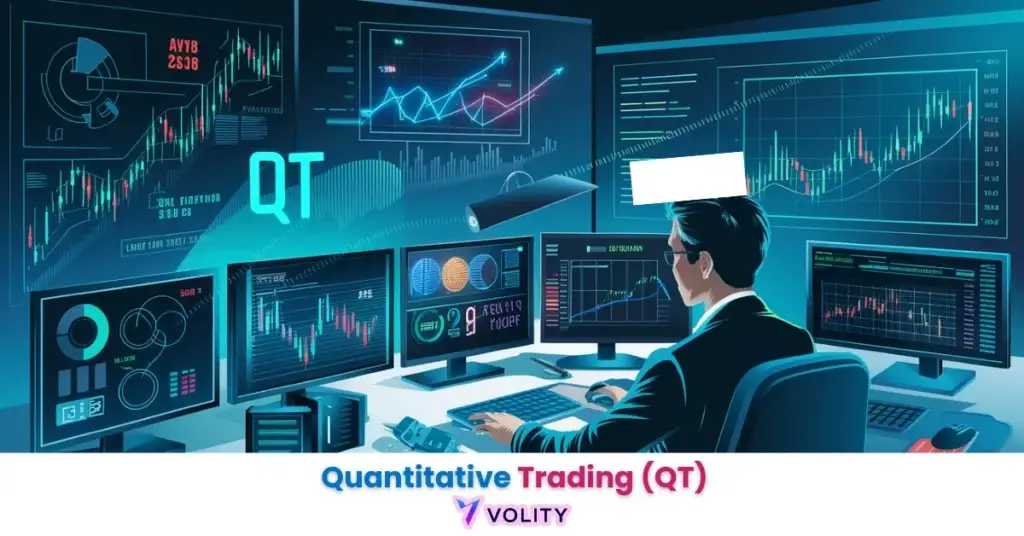
Quantitative trading uses math, statistics, and code to make trading decisions. You basically follow a set of rules based on data instead of depending on intuition or simple guesses.
Here’s what happens: you create strategies from patterns in historical prices, trading volume, or financial indicators. Once the rules are set, you got nothing else to do. Computers do the rest. They scan the markets, spot opportunities, and execute trades fast.
You may think it sounds a bit complex, but the idea is really simple. Quant trading removes guesswork and replaces it with logic, data, and automation. All done via the computer.
How Does Quantitative Trading Work?
Quantitative trading depends on data and algorithms to make decisions. It all starts with creating a strategy based on mathematical models. Such models deeply analyze historical data. Then, they predict future price movements or market trends. Once the strategy is ready, the algorithm takes over and scans the markets for opportunities. It finds a possible match and enforces a trade in a fraction of a second.
The Role of Algorithms in Trading
For the broader algo landscape, see our algorithmic trading guide.
Do keep in mind that algorithms are the backbone of quantitative trading. What do they do? Follow done and dusted rules to identify profitable trading opportunities. Now, these rules can be based on anything. Could be price movements or even market sentiment. The algorithm needs to execute trades quickly and correctly, something human traders can’t land up at. By using algorithms, traders can make decisions faster. Precision. Zero emotional bias.
Role of Data in Every Decision
Here’s another idea: data is king when it comes to quantitative trading. It all starts with collecting large amounts of data, such as stock prices, trading volumes, and even economic reports. Data is analyzed to find patterns or trends that can lead to profitable trades. If you have got more data, then you have a better algorithm to make decisions. Fact is, quant trading systems rely on data to generate insights, predict outcomes, and take action. All without any human intervention. Amazing, no?
Ready to Elevate Your Trading?
You have the information. Now, get the platform. Join thousands of successful traders who use Volity for its powerful tools, fast execution, and dedicated support.
Create Your Account in Under 3 MinutesCore Elements of a Quant Trading Strategy
Want to make quantitative trading work? All you need is a strong strategy. Here’s what goes into it:
Signals, Models, and Market Patterns
Trading signal is the right trigger that tells you when to buy or sell. Such signals are generated by mathematical models that analyze past market data, right? Your goal is to spot repeating patterns in the market that can predict future movements. Remember, the better the model, the more accurate the signals. Many sophisticated quant systems also model quant derivatives such as options and futures, where pricing dynamics amplify predictive accuracy.
Backtesting and Performance Checks
What do you need to do before you trust a strategy with real money?You test it. Backtesting is the process you need. It involves applying your trading model to historical data to see how it would have performed in the past. You will then get an idea of its effectiveness and help fine-tune the model. Performance checks let you judge the strategy’s success rate. Not only that. You will even get informed on the risk levels, and overall reliability.
Execution and Order Management
Once your strategy gives the go-ahead, your next step is executing the trade. Execution involves placing buy or sell orders on the market. Now, when it comes to quantitative trading, speed is crucial. Not to worry.
Algorithms handle this part. They place orders in milliseconds to capitalize on short-lived opportunities. Order management confirms the trades are completed competently, which keeps costs low and prevents slippage (when the trade is executed at a worse price than expected).
Why Do Traders Use Quantitative Methods?
Traders turn to quantitative methods for a few key reasons. Here they are:
Speed and Accuracy in Fast Markets
Remember, markets move quickly, and opportunities can disappear in seconds. Good news is: quantitative methods allow traders to execute trades at lightning speed. Algorithms scan and react to market changes in a giffy. Now that is something humans can’t do. Speed like this ensures that traders don’t miss profitable moments. Plus, the accuracy of automated systems means trades are carried out exactly as planned. No mistakes.
Avoiding Emotional Decision-Making
It’s obvious that emotions cloud judgment. In this case, such a saying can lead to poor trading decisions. Fear. Greed. Overconfidence. All are factors that affect human traders. Don’t fret. Quantitative methods remove that element completely. By following data-driven strategies, traders stick to logic. Zero intuition. It really helps avoid hasty decisions and keeps the strategy firm and disciplined.
What Are the Risks of Quantitative Trading?
- System errors can cause the algorithm to make wrong trades or misinterpret signals, leading to unexpected losses.
- Overfitting happens when a model is too focused on past data. In all honesty, this just causes failure when the market changes in unexpected ways.
- Unexpected market interruptions, like a financial crash or sudden news, can cause the model to act wrongly or not adapt to new conditions.
- Imagine there’s extreme market conditions, such as high volatility. Strategies might not work as intended, which leads to significant losses.
- Poor quality or incomplete data can misguide the algorithm into making bad predictions. What happens then? Inaccurate trades.
- Algorithms might act too quickly in reaction to small changes, which causes a domino effect of wrong trades that shoot up quickly.
Who Uses Quantitative Trading Today?
Hedge Funds and Algorithmic Firms
Did you know hedge funds and algorithmic trading firms are the primary players in quantitative trading? Yes, such firms use complex algorithms and large amounts of data to make decisions in the market. Quick and calculated. Their trading strategies are based on sophisticated mathematical models that read into historical market data to foresee future price movements. Well, they have access to high-speed computers and cutting-edge technology. So, they can execute thousands of trades per second. An instant advantage of market inefficiencies in real time. For these firms, quantitative trading is all about augmenting profit while keeping down risk. It’s a core component of their overall strategy.
Individual Traders Using Retail Tools
Hedge funds do dominate the world of quantitative trading but individual traders are also getting in on the action. All thanks to the rise of retail trading platforms. Even people can now access tools that were once only available to large institutions. Such platforms offer automated trading bots, backtesting software, and other algorithmic tools that give individual traders an opportunity to apply quant strategies. Some retail systems even merge data-driven models with social signal analysis, where quant insights blend with crowd sentiment for smarter automation.
All without needing a deep knowledge of programming. Don’t forget, individual traders still don’t have the same resources as hedge funds. Tools still give them the ability to make data-driven decisions and automate their trades. So, it removes the emotional bias aspect from their trading strategies.
Turn Knowledge into Profit
You have done the reading, now it is time to act. The best way to learn is by doing. Open a free, no-risk demo account and practice your strategy with virtual funds today.
Open a Free Demo AccountFinal Thoughts
So, to wind this up, it’s clear that quantitative trading can offer significant advantages. Speed, precision, and takes away the emotional angle from trading decisions. Still, it’s not for everyone. It requires a solid hold on data analysis, algorithms, and a clear knowledge of financial markets. Do you enjoy working with data and systems? Are you comfortable with technology? If so, quant trading could be a great fit for you. But do remember, it’s important to be aware of the risks involved. More if you’re new to this approach. Make sure to carefully consider if this type of trading lines up with your skills and goals before diving in. Good luck!
FAQs
What our analysts watch: Three lenses dominate our reading of the equity tape. Sector rotation tells us where capital is moving (defensives versus cyclicals, value versus growth). Earnings revisions show whether analyst expectations are catching up to or trailing reality. Real yields and the dollar set the discount rate that valuation multiples respond to. When earnings estimates rise faster than the index price and real yields stabilise, the setup tends to favour patient longs.
Frequently asked questions
How much money do I need to start trading stocks?
Many regulated brokers now allow account opening with no minimum deposit and offer fractional shares for as little as $1. A practical starting balance for a long-only beginner is $500 to $2,000, enough to diversify across a handful of positions without paying meaningful percentage spreads. The UK FCA publishes investor education resources worth reading before opening an account.
What is the difference between stocks, ETFs, and CFDs?
A stock is direct ownership in a company. An ETF is a basket of stocks (or other assets) traded as a single security. A CFD (contract for difference) is a leveraged derivative that tracks the underlying price without conferring ownership. Each has different cost, tax, and risk profiles. ESMA imposes leverage caps on retail CFDs in the EU and UK.
How do I choose a trustworthy broker?
Verify regulation with a tier-one authority (FCA in the UK, BaFin in Germany, ASIC in Australia, CySEC for EU passporting). Check segregated client funds, negative-balance protection, transparent fees, and a clean disciplinary record. Avoid any platform offering guaranteed returns or pressuring deposits. The FCA Financial Services Register is free.
Should I day-trade or invest long-term?
Most retail accounts that day-trade lose money over time. Long-term passive investing in diversified index ETFs has historically delivered competitive returns with far less effort and lower stress. Active day-trading can work, but it requires capital, an edge proven over hundreds of trades, and the time to monitor positions intraday. Start passive; layer active only after the basics are durable.
Related guides
- Automated forex trading
- Best forex trading strategies
- Forex scalping strategy
- Best trading platforms
- Risk management
Volity operates a trading platform and also publishes educational and analytical content about trading. The content on this page is for educational purposes only and should not be considered financial advice. Volity may benefit commercially when readers open trading accounts through links on this site.
Our content is produced and reviewed under documented editorial standards; see our comparison and review methodology.