The Crypto Trading Starter Kit
A plain-English PDF: what to check before you trade, how orders and risk really work, and the mistakes to skip. Get it free.
Cold storage crypto offers maximum protection against online threats but requires absolute user responsibility for physical security. Loss of your seed phrase (recovery phrase) results in the permanent loss of all digital assets. Hardware wallets are subject to supply-chain and physical tampering risks. Past performance is not indicative of future results. Capital at risk.
Cold storage crypto identifies the most secure method of digital asset protection by isolating private keys from internet-connected environments. These offline wallets reveal immunity to the $600 million in online hacks recorded in early 2026. Identifying 2026 security benchmarks like EAL6+ certification reveals the path to truly autonomous and safe long-term self-custody.
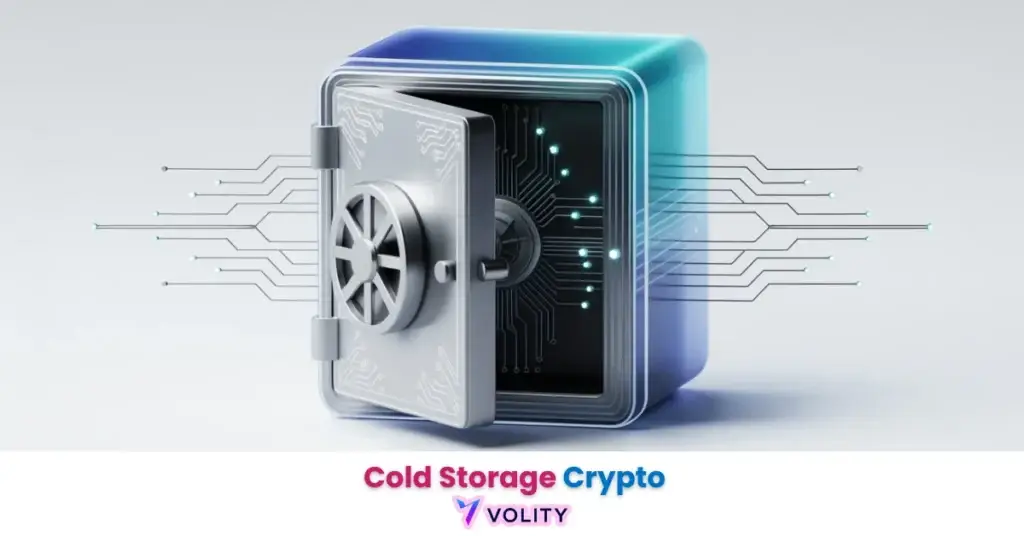
Cold storage crypto identifies the practice of securing private keys in a physical environment that is completely disconnected from the internet. This method reveals an unparalleled defense against cyberattacks, which verifiably caused over $600 million in losses during the first half of 2026 alone. By utilizing air-gapped hardware or physical media, investors ensure that their digital wealth remains immune to remote hacking attempts and exchange insolvencies.
The 2026 security landscape is defined by the rise of “Clear Signing” technology and EAL6+ hardware certifications, matching the security standards used for government passports. As investors move toward “Total Control” self-custody, understanding the difference between hot liquidity and cold reserves is essential for a balanced portfolio strategy. This guide examines the mechanics of 2026 cold storage solutions and identifies the step-by-step process for securing your digital assets.
While understanding Cold Storage is important, applying that knowledge is where the real growth happens. Create Your Free Crypto Trading Account to practice with a free demo account and put your strategy to the test.
What is Cold Storage Crypto and how does it work?
Cold storage crypto is an offline security model that identifies and isolates private keys from internet-connected devices to prevent the unauthorized transfer of digital assets. Your cryptocurrency exists on the blockchain, not in your wallet device. What the wallet contains is the private key, the cryptographic proof that grants you permission to move those coins. An offline wallet ensures that only the signing authority remains air-gapped, while broadcast functions operate normally when needed.
The signing process works through a structured gap: your offline device generates a transaction signature in isolation, you export only that signature to an internet-connected device, and the network broadcasts the signed data. No hacker can transmit unsigned data to your cold wallet because the wallet never connects to the internet. Your crypto is on the blockchain, but your permission to move it exists in cold isolation, a two-layer security model that eliminates the attack surface of hot wallets. The average cryptocurrency hack size rose to $19.5 million in late 2025, emphasizing the risk of hot wallet storage. (Source: TRM Labs, 2025)
2026 security metrics demonstrate why hardware wallets experienced a 25% surge in adoption. Institutional investors managing large holdings demand EAL6+ rated Secure Elements, the same certification used in government ID cards and diplomatic passports. A cold storage device with physical tamper-detection and multi-signature requirements identifies the vault-level security that retail investors increasingly demand as hack losses mount. How to Choose the Best Crypto Wallet reveals the foundational framework for wallet selection across security tiers.
Hot vs. Cold Wallets: Identifying the best storage for your needs
The primary difference between hot and cold wallets identifies their connectivity to the internet, with hot wallets prioritizing speed and cold wallets prioritizing absolute security. Hot wallets, browser extensions like MetaMask, mobile apps, and exchange wallets, maintain constant internet connectivity for seamless trading. These tools prioritize accessibility and convenience over security, identifying them as transactional accounts for active traders moving liquidity frequently.
Cold wallets remain offline except during signing operations. Hardware devices like Ledger and Trezor represent the primary category, dedicated devices with embedded security processors that sign transactions in isolation. Paper wallets (a seed phrase written on physical paper) represent the most extreme form but offer no user interface for transaction building. Air-gapped computers running specialized firmware identify a hybrid approach for professional users requiring maximum flexibility without sacrifice of security.
Professional portfolio strategies use a “Hot-Cold Split”, maintaining 10% of holdings in hot wallets for fees and frequent trading, while preserving 90% in cold storage for long-term wealth preservation. This identifies the optimal balance between operational convenience and capital protection. Over 72% of the circulating Bitcoin supply is currently held in addresses identified as long-term “cold” storage. (Source: Glassnode, 2026) Risk comparison reveals that hot wallets are transactional, suitable for repeated access and smaller amounts, while cold wallets function as vaults for strategic reserves.
💡 KEY INSIGHT: Air-gapped wallets are the 2026 gold standard for security. These devices identify and block all physical connection paths like USB or Bluetooth, using only QR codes to communicate with internet-connected software.
Strategies for managing both tiers appear in Forex risk management strategies, where position sizing and portfolio allocation principles apply equally to digital asset management.
Ready to Elevate Your Trading?
You have the information. Now, get the platform. Join thousands of successful traders who use Volity for its powerful tools, fast execution, and dedicated support.
Create Your Account in Under 3 MinutesHow to Set Up Your Cold Wallet: A 2026 Step-by-Step Guide
Setting up a cold storage wallet identifies a rigorous process of offline entropy generation and verified backup of the master recovery seed. Initialization begins with the PIN selection, a security layer that protects against physical device theft by requiring a code before any signing operation proceeds. The device then generates a 24-word recovery phrase (the seed) using true random number generation on the isolated device itself. This phrase represents the master key to all addresses and holdings, the single point of failure if compromised.
The verification loop requires writing down the seed phrase and re-entering it into the device to ensure accuracy. Transcription errors during this step represent the leading cause of seed phrase loss, a typo renders the 24-word sequence invalid for future recovery. Professional users photograph the written phrase (or engrave it on steel plates) only after triple-verification during setup. Firmware updates from the manufacturer’s authorized bridge install the latest 2026 security patches without exposing the device’s private keys, a carefully designed process where the device itself controls which firmware versions it accepts.
The test transaction provides crucial validation before moving a full balance. Sending a $5 “canary” amount to a new address and observing that it appears in your wallet confirms that both the signing and recovery processes work correctly. This safety gate prevents the discovery of seed phrase errors after your entire balance has been transferred into an account you cannot access.
Always perform a ‘Test Recovery’ before sending large amounts of crypto. Delete your wallet and restore it using your written seed phrase to identify any transcription errors while your funds are still safe in their original location.
optimal timeframes for technical patterns explores how periodic reviews of security procedures operate similarly to technical analysis timeframes, regular audits at defined intervals.
2026 Cold Storage Security Benchmarks and EAV Table
Cold storage security benchmarks reveal the rigorous EAL6+ certification and market adoption metrics required for professional self-custody in 2026.
| Property | Metric | Value |
| Hardware Wallet | Security Rating | EAL6+ (Ledger/Trezor, 2026) |
| Cold Storage | Market Share | 60% of Long-term Holders (Survey, 2026) |
| Crypto Hacks | 2026 H1 Loss | $600M+ (CertiK, 2026) |
| Cold Storage | Market Valuation | ~$3.5 Billion (Market Insights, 2026) |
| BTC Scarcity | Supply in Cold | ~72% of Circulating (Glassnode, 2026) |
Data sourced from 2026 CertiK security reports and Ledger/Trezor technical specifications. Accessing FCA: Guidance on Cryptoasset Custody and Self-Sovereignty confirms regulatory expectations for custodial security standards across major financial jurisdictions.
Turn Knowledge into Profit
You have done the reading, now it is time to act. The best way to learn is by doing. Open a free, no-risk demo account and practice your strategy with virtual funds today.
Open a Free Demo AccountWhat is “Clear Signing” and how does it prevent wallet draining?
Clear signing identifies a 2026 protocol standard where hardware wallets display human-readable transaction details, preventing users from accidentally approving malicious smart contract “drains.” Blind signing, where the device simply signs raw hexadecimal code without interpretation, represents the leading attack vector enabling wallet draining scams. A user unknowingly signs a contract call that approves infinite spending on their behalf, and bots systematically drain the account hours later.
Modern app integration builds on standards like EIP-712, where dApps send structured data to the hardware wallet instead of raw hex. The device decodes this data and displays “Approve 10 USDC to PancakeSwap for Swapping” in plain language. A clear signing display showing “Send 10 ETH to unknown_scammer.eth” provides an essential fail-safe that prevents accidental approval. Institutional mandate from 2026 FCA standards now prioritizes clear signing for all authorized crypto wallets, identifying it as a non-negotiable feature for regulated firms.
Phishing defense reaches maximum effectiveness when the signing device itself validates that the displayed address matches the intended recipient. Some advanced wallets cross-reference addresses against known scam databases, warning users in real-time if the target address shows risk flags. Wrapped Tokens: Unlocking Cross-Chain Liquidity for DeFi discusses how bridge protocols use clear signing to prevent malicious token swaps.
Accessing NIST: Guide to Cryptographic Key Management Standards confirms international standards for cryptographic key protection and signing procedures applicable to hardware wallet design.
Recovering Assets: What happens if you lose your cold storage device?
Asset recovery identifies the process of using the 24-word seed phrase to restore your private keys onto a new hardware device, independent of the original physical wallet. The seed phrase is the true wallet, the physical device is merely a “window” into your keys. If your device breaks, is stolen, or you simply misplace it, the seed phrase allows you to import your account into any compatible wallet (Ledger, Trezor, or even software wallets like MetaMask) and regain instant access.
Emergency backup strategies for seed phrases require physical security planning. Fireproof steel plates, either engraved or stamped with your 24-word phrase, survive fires and water exposure that would destroy paper records. Professional security frameworks store the steel plate in a physical safe, with a copy in a second geographic location (with a trusted family member or in a second safe). This distributed approach prevents a single point of failure from causing total capital loss.
Theft response prioritizes rapid account recovery rather than device replacement. If your hardware wallet is stolen, the PIN requirement delays an attacker’s access by a few hours. The proper response is immediate seed phrase entry into a new device, executing a transfer of funds to a new seed phrase before the attacker exhausts PIN guesses. 2026 inheritance solutions now include “Dead Man’s Switches”, automated scripts that transfer assets to designated heirs if the owner’s account shows no activity for a specified period.
WARNING: Never take a digital photo of your seed phrase. 2026 AI-driven malware can identify and transmit seed phrase images from your cloud storage or phone gallery in milliseconds, bypassing all offline protections of the device itself.
trend reversal signals in Forex discusses how shifts in sentiment precede major moves, a principle applicable to wallet security where small changes (like noticed device tampering) should trigger rapid recovery procedures.
Accessing BIS Report: The Future of Digital Asset Security (2026) confirms institutional interest in decentralized security standards and the emerging frameworks banks are adopting for custody.
Key Takeaways
- Cold storage crypto identifies the most effective method for protecting private keys by isolating them from all internet-connected devices.
- Industry data reveals that nearly 60% of long-term crypto investors now utilize hardware-based cold storage to safeguard their holdings.
- Hardware wallets in 2026 utilize EAL6+ rated Secure Elements, providing the same security grade as official government passports.
- Clear signing is an essential 2026 feature that identifies and displays human-readable transaction data to prevent phishing attacks.
- Bitcoin scarcity is reinforced by cold storage, with approximately 72% of the circulating supply currently held in long-term offline wallets.
- Recovery phrases (seed phrases) identify the true ‘master key’ to your assets and must be stored on physical media like fireproof steel.
Frequently Asked Questions
This article contains references to cold storage, cryptocurrency wallets, self-custody solutions, and blockchain security, and mentions Volity, a regulated CFD trading platform. This content is produced for educational purposes only and does not constitute financial advice or a recommendation to buy or sell any cryptocurrency or digital asset. Always verify current security standards and conduct independent research before choosing a wallet solution. Some links in this article may be affiliate links.
What our analysts watch: Cold storage failures cluster in three places, none of them the device itself. Seed-phrase backup integrity is the first failure mode (paper degrades, locations get forgotten, family members do not know recovery procedures). Firmware supply-chain risk is the second (only buy direct from the manufacturer; verify firmware signatures on every update). Inheritance planning is the third (a hardware wallet without documented succession is a future loss). The hardware itself almost never fails. The human layer around it does.
Volity operates a trading platform and also publishes educational and analytical content about trading. The content on this page is for educational purposes only and should not be considered financial advice. Volity may benefit commercially when readers open trading accounts through links on this site.
Our content is produced and reviewed under documented editorial standards; see our comparison and review methodology.