Futures trading involves daily cash settlement and margin calls that can liquidate your account in minutes when market movements exceed your performance bond. Leverage amplifies losses equally to gains, a 10% adverse move in a 20:1 leveraged position wipes out 200% of your initial capital. Trading during gap-open sessions (especially commodity futures during geopolitical shocks) can result in losses exceeding your deposit as orders execute at unfavorable prices. Capital at risk in all leveraged trading.
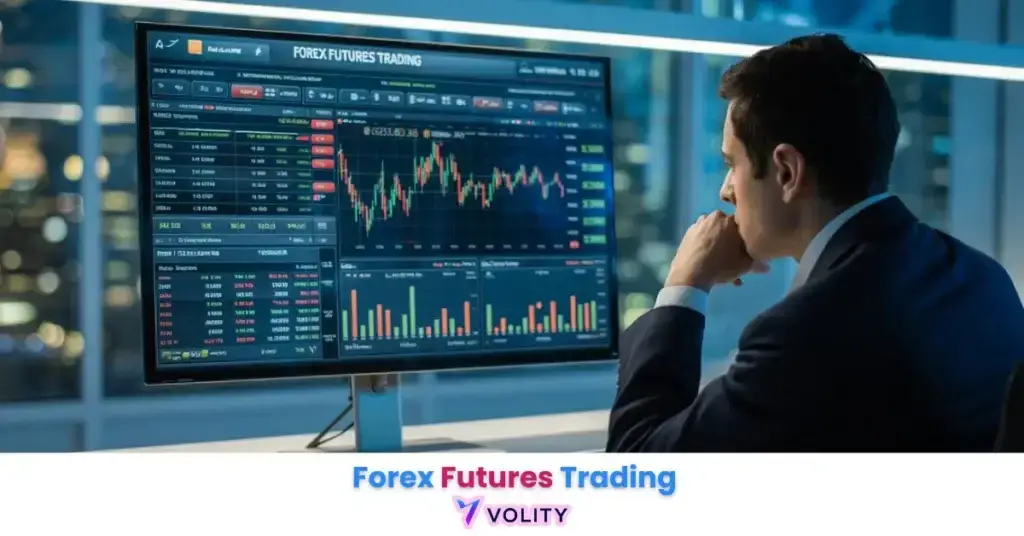
Futures trading is the exchange of standardized, legal agreements to buy or sell a specific asset at a predetermined price on a future date. Traded on regulated exchanges like the CME and ICE, futures offer high leverage and central clearing, eliminating counterparty risk. In 2026, the growth of micro-futures has made this institutional market accessible to retail traders, providing a robust platform for hedging currency risk or speculating on global commodity and index trends.
Futures trading functions as a highly regulated and transparent pillar of the global financial system, providing a centralized venue for risk transfer. This structure allows participants to lock in prices for assets ranging from crude oil to treasury notes, ensuring stability in unpredictable economic cycles. It serves as a primary benchmark for market sentiment and future price expectations.
The 2026 trading environment is characterized by unprecedented liquidity in equity index and energy futures as geopolitical shifts drive market volatility. Traders utilize these instruments to achieve superior capital efficiency through the use of exchange-defined performance bonds and centralized clearing.
While understanding Forex is important, applying that knowledge is where the real growth happens. Create Your Free Forex Trading Account to practice with a free demo account and put your strategy to the test.
What is futures trading and how does it function?
Futures trading is the execution of standardized contracts on regulated exchanges that obligate the parties to trade an underlying asset at a fixed price on a future date.
Exchange-traded futures are among the largest and most closely supervised markets in finance, and the concentration of volume in a handful of contracts is what gives them their depth. That scale reflects how institutional investors, corporations and speculators rely on futures for daily risk management.
Futures markets operate through three foundational mechanisms:
- Standardization: Every contract specifies the exact amount of the underlying asset, the minimum price increment (tick), and the expiration date, eliminating ambiguity
- The Clearinghouse: Acting as the counterparty to every trade, this institution eliminates credit risk by guaranteeing settlement regardless of individual participant default
- Mark-to-Market: Daily cash settlement means profits and losses are credited or debited from your account at the close of each trading session
Without a clearinghouse stepping between buyers and sellers, futures markets would face the same counterparty risk that plagued forex OTC markets during the 2008 financial crisis. Instead, the clearing house stands between the two sides of every trade, which is what removes counterparty credit risk from the transaction. Most traders close positions before expiration and never take physical delivery. A long position profits when prices rise; a short position profits when prices fall.
The Anatomy of a Futures Contract
A futures contract specification defines the specific amount of the underlying asset, the minimum price increment (tick), and the final settlement method.
Tick Size vs. Tick Value reveals why position sizing differs dramatically across different contracts. The E-mini S&P 500 has a tick of 0.25 index points, worth $12.50 per tick (each point = $50). The Micro E-mini S&P 500 has the same tick size but worth only $1.25 per tick, exactly one-tenth the exposure. Understanding tick values becomes essential because a seemingly small movement creates different dollar impacts across contracts.
Expiry Cycles demonstrate why most contracts follow a March, June, September, December schedule. This quarterly pattern allows brokers to manage settlement logistics efficiently. Traders typically “roll” their positions forward (closing the current contract and opening the next one) 1-2 weeks before expiration, avoiding the complex final settlement process.
Ready to Elevate Your Trading?
You have the information. Now, get the platform. Join thousands of successful traders who use Volity for its powerful tools, fast execution, and dedicated support.
Create Your Account in Under 3 MinutesIs futures trading better than stock trading?
The comparison between futures and stocks identifies the distinct advantages of leverage, trading hours, and capital efficiency inherent in derivatives markets.
Leverage Advantage explains how traders can control $100,000 of S&P 500 exposure with only $5,000 in margin. This amplification effect accelerates both gains and losses, a 10% market move becomes a 200% account swing when using 20:1 leverage. Active day traders migrate toward index futures for the near-continuous session and the capital efficiency of a performance bond, not because the instrument is inherently better.
24/5 Access allows trading from Sunday night through Friday, covering all global news cycles. While stock markets close at 4 PM EST daily, futures markets remain open almost continuously, reacting to overnight economic data releases, geopolitical shocks, and Asian trading activity. Technical patterns visible on daily stock charts become clearer when observed on 24-hour futures charts.
Short Selling in futures occurs with seamless execution and no “locate” fees. Stock traders must locate and borrow shares from a broker before shorting, and pay a borrow fee that rises with scarcity. Futures traders can short any instrument instantly at the market price, creating symmetrical profit potential whether prices rise or fall. Chart types appear identically in both markets, but futures charts reflect 24-hour price action while stock charts show only the 9:30 AM – 4 PM session.
How much money do I need to start trading futures?
Minimum capital requirements identify the threshold needed to cover initial performance bonds and maintain a sufficient cushion against daily mark-to-market fluctuations.
Micro E-mini Contracts represent the 2026 standard for retail entry, allowing starts with as little as $500 to $1,000. These 1/10th-sized contracts permit beginners to learn position management and psychological discipline without risking excessive capital. The full-size E-mini S&P 500 carries a performance bond several times larger, which is what kept the contract out of reach for most retail traders until the micro contracts arrived.
Intraday Margin vs. Overnight Margin creates a hidden capital requirement that surprises beginners. Brokers commonly allow a reduced day-trade margin on a position that is closed before the session ends, then apply the full exchange performance bond to anything held through the close. The overnight figure is a multiple of the intraday one, so a trader who sizes to the day-trade number can open a position during the session and face a margin call the moment the overnight requirement applies.
Choosing a broker comes down to execution, clearing arrangements and whether the firm is authorised where you are. Check the regulator register before funding, and treat any offer of extreme leverage on a futures account as a reason to look elsewhere rather than a feature. Understanding how leverage ratios differ across asset classes is essential for risk management.
Worked example: a trader holds 1 Micro E-mini S&P 500 contract (/MES) in a $1,000 account under a broker day-trade margin of $200. The market moves 20 points in the trader’s favour; at $5 a point that is $100, a 10% return on total account capital and 50% on the margin actually committed. The same 20 points against the position is the same $100, which is why the day-trade margin is a financing figure and not a risk budget. Past performance is not indicative of future results.
Understanding Margin: Initial vs. Maintenance Thresholds
Futures margin identifies the performance bond required by the exchange to guarantee the financial integrity of every open position.
| Contract | Ticker | Notional Size | Minimum Price Increment | Tick Value |
| E-mini S&P 500 | /ES | 50 x Index | 0.25 index points | $12.50 |
| Micro E-mini S&P 500 | /MES | 5 x Index | 0.25 index points | $1.25 |
| Crude Oil | /CL | 1,000 Barrels | $0.01 per barrel | $10.00 |
| Gold | /GC | 100 Ounces | $0.10 per ounce | $10.00 |
| Euro FX | /6E | €125,000 | 0.00005 per euro | $6.25 |
Contract specifications. Performance bond (margin) requirements are set by the exchange, revised frequently, and raised further by most brokers, so check the current figure with your broker before sizing a position.
Initial margin is the capital required to open a position, this amount reserves funds specifically for your trade. Maintenance margin is the minimum balance required to keep the position open, typically 60-75% of initial margin. The difference between these thresholds creates a critical distinction: your account enters a warning state when equity falls below maintenance, but the position remains open. When equity falls below the critical liquidation threshold, the broker closes positions automatically without permission.
Daily mark-to-market settlement means your account balance adjusts every 24 hours based on price changes. Unlike forex where floating profits remain unrealized until position closure, futures account balances update each evening. This daily cash settlement creates a unique psychology, you see actual money leaving your account during drawdown periods, not merely unrealized losses. Traders accustomed to forex’s floating P&L sometimes struggle with the psychological pressure of daily cash deductions.
Risks of futures trading: Volatility and Leverage
Market risk identifies the potential for substantial financial loss when leverage amplifies the impact of adverse price movements on a futures account.
The “Double-Edged Sword” of 20:1 leverage can wipe out an account in minutes during high-volatility events. The E-mini S&P 500 is 50 times the index, so with the index near 5,000 the contract controls roughly $250,000 of exposure and each 1 percent move is about $2,500. Against a performance bond a fraction of that size, a single bad session can take the whole account before the trader can react. In March 2020 equity index futures repeatedly hit their overnight price limits and reopened far below the prior close, liquidating leveraged traders who held positions through the news.
Slippage and Liquidity Gaps create execution risk during news spikes and market opens. When the Federal Reserve announces an unexpected policy pivot, order books thin instantly and price gaps fill wide ranges in milliseconds. A market order submitted into that window can fill several ticks away from the price on screen, which is a cost the position carries before it has any directional exposure at all.
Psychological Pressure stems from managing the stress of daily cash deductions. Watching cash leave the account every evening during a losing streak creates emotional pressure that drives poor decision-making. Experienced traders compartmentalize this by focusing on process (entries, exits, risk management) rather than account balances. Beginners often abandon winning strategies mid-drawdown, crystallizing losses that would have reversed given another week of patient execution.
Turn Knowledge into Profit
You have done the reading, now it is time to act. The best way to learn is by doing. Open a free, no-risk demo account and practice your strategy with virtual funds today.
Open a Free Demo AccountPopular futures markets for 2026 traders
Asset class selection identifies the specific sectors, from equity indices to energy commodities, that offer the highest liquidity and directional opportunity.
Equity Indices dominate retail futures participation. Trading the S&P 500 (/ES and /MES), Nasdaq 100 (/NQ), and Russell 2000 (/RTY) provides exposure to broad market trends. The E-mini S&P 500 and its micro sibling together carry the deepest retail-accessible order book in the equity index complex, which is where large orders execute with the least slippage.
Energy and Metals futures serve both hedgers and speculators. Crude Oil (/CL) is the deepest energy contract, reacting to OPEC announcements, geopolitical tensions and demand forecasts. Gold (/GC) attracts traders seeking inflation hedges and safe-haven positioning during market crashes. Agricultural futures (Corn, Soybeans, Wheat) follow seasonal patterns, weather reports, and global supply dynamics.
The 2026 Bond Market reveals why Treasury Note futures (/ZN, /ZB) are essential for hedging interest rate risk. With central banks signaling higher rates globally, traders use bond futures to lock in yields and hedge fixed-income portfolios. The relationship between Treasury yields and stock prices creates a natural hedging dynamic, rising rates typically pressure equities, making short bond futures positions valuable for equity hedges.
Technical indicators like moving averages, RSI, MACD, and Bollinger Bands function equivalently across stocks, futures, and forex. Position sizing frameworks based on account percentage and volatility transfer directly to futures trading.
Key Takeaways
- Futures contracts are standardized legal agreements to buy or sell an asset at a set price on a future date, traded on regulated exchanges.
- Market leverage allows traders to control large notional values with a small performance bond, amplifying both gains and potential losses.
- The clearinghouse serves as the counterparty to every transaction, ensuring the financial integrity of the market and eliminating credit risk.
- Mark-to-market is the process of daily cash settlement where profits and losses are credited or debited from your account at the end of each session.
- Micro futures have democratized access in 2026, allowing retail traders to participate in institutional markets with as little as $500.
- Standardization ensures that every contract has a fixed size, tick value, and expiry date, providing transparency and consistency for all participants.
Frequently Asked Questions
This article contains references to futures trading, CME Group contracts, and Volity, a regulated CFD trading platform. This content is produced for educational purposes only and does not constitute financial advice or a recommendation to trade any futures contract. Futures trading involves substantial risk of loss; always verify current margin requirements with your broker and maintain adequate capital buffers before opening positions. Past performance is not indicative of future results. Some links in this article may be affiliate links.