Quick answer
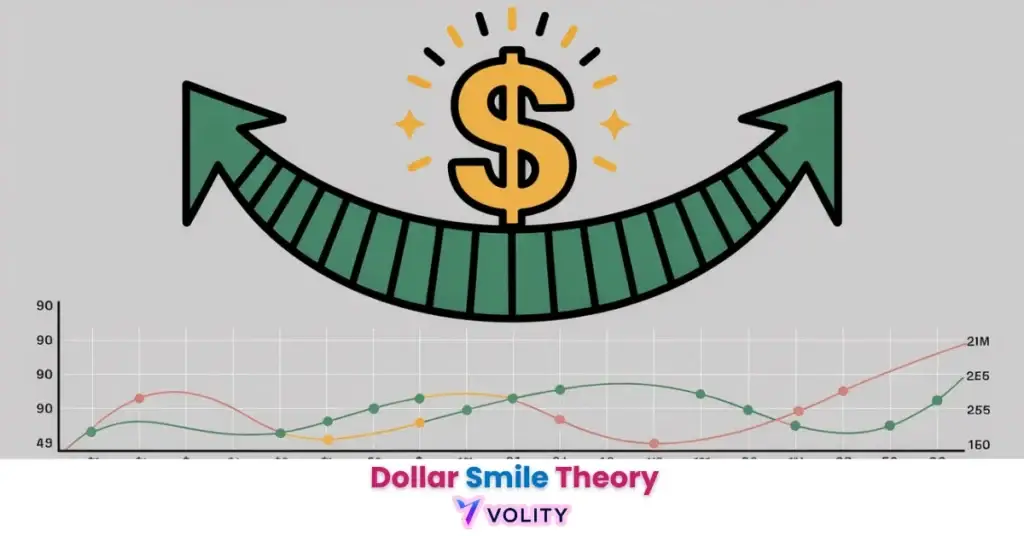
The dollar smile theory explains why the US dollar tends to strengthen at both economic extremes: during global risk-off panics, when investors seek the dollar’s safety, and during strong US growth, when high US returns attract capital. The dollar weakens in the middle, when the US economy is sluggish but the world is calm. The pattern resembles a smile.
Trading the US Dollar Index (DXY) involves exposure to global macroeconomic volatility and central bank policy shifts. Safe-haven flows can reverse rapidly during geopolitical de-escalation. Past performance is not indicative of future results. Capital at risk.
Dollar Smile Theory is a macroeconomic framework that explains why the US dollar strengthens during both extreme global panic and significant US economic outperformance. In early 2026, the theory was validated by a safe-haven surge to 100.53 during the Iran conflict, followed by a move toward the 98.25 bottom as geopolitical tensions eased and the market anticipated the Kevin Warsh Fed transition.
While understanding Dollar Smile Theory is important, applying that knowledge is where the real growth happens. Create Your Free Forex Trading Account to practice with a free demo account and put your strategy to the test.
Dollar Smile Theory reveals a cyclical currency pattern where the US dollar thrives in conditions of absolute fear or absolute dominance. Statistics from March 2026 indicate that the US Dollar Index (DXY) peaked at 100.53, reflecting massive safe-haven inflows during the height of Middle Eastern geopolitical instability.
Success in macro trading requires identifying whether current dollar strength is driven by risk aversion or fundamental yield advantages. This guide identifies the three phases of the curve, the 2026 Fed transition impact, and the “USD Smirk” modifications required for the post-pandemic era.
What is the Dollar Smile Theory and how does it categorize USD movement?
Dollar Smile Theory is a macroeconomic model developed by Stephen Jen that posits the US dollar gains value during periods of global economic crisis and periods of robust US growth. The framework describes three distinct phases plotted as a U-shaped curve: the Left Side (fear-driven safe-haven demand), the Middle (weak dollar zone), and the Right Side (growth and yield-attraction). The dollar behaves as a “Giffen good” during panic, where demand paradoxically increases as uncertainty rises, traders abandon riskier currencies to hold the most liquid, trusted asset globally. Jen set the framework out in 2001 while at Morgan Stanley, and it was tested repeatedly through the 2008 financial crisis and the 2020 pandemic shock.
currency strength. Learn how DXY movements affect forex pairs and broader market sentiment in 2026." class="internal-link" href="https://volity.io/forex/us-dollar-index-dxy/">US Dollar Index DXY formula and components explains the composition of DXY and how it reflects broad dollar demand across global reserve holders. The BIS Triennial Central Bank Survey, OTC foreign exchange turnover in April 2025 records the dollar on one side of the overwhelming majority of global FX trades, which is the mechanical reason panic flows into it first. Historical analysis shows that the theory has predicted major dollar moves across multiple market regimes, from the deflation scare of 2015 through the stagflation concerns of 2022.
Ready to Elevate Your Trading?
You have the information. Now, get the platform. Join thousands of successful traders who use Volity for its powerful tools, fast execution, and dedicated support.
Create Your Account in Under 3 MinutesHow does the Federal Reserve influence the dollar smile in 2026?
The Federal Reserve influences the dollar smile through interest rate differentials and liquidity provisions that dictate the attractiveness of USD-denominated assets. The Right Side of the smile strengthens when the Fed maintains rates above international peers, higher yields attract foreign capital seeking better returns on dollar-denominated Treasury bonds. Kevin Warsh took the oath of office as Fed Chair on 22 May 2026, and the market reads him as prioritising price stability over growth stimulus, which supports the right side of the smile. The Fed’s swap lines with foreign central banks also manage the Left Side by preventing dollar scarcity during crises, limiting the magnitude of safe-haven spikes.
A wide US-Germany 10-year yield spread through the spring of 2026 supported the right side of the smile, reflecting higher real returns for USD investors than for their Eurozone counterparts. interest rate trading in Forex explains how central bank policy differentials drive currency valuations across multi-year horizons. Warsh’s appointment signals a shift toward restrictive policy, a development that strengthens long-term dollar demand as international capital rotates into higher-yielding US assets.
Why does the USD strengthen during times of economic uncertainty?
USD strength during economic uncertainty is the result of massive capital flight into the world’s most liquid and trusted reserve currency during “risk-off” market regimes. The Liquidity Premium describes why traders sell equities, emerging market bonds, and commodity currencies to hold cash during crises, the US dollar and US Treasuries are the only assets that universally maintain bid-ask spreads and deep liquidity during panic. The Safe-Haven Hierarchy ranks the USD at the top, followed by the Swiss Franc (CHF) and gold, but the dollar’s dominance is unmatched because it serves dual functions: a safe harbor and a system of global commerce.
Real-world example (March 2026):
The US-Iran-Israel conflict and subsequent Strait of Hormuz blockade triggered a safe-haven surge where global investors liquidated risky assets. The DXY jumped to 100.53 as “Petrodollar trade” dynamics reasserted themselves, oil, the world’s most traded commodity, is priced in USD, making dollar demand inevitable during energy security crises. Simultaneously, the VIX spiked above 30, signaling extreme equity market fear and accelerating the dollar’s premium. Past performance is not indicative of future results.
Forex sentiment analysis indicators reveals how the Commitment of Traders report tracks the extreme positioning that precedes major dollar moves during geopolitical events. The Petrodollar premium ensures that any global energy crisis automatically strengthens the dollar, a structural feature that will persist as long as oil remains globally traded in USD.
When does the dollar weaken at the bottom of the “Smile”?
The dollar weakens at the bottom of the smile when global growth is synchronized and US economic output is stagnant compared to international peers. The “Boring Middle” represents periods where both developed and emerging markets grow consistently, in this environment, investors have no reason to hide in the US dollar and rotate into the Euro (EUR) for European growth opportunities or the Australian Dollar (AUD) for cyclical upside. Yield Chasing dominates during these phases as investors pursue higher returns in growth currencies rather than safety.
Through April 2026 the DXY gave back the bulk of its March spike, sliding back under 99 as ceasefire hopes reduced the fear premium that had dominated the previous month. risk differentials and currency values explains why interest rate spreads and growth differentials drive currencies more powerfully than single-variable sentiment during calm market phases.
Is the traditional “Dollar Smile” fading into a “USD Smirk”?
The “USD Smirk” is a modern modification of the theory where the dollar’s safe-haven gain is reduced by high hedging costs and structural shifts in capital repatriation. JP Morgan’s 2025/26 thesis suggests that the dollar may underperform during future recessions because US technology capital (held by foreign investors) faces prohibitive costs to hedge dollar exposure, forcing international holders to accept currency losses or liquidate US equities outright. Post-COVID Liquidity distorts the traditional growth-based right side, excess US fiscal stimulus inflated the money supply, creating the counterintuitive environment where the dollar could weaken even as US yields rise.
Central Bank Diversification represents another structural headwind; the dollar’s share of allocated global reserves has fallen by well over ten percentage points since 2000, a trend that could accelerate if the USD Smirk becomes entrenched. Commitment of Traders COT reports show that large speculators are holding historic short positions against the dollar, suggesting that the traditional smile’s left side may be compressed by hedging demand. J.P. Morgan Global Research is one of several desks publishing on these structural shifts and their implications for the next decade of currency markets.
April 2026 Macro Benchmarks (EAV Table)
Macro benchmarks reveal the current technical and fundamental drivers acting on the US dollar’s smile-phase positioning. The DXY’s slide back under 99 through late April reflects a transition phase where the fear premium has faded but growth conviction remains weak. A 10-year Treasury yield near 4% supports the right side of the smile through relative yield advantages, while a wide US-Germany spread anchors international capital flows toward dollar assets.
| Entity | Attribute | Value (late April 2026) | Basis |
| US Dollar Index (DXY) | Spot level | back under 99 | observed market quote |
| 10Y Treasury Yield | Current rate | near 4% | observed market quote |
| DXY March peak | Geopolitical high | around 100 | observed market quote |
| DXY monthly change | April direction | lower | observed market quote |
| Yield spread | US-Germany (10Y) | wide, favouring USD | observed market quote |
Levels are described qualitatively because intraday quotes move; check a live DXY chart before trading against any of them.
Turn Knowledge into Profit
You have done the reading, now it is time to act. The best way to learn is by doing. Open a free, no-risk demo account and practice your strategy with virtual funds today.
Open a Free Demo AccountKey Takeaways
- Dollar Smile Theory explains USD strength during two extremes: global risk aversion (fear) and US economic outperformance (greed).
- The “Left Side” of the smile was validated in March 2026 as DXY hit 100.53 due to Middle East war risks.
- The “Right Side” of the smile is currently supported by Treasury yields near 4% and the Kevin Warsh Fed transition of 22 May 2026.
- The “Middle” of the smile represents a weak USD, typically occurring when global growth is stable and the “fear premium” fades.
- The “USD Smirk” is a 2026 variant suggesting the dollar may be less effective as a safe haven due to high hedging costs.
- Seasonal patterns are a weak input next to the smile itself; position on which corner the cycle is in, not on the calendar month.
Frequently Asked Questions
This article contains references to Dollar Smile Theory and Volity, a regulated CFD trading platform. This content is produced for educational purposes only and does not constitute financial advice or a recommendation to buy or sell any financial instrument. Always verify current regulatory status and platform details before using any trading service. Some links in this article may be affiliate links.
What our analysts watch: Three regime markers that locate the current cycle on the smile rather than guessing it. The relative-growth gap between the US and the rest of the developed world (US PMI minus non-US developed PMI, or a more formal nowcast version, signals which corner of the smile is active). Cross-currency basis swap stress (a sharp tightening in dollar funding markets during global stress is the leading indicator that the left corner of the smile is taking over from whatever regime preceded it). The Federal Reserve broad dollar index versus DXY divergence (when the broader index strengthens faster than DXY, the dollar move is being driven by emerging-market weakness rather than developed-market dynamics, which carries different implications for which corner of the smile is in play).
Volity operates a trading platform and also publishes educational and analytical content about trading. The content on this page is for educational purposes only and should not be considered financial advice. Volity may benefit commercially when readers open trading accounts through links on this site.
Our content is produced and reviewed under documented editorial standards; see our comparison and review methodology.