...

How to Trade Bearish and Bullish Pennants in Forex?

Table of Contents
Quick Summary
A Pennant pattern forms when price pauses after a strong move and compresses into a small triangular shape. The pattern signals trend continuation because buyers or sellers consolidate before pushing price in the same direction. Traders confirm Pennant patterns by watching for a breakout that follows the initial impulse move.

Pennant patterns are short-term continuation chart formations indicating a temporary pause in an existing trend before its resumption. Traders use them to identify high-probability entry points by observing a consolidating triangular shape (the pennant) following a sharp price move (the flagpole), then anticipating a breakout in the original trend direction. This setup typically resolves within 1-3 weeks or shorter on intraday charts.

Instead of predicting market direction, successful traders focus on reacting to confirmed setups. Pennant patterns provide a robust roadmap for capitalizing on strong trend continuations in the Forex market.

While understanding Pennant Patterns in Forex is important, applying that knowledge is where the real growth happens. Create Your Free Forex Trading Account to practice with a free demo account and put your strategy to the test.

What Are Pennant Patterns in Forex?

Pennant patterns represent a temporary consolidation in price action, signaling that market participants are pausing before resuming the prevailing trend. They are continuation patterns, meaning they confirm an existing trend rather than reversing it. This consolidation reflects a brief equilibrium between buyers and sellers, often characterized by decreasing volume, before a decisive push in the initial direction.

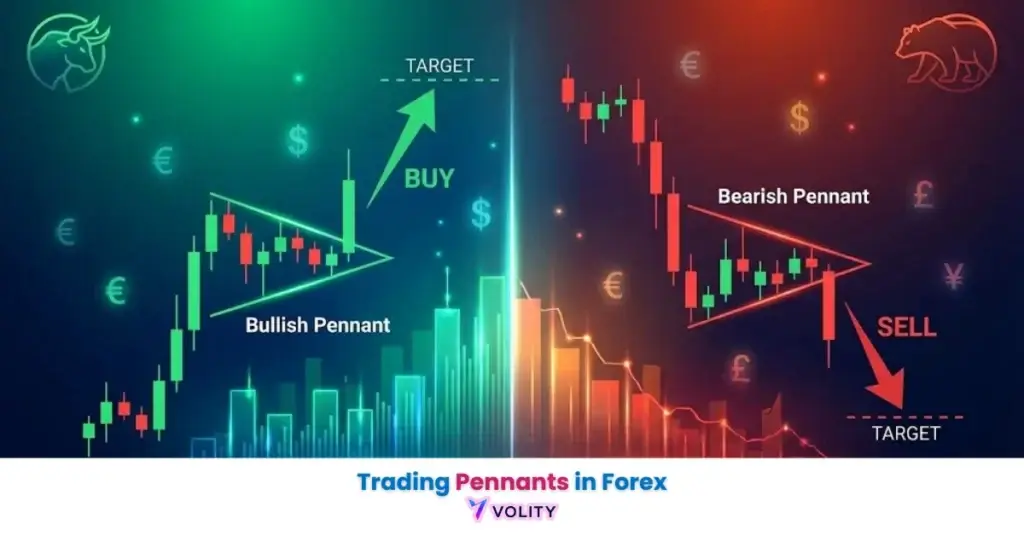
Pennants can be both bullish or bearish, depending on the preceding trend. A bullish pennant follows an uptrend, indicating further upward movement, while a bearish pennant follows a downtrend, suggesting additional downward price action.

The Anatomy of a Pennant

Understanding the distinct components of a pennant pattern is crucial for accurate identification and trading. Each part plays a specific role in signaling the pattern’s validity and potential price targets.

The Flagpole (The Sharp Initial Move)

The flagpole defines the pattern’s preceding strong, impulsive move. It represents the initial, rapid price change that establishes the current trend direction. For a bullish pennant, this is a sharp vertical rally; for a bearish pennant, it is a steep decline. The length of the flagpole is critical for determining the potential price target after the breakout. Traders project this length from the breakout point to estimate future price movement.

The Pennant (Converging Trendlines/Consolidation)

Following the flagpole, price enters a consolidation phase, forming a small, symmetrical triangle. This triangular shape, the pennant, consists of two converging trendlines. The upper trendline slopes downwards, and the lower trendline slopes upwards, meeting at an apex. This convergence reflects a decrease in volatility and uncertainty as market participants digest the prior move. Volume typically decreases significantly during this consolidation period.

The Breakout (Resuming the Trend)

The breakout occurs when price decisively moves outside the pennant’s converging trendlines. A bullish breakout happens above the upper trendline, indicating the uptrend’s resumption. A bearish breakdown occurs below the lower trendline, confirming the downtrend’s continuation. The breakout is often accompanied by a significant surge in trading volume, validating the pattern and signaling strong conviction from traders.

Pennants vs. Symmetrical Triangles

While both pennants and symmetrical triangles feature converging trendlines, their context and duration distinguish them. Pennants are short-term continuation patterns, typically forming over 1 to 3 weeks on daily charts, or often within a few hours on intraday timeframes like 15-minute or 1-hour charts.

Their formation usually lasts for a maximum of 20-30 candles. They represent a brief pause before resuming a strong trend. Symmetrical triangles, conversely, are often medium-term patterns, taking several weeks to months to form.

They can act as either continuation or reversal patterns, indicating a period of indecision without a strong preceding impulsive move. The key difference lies in the initial flagpole and the duration of the consolidation. Pennants require the strong, immediate flagpole.

Ready to Elevate Your Trading?

You have the information. Now, get the platform. Join thousands of successful traders who use Volity for its powerful tools, fast execution, and dedicated support.

Create Your Account in Under 3 Minutes

The Bearish Pennant Pattern (Sell Setup)

The bearish pennant pattern develops during an established downtrend, signaling a high probability that the downward momentum will continue. This setup is a favorite among trend traders for identifying short-selling opportunities.

After a significant price drop, the market consolidates briefly, forming the pennant, before breaking down to continue its decline. This pattern provides specific entry, stop loss, and take profit levels, making it highly actionable for traders.

The subsequent price action after a bearish pennant is typically a continuation of the initial downtrend, often equaling the length of the flagpole.

Identifying the Bearish Flagpole

A bearish flagpole is a sharp, aggressive downward move in price, indicating strong selling pressure. This initial impulse establishes the prevailing downtrend. On a MetaTrader 4 (MT4) or TradingView chart, look for a steep, almost vertical drop in price that precedes the pennant formation. This strong move acts as the foundation for the entire pattern. The flagpole confirms that sellers are in control, setting the stage for a potential continuation.

Validating the Consolidation Phase

The consolidation phase of a bearish pennant manifests as a tight, triangular price action. Price oscillates within two converging trendlines, moving sideways after the sharp flagpole decline. This period reflects a temporary reduction in selling momentum as some buyers enter, but sellers ultimately retain control. Critically, volume must drop significantly during this consolidation. A low trading volume confirms that the market is in a holding pattern, not a reversal. Without this volume decline, the pattern’s reliability decreases substantially.

The Breakdown and Target

Trading a bearish pennant involves entering a short order upon the breakdown below the pennant’s lower trendline. This breakdown confirms the resumption of the downtrend. The take profit target is typically measured by projecting the length of the flagpole from the point of the breakout. For example, if the flagpole dropped 150 pips, traders aim for an additional 150-pip move after the breakdown. Placing a stop loss just above the high of the pennant provides a clear risk management point, protecting against false breakouts or reversals.

💡 KEY INSIGHT: Volume always tells the true story. A valid pennant shows decreasing volume during consolidation and increasing volume on the breakout.

The Bullish Pennant Pattern (Buy Setup)

The bullish pennant pattern emerges during an active uptrend, indicating that buying pressure is likely to continue pushing prices higher after a short pause. This pattern offers specific long entry opportunities for traders looking to capitalize on existing momentum. It forms as the market takes a brief breather following a strong upward move, consolidating into a small, symmetrical triangle before breaking out to the upside. The subsequent price action after a bullish pennant typically extends the original uptrend.

Identifying the Bullish Flagpole

A bullish flagpole appears as a rapid, steep ascent in price, demonstrating robust buying momentum. This sharp upward move signals the initial dominance of buyers in the market. Traders identify this on their TradingView or MT5 charts as a near-vertical price surge preceding the pennant formation. The strength and length of this flagpole are essential. It provides the initial thrust that the pennant pattern seeks to continue, indicating a strong underlying trend.

The Breakout Confirmation

Confirmation of a bullish pennant occurs when price decisively breaks above the upper trendline of the pennant. This breakout signals that buyers have regained control and the uptrend is resuming. A strong long order entry is typically considered valid only after a candlestick closes above this trendline on the chosen timeframe. Crucially, this breakout should be accompanied by a significant volume spike. A surge in volume validates the buying pressure, distinguishing a genuine breakout from a potential fakeout. Without this increased volume, the breakout’s reliability diminishes.

WARNING: Bullish pennants, while reliable, can still fail. Approximately 25-30% of these patterns may not reach their full projected target or experience a false breakout. Always prioritize strict risk management.

Step-by-Step: How to Trade the Pennant Pattern Strategy

Trading the pennant pattern effectively requires a structured approach, encompassing precise entry protocols, robust risk management, and calculated profit-taking strategies. This detailed guide outlines the execution phases for capitalizing on both bullish and bearish pennants in Forex. Successful trading involves patience and adherence to these specific steps on platforms like MT4 or TradingView.

Pennants pattern trading strategy

Step 1: Entry Protocols

Executing a trade on a pennant pattern offers two primary entry methods, each suited to different risk appetites. Both approaches aim to capitalize on the confirmed breakout in the direction of the flagpole.

Aggressive Entry (On the Break)

An aggressive entry involves placing a buy order (for bullish pennants) or a sell order (for bearish pennants) immediately as price breaks the pennant’s trendline. Traders often use pending orders placed just outside the trendline or execute market orders upon observing the initial breach. This method aims to capture the earliest possible move, maximizing potential profit. However, it carries a higher risk of fakeouts, where price briefly breaks out only to reverse back into the pennant.

Conservative Entry (On the Retest)

A conservative entry involves waiting for price to retest the broken trendline after the initial breakout. This means price breaks out, moves slightly, then returns to touch the trendline, which now acts as a support (for bullish) or resistance (for bearish) level. Entering on this retest provides higher confirmation, as the market validates the new support/resistance. This approach reduces fakeout risk, but may result in a slightly less favorable entry price compared to an aggressive entry, potentially missing some of the initial momentum.

Step 2: Risk Management (Stop Loss Placement)

Effective risk management is paramount when trading pennants. Placing a stop loss order precisely protects capital against adverse price movements.

For a bullish pennant, the stop loss position is typically placed just below the lowest point of the pennant’s consolidation range. This ensures that if the pattern fails and price moves against the anticipated uptrend, losses are minimized.

For a bearish pennant, the stop loss is placed just above the highest point of the pennant’s consolidation range. Proper stop loss placement is critical in mitigating margin calls and controlling overall portfolio leverage. A common rule is risking only 1-2% of account capital per trade.

Step 3: Setting Take Profit Targets

The most common and effective technique for setting take profit targets with pennants is the measured move. This involves projecting the length of the flagpole from the point where price breaks out of the pennant. If a bullish flagpole measured 120 pips, a trader would aim for an additional 120-pip move from the breakout point. For a bearish pennant, if the flagpole dropped 100 pips, the take profit would target another 100-pip decline. This technique provides a logical and statistically sound target based on the pattern’s initial momentum.

Advanced Analysis: Reliability and Filters

Going beyond basic identification significantly enhances a pennant pattern’s trading reliability. Understanding the nuances of volume and pattern duration separates high-probability setups from less reliable ones. While no pattern guarantees success, integrating these filters into your analysis can improve a trade’s probability of reaching its target. Statistical analysis indicates that well-formed pennant patterns demonstrate a success rate of approximately 70-75% in continuing the trend.

The Role of Volume in Confirmation

Volume serves as the ultimate validator for pennant patterns. During the pennant’s consolidation phase, trading volume must decrease significantly. This decline indicates that fewer traders are participating, reflecting a temporary pause rather than a reversal. Upon the decisive breakout from the pennant, volume must explode. A sudden surge in volume confirms strong market conviction behind the breakout, indicating a high likelihood of continued price movement in the trend’s direction. Without this precise volume profile – decreasing during consolidation, increasing on breakout – the pattern’s reliability drops, making it prone to fakeouts for a technical trader.

Duration Matters

The duration of the pennant’s formation critically influences its reliability. Pennants are inherently short-term patterns, representing a quick consolidation before a powerful continuation. A valid pennant typically forms over 1 to 3 weeks on daily charts, or often within a few hours on intraday charts (e.g., 15-minute or 1-hour timeframes). If the consolidation drags on for too long, exceeding 20-30 candles on a given timeframe, it loses its “impulse” momentum. An extended consolidation often transforms the pattern into a broader symmetrical triangle or a complex range, diminishing its predictive power as a rapid continuation setup. Traders should avoid trading pennants that become overly protracted.

Tip: Always check for coinciding support and resistance lines near the pennant’s breakout point. A breakout through a key S/R level reinforces the pattern’s strength.

Common Mistakes and Real World Troubleshooting

Even experienced traders can misinterpret pennant patterns, leading to unprofitable trades. Understanding common pitfalls and developing troubleshooting strategies is essential for successful application in the Forex market. Addressing these practical errors can significantly improve a trader’s performance when utilizing pennants on platforms like MT4 or TradingView.

Trading Against the Trend

One of the most frequent mistakes involves trading a pennant against the prevailing trend. Pennants are strictly continuation patterns. Mistaking a short-term consolidation during an uptrend for a bearish pennant (hoping for a reversal) or vice-versa is a critical error. This occurs when traders ignore the flagpole, which clearly establishes the trend. Always ensure the pennant forms after a strong, defined trend (the flagpole) and that you are preparing to trade with that trend’s anticipated continuation. Trading against the trend significantly increases risk and often leads to margin calls.

Turn Knowledge into Profit

You've done the reading, now it's time to act. The best way to learn is by doing. Open a free, no-risk demo account and practice your strategy with virtual funds today.

Open a Free Demo Account

The “Fakeout” Trap

Fakeouts are a major challenge in technical analysis, especially with pennants. A fakeout occurs when price briefly breaks above or below a pennant’s trendline, only to reverse quickly and move back into the pattern, often triggering stop losses.

To mitigate the “fakeout” trap, traders should not enter immediately upon a trendline breach. Instead, wait for a full candlestick close (e.g., a 4-hour candle close on MT4/MT5) outside the pennant’s trendline.

This confirms the breakout’s validity, reducing the likelihood of a false signal. High leverage exacerbates losses from fakeouts, so disciplined confirmation is vital.

📌 REMEMBER: A single candle close outside the pennant trendline on your chosen timeframe offers stronger confirmation than just a mere breach.

Comparison: Pennant vs. Flag vs. Wedge

Understanding the distinctions between similar continuation patterns like pennants, flags, and wedges is crucial for accurate chart analysis. Each pattern possesses unique characteristics that influence its interpretation and trading strategy. While all three indicate a pause in a trend, their shapes, duration, and volume profiles differ significantly. This table highlights their primary differentiating factors for clarity.

FeaturePennantFlagWedge
ShapeSmall symmetrical triangleParallel trendlines (rectangle/channel)Converging trendlines (both slope up or down)
DurationShort-term (1-3 weeks / few hours intraday)Short-term (1-3 weeks / few hours intraday)Medium-term (several weeks to months)
Direction BiasContinuation (same as flagpole)Continuation (opposite to flagpole)Reversal or Continuation (depends on slope)
Volume ProfileDecreases during consolidation, spikes on breakoutDecreases during consolidation, spikes on breakoutDecreases during formation, can spike on breakout or breakdown
Preceding TrendStrong, impulsive move (flagpole)Strong, impulsive move (flagpole)Strong trend (can be less impulsive)

Key Takeaways

    [li]Identify the flagpole and the short-term, symmetrical triangular consolidation.[/li][li]Confirm pennant validity by observing decreasing volume during consolidation and increasing volume on breakout.[/li][li]Implement aggressive or conservative entry protocols, always placing a clear stop loss.[/li][li]Measure take profit targets by projecting the flagpole’s length from the breakout point.[/li][li]Avoid common mistakes like trading against the trend or falling for fakeouts by waiting for candle closes.[/li]

Bottom Line

Moving from recognizing a chart pattern to executing a live trade requires a precise, systematic approach. This guide empowers traders to confidently identify and trade bullish and bearish pennants by emphasizing a volume-first validation strategy. The critical path involves first confirming the flagpole, then observing decreasing volume during consolidation, and finally, entering on a high-volume breakout. While these patterns offer robust entry points, consistently applying strict risk management is more important than achieving any specific profit target. Open your demo account today to practice identifying these patterns and testing your entry protocols risk-free.

FAQ

What is the 90% rule in forex?

The '90% rule' typically refers to the common statistic suggesting that approximately 90% of retail Forex traders lose 90% of their capital within 90 days. This highlights the critical importance of risk management and sound trading strategies.

What is 'Bearish Pennant' in a chart pattern?

A bearish pennant is a continuation pattern that forms during a strong downtrend. It features a sharp initial price drop (the flagpole) followed by a brief, symmetrical triangular consolidation before price breaks down further.

What is a bullish pennant in trading?

A bullish pennant is a continuation pattern indicating an uptrend will likely resume. It forms with a strong upward price move (the flagpole), followed by a brief, tight consolidation in a triangular shape, then breaks out to the upside.

How can we predict if a market will be bullish or bearish?

Traders do not predict market direction but rather analyze price action, volume, and technical indicators to identify existing trends or high-probability setups like pennants. They react to confirmations, not prophecies, to determine potential future movements.

How can we use Pennant pattern in trading?

Use pennants by identifying a strong flagpole, waiting for a volume-decreasing triangular consolidation, and entering a trade upon a high-volume breakout in the flagpole's direction. Set stop losses beyond the pennant and take profits based on the flagpole's length.

References

Start Your Days Smarter!

Get market insights, education, and platform updates from the Volity team.

Start Your Days Smarter!

High-Risk Investment Notice:  Website information does not contain and should not be construed as containing investment advice, investment recommendations, or an offer or solicitation of any transaction in financial instruments. It has not been prepared in accordance with legal requirements designed to promote the independence of investment research, and it is not subject to any prohibition on dealing ahead of the dissemination of investment research. Nothing on this site should be read or construed as constituting advice on the part of Volity Trade or any of its affiliates, directors, officers, or employees.

Please note that content is a marketing communication. Before making investment decisions, you should seek out independent financial advisors to help you understand the risks.

Services are provided by Volity Trade Ltd, registered in Saint Lucia, with the number 2024-00059. You must be at least 18 years old to use the services.

Trading forex (foreign exchange) or CFDs (contracts for difference) on margin carries a high level of risk and may not be suitable for all investors. There is a possibility that you may sustain a loss equal to or greater than your entire investment. Therefore, you should not invest or risk money that you cannot afford to lose. The products are intended for retail, professional, and eligible counterparty clients. For clients who maintain account(s) with Volity Trade Ltd., retail clients could sustain a total loss of deposited funds but are not subject to subsequent payment obligations beyond the deposited funds. Professional and eligible counterparty clients could sustain losses in excess of deposits.

Volity is a trademark of Volity Limited, registered in the Republic of Hong Kong, with the number 67964819.
Volity Invest Ltd, number HE 452984, registered at Archiepiskopou Makariou III, 41, Floor 1, 1065, Lefkosia, Cyprus is acting as a payment agent of Volity Trade Ltd.

Volity Trade Ltd. is an introductory broker for UBK Markets Ltd. It offers execution and custody services for clients introduced by Volity. UBK Markets Ltd is authorised and regulated by the Cyprus Securities and Exchange Commission (CySEC), license number 186/12 and registered at 67, Spyrou Kyprianou Avenue, Kyriakides Business Center, 2nd Floor, CY-4003 Limassol, Cyprus.

Volity Trade Ltd. does not offer services to citizens/residents of certain jurisdictions, such as the United States, and is not intended for distribution to or use by any person in any country or jurisdiction where such distribution or use would be contrary to local law or regulation.

Copyright: © 2025 Volity Trade Ltd. All Rights reserved.