...

Piercing Line Pattern in Forex: Reliability, Rules & Algorithmic Data

Table of Contents
Quick Summary
The Piercing Line pattern is a two-candle bullish reversal pattern signaling a potential shift from a downtrend to an uptrend in financial markets, particularly in Forex. 

The Piercing Line pattern indicates a significant shift in market sentiment, as buyers aggressively reject lower prices after an initial bearish movement. It appears at the bottom of a prevailing downtrend, suggesting that bearish momentum is waning and bullish pressure is building. 

This pattern offers intermediate to advanced Forex traders a clear signal when combined with other technical indicators, making it a valuable tool for identifying potential buying opportunities.

While understanding Piercing Line Candlestick Pattern is important, applying that knowledge is where the real growth happens. Create Your Free Forex Trading Account to practice with a free demo account and put your strategy to the test.

What Is the Piercing Line Candlestick Pattern?

The Piercing Line candlestick pattern functions as a powerful bullish reversal pattern which emerges during a prevailing downtrend in the Forex market. It signifies that sellers, or “bears,” lose control, and buyers, or “bulls,” begin to dominate price action. 

This pattern holds a reliability score of 7/10 for spotting bullish reversals, according to market analysis. Its immediate contrast is the Dark Cloud Cover, its bearish counterpart, which signals a downward reversal after an uptrend.

The Anatomy of a Bullish Reversal

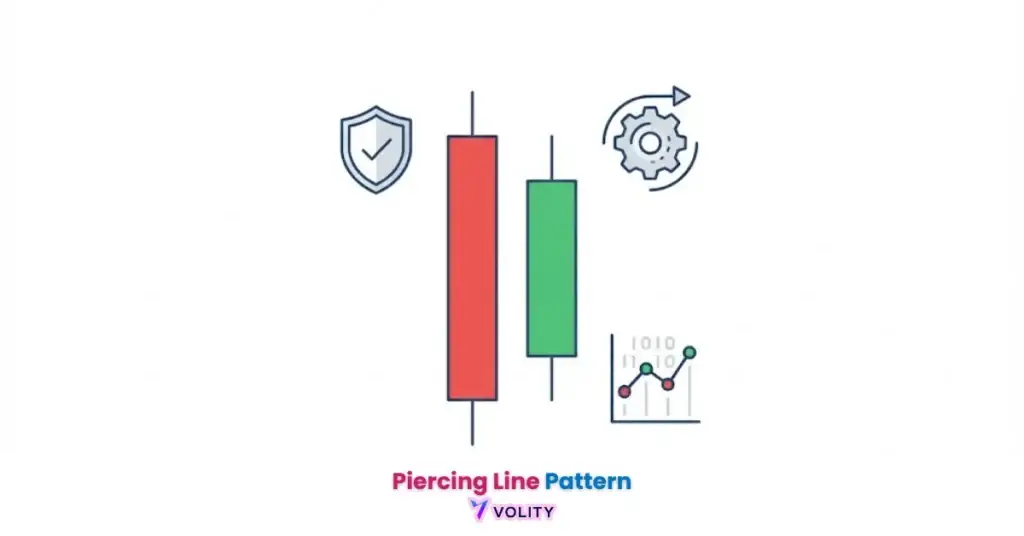
The Piercing Line is a two-candle setup characterized by a specific sequence of price action. The first candle is a long bearish candle, confirming the existing downtrend. Following this, the second candle opens lower than the first candle’s close (often a “gap down” in traditional markets) but then aggressively pushes upward. This bullish second candle closes above the 50% retracement level of the first bearish candle’s real body, but not above its opening price. This critical close above the midpoint demonstrates significant buying pressure, as bulls reclaim substantial ground from the bears.

Bullish vs. Bearish Context: Why Trend Matters

The context of the prevailing trend is paramount for interpreting the Piercing Line pattern correctly. 

A Piercing Line pattern appearing during an uptrend or in a sideways consolidation range lacks reversal significance. 

It specifically functions as a bullish signal when it forms after a clear, established downtrend, indicating potential exhaustion of selling pressure. This requirement ensures that the pattern is interpreted within its appropriate market dynamic.

Recognition Criteria & The ‘Forex Gap’ Nuance

Identifying a Piercing Line pattern requires strict adherence to specific recognition criteria, particularly regarding the relative positions of the two candles’ opens and closes. The second candle must open below the low of the first bearish candle, establishing a “gap down” in price. 

This second candle, which is bullish, must then close above the 50% midpoint of the first bearish candle’s body, but remain below its open. This close above the midpoint is the defining characteristic of the pattern. Traders often observe this pattern on H4–Daily timeframes to filter out market noise and increase its reliability.

The 50% Rule: Calculating the Midpoint

The 50% rule is fundamental to confirming the Piercing Line. To calculate the midpoint, determine the range of the first bearish candle’s real body (Open – Close). The bullish second candle’s closing price must fall within the upper half of this range. For instance, if the first candle opened at 1.1200 and closed at 1.1100, its body is 100 pips. 

The midpoint is 1.1150. The second bullish candle must close above 1.1150, but still below 1.1200. This precise entry into the prior candle’s territory signifies the bullish takeover.

Ready to Elevate Your Trading?

You have the information. Now, get the platform. Join thousands of successful traders who use Volity for its powerful tools, fast execution, and dedicated support.

Create Your Account in Under 3 Minutes

Why Real Gaps Are Rare in Forex (Vs. Stocks like Tesla/JPM)

A critical nuance for Forex market traders is the concept of the “gap down.” In traditional equity markets, like those for Tesla (TSLA) or JPMorgan (JPM), true price gaps are common due to market closures overnight or over weekends. 

However, the Forex market operates 24 hours a day, five days a week, making genuine price gaps during active trading rare. 

For Forex, the “gap down” typically manifests as the second candle opening lower than the close of the first candle, rather than its low. This slight modification accounts for the continuous nature of currency trading.

💡 KEY INSIGHT: While stock markets regularly exhibit true price gaps, the 24/5 continuous nature of the Forex market means a “gap down” for a Piercing Line typically implies the second candle’s open is below the first candle’s close, not necessarily its low. This adjustment is crucial for accurate pattern identification in currency pairs.

Market Psychology: Inside the Reversal

The Piercing Line pattern articulates a clear narrative of shifting short-term sentiment shifts and a direct battle between Bears and Bulls. Initially, the prevailing downtrend empowers the bears, driving prices lower. The first long bearish candle confirms this bearish control. The second candle opens even lower, suggesting continued bearish dominance, often initiating with a gap down. However, this is where the market narrative pivots.

The Battle Between Bears and Bulls

Despite the bearish open, buying pressure aggressively enters the market. Bulls capitalize on the lower prices, driving the price upward throughout the second candle’s formation. 

This strong bullish surge pushes the price beyond the 50% midpoint of the preceding bearish candle’s body. The close above this critical level signifies a strong rejection of lower prices and indicates a significant transfer of power from sellers to buyers. 

The longer the second bullish candle, and the deeper it penetrates the first candle, the more conviction this bullish reversal pattern suggests.

Interpreting Volume During the Formation

Volume analysis provides further confirmation of the Piercing Line pattern’s validity. Ideally, the first bearish candle forms on high or increasing volume, confirming the strength of the downtrend. The second bullish candle should also exhibit high or increasing volume as the bulls step in. 

A significant increase in volume during the formation of the bullish second candle supports the idea that substantial buying pressure underpins the price reversal, making the signal more reliable. Conversely, a Piercing Line pattern on low volume suggests weaker conviction and may result in a less reliable reversal.

Algorithmic Trading: Input Parameters & Reliability Data

For algorithmic traders, the Piercing Line pattern transcends visual identification, requiring precise logical constraints for bots to detect. 

This quantitative approach enables automated systems to identify the pattern consistently. While the Piercing Line Reliability Score is 7/10, newer, more robust patterns developed through extensive data analysis offer higher reliability.

Coding the Pattern: Logical Constraints for Bots

Algorithmic detection of the Piercing Line pattern requires defining specific conditions. Assuming C represents the Close price, O the Open price, H the High price, L the Low price, and [i] denotes the i-th candle (where [0] is the current/second candle and [1] is the previous/first candle), the exact logic for coding is:

  1. First Candle is Bearish: O[1] > C[1]
  2. Second Candle is Bullish: O[0] < C[0]
  3. Second Candle Opens Below First Candle’s Low (Forex Nuance): O[0] < C[1] (or O[0] < L[1] for strict traditional interpretation)
  4. Second Candle Closes Above 50% of First Candle’s Body: C[0] > (O[1] + C[1]) / 2
  5. Second Candle Closes Below First Candle’s Open: C[0] < O[1]

These precise conditions allow platforms like TickTrader to automatically scan for and potentially act upon these patterns.

Statistical Reality: Piercing Line vs. MIDDAM (38M Candle Study)

Academic research continuously seeks to improve pattern recognition in high-frequency trading. A significant study compared traditional patterns like Doji with advanced algorithmic patterns like MIDDAM (MInimal Difference in shadow for Directional Analytical Movement). This research, utilizing a vast dataset of over 38,000,000 1-minute historical candles in Forex market simulations, revealed compelling results. MIDDAM patterns demonstrated significantly higher profitability, yielding 138 times more profit than Doji patterns as a reversal signal. 

Furthermore, MIDDAM achieved a robust win-to-loss ratio of 6:2 across tested currency pairs. 

This data indicates a shift towards quantifying patterns with ‘Reliability Scores’ and validates the need for rigorous statistical analysis beyond mere visual recognition. While the Piercing Line has a decent 7/10 reliability score, patterns like the Bullish Kicker, rated 10/10 reliability, often present superior alternatives for discerning reversals. 

The blockchain-based trading platform Morpher also integrates advanced analytics, showcasing the trend of merging fintech with educational trading tools.

WARNING: Relying solely on the visual recognition of traditional candlestick patterns like Doji in modern high-frequency Forex markets is often unreliable for reversals. Academic studies, such as the MIDDAM comparison, validate the necessity of statistically proven algorithmic patterns for consistent profitability.

Trading Strategies: Confirmation & Indicators

Trading the Piercing Line pattern effectively demands confirmation beyond the pattern itself. Traders never execute trades based solely on the Piercing Line without a subsequent third bullish candle or confluence with other technical indicators. 

This approach significantly enhances the pattern’s reliability and reduces the incidence of misleading signals often seen on lower timeframes due to market noise.

Strategy 1: Combining with RSI & Stochastic Oscillators

Integrating momentum oscillators like the Relative Strength Index (RSI) and Stochastic with the Piercing Line pattern strengthens a bullish reversal signal. 

When the Piercing Line forms, traders look for RSI divergence, where price makes a lower low, but the RSI makes a higher low, indicating weakening bearish momentum. Similarly, the Stochastic oscillator should be in the oversold zone (below 20) and show a bullish crossover or divergence. This indicator confluence provides a multi-faceted confirmation of potential buying pressure and validates the reversal.

Strategy 2: Moving Average Confluence on H4 Charts

Another potent strategy involves combining the Piercing Line with Moving Averages, particularly on H4 charts or Daily timeframes

A valid Piercing Line pattern forming at or near a key moving average (e.g., 50-period, 100-period, or 200-period Exponential Moving Average) suggests a strong support level.

If the price bounces off a significant moving average and simultaneously forms a Piercing Line, it reinforces the bullish bias. 

This strategy works effectively as moving averages identify dynamic support and resistance zones.

Risk Management: Entry, Stop Loss, and Take Profit

Effective risk management is crucial when trading any pattern.

  1. Entry: Traders typically enter a long position after the close of the bullish second candle or upon the confirmation of a third bullish candle.
  2. Stop Loss Placement: The stop loss is positioned just below the low of the second bullish candle (the signal candle). This placement protects capital if the reversal fails and bears regain control.
  3. Take Profit: Take-profit targets are often set at previous resistance levels, significant swing highs, or based on a favorable risk-to-reward ratio (e.g., 1:2 or 1:3). Trailing stops can also be employed to lock in profits as the trade moves in the desired direction.

Comparative Analysis: Piercing Line vs. Other Patterns

The Piercing Line pattern is one of many candlestick formations that signal potential reversals, but understanding its specific characteristics in relation to others provides essential context. Patterns vary in their structure, reliability, and the market sentiment they convey.

PatternTypeCandlesSignalKey CharacteristicReliability Score
Piercing LineBullish Reversal2Bullish2nd candle opens lower than 1st close, closes above 50% of 1st body.7/10
Dark Cloud CoverBearish Reversal2Bearish2nd candle opens higher than 1st close, closes below 50% of 1st body.9/10
Bullish EngulfingBullish Reversal2Bullish2nd bullish candle body completely engulfs 1st bearish candle body.High
Morning StarBullish Reversal3BullishLong bearish, small body (gapped), long bullish.High
HammerBullish Reversal1BullishSmall body, long lower wick (at least 2x body), little to no upper wick.Moderate
DojiNeutral/Reversal1IndecisionOpen and close are virtually the same, forming a cross or plus sign.Low (in Forex)
Bullish KickerBullish Reversal2Strong BullPrice gaps up from a bearish candle, creating a new bullish candle that opens above the previous high (no overlap).10/10

Piercing Line vs. Dark Cloud Cover

The Dark Cloud Cover is the direct bearish inverse of the Piercing Line. While the Piercing Line signals a bullish reversal from a downtrend, the Dark Cloud Cover signals a bearish reversal from an uptrend. 

The Dark Cloud Cover features a bullish first candle, followed by a bearish second candle that opens above the first candle’s high (a “gap up”) and then closes below the 50% midpoint of the first candle’s body. 

The Dark Cloud Cover actually holds a higher reliability score of 9/10, indicating a stronger bearish signal in many market conditions.

Piercing Line vs. Bullish Engulfing

Both the Piercing Line and the Bullish Engulfing pattern are two-candle bullish reversal patterns occurring in a downtrend. The key difference lies in the second candle’s action. 

In a Bullish Engulfing pattern, the second bullish candle’s body entirely engulfs the first bearish candle’s body, opening below its close and closing above its open. 

This complete engulfment often makes the Bullish Engulfing pattern a stronger and more common signal of bullish takeover compared to the Piercing Line, where the second candle only penetrates beyond the 50% mark.

Piercing Line vs. Morning Star

The Morning Star is a three-candle bullish reversal pattern, generally considered more reliable than the two-candle Piercing Line due to its extra confirmation. 

It consists of a long bearish candle, followed by a small-bodied candle (often a Doji or Spinning Top) that gaps down and signals indecision, and finally a long bullish candle that closes well into the body of the first bearish candle. 

The additional candle of indecision and subsequent bullish confirmation strengthens the Morning Star’s reversal potential compared to the Piercing Line.

Tip: Always prioritize multi-candle patterns and those confirmed by statistical analysis (like the Bullish Kicker at 10/10 reliability) for more robust trading signals, especially in the fast-paced Forex market.

Bottom Line

Use the Piercing Line pattern to identify bullish reversals in the Forex market with a reliability score of 7/10. Confirm the pattern when a bearish candle is followed by a bullish candle that closes above the prior body’s 50% midpoint. Strengthen accuracy with RSI divergence or Moving Average alignment on H4–Daily charts to reduce noise. Support decisions with quantitative research and algorithmic testing to trade statistically reliable patterns.

Key Takeaways

  • The Piercing Line is a two-candle bullish reversal pattern with a 7/10 reliability score, best utilized on H4–Daily timeframes.
  • Its defining characteristic is the second bullish candle opening below the first bearish candle’s close and closing above the 50% midpoint of the first candle’s body.
  • In Forex, the “gap down” means the second candle opens below the first candle’s closing price due to the market’s continuous nature.
  • Always seek confirmation with indicators like RSI divergence or Moving Averages to enhance pattern validity.
  • Modern algorithmic patterns like MIDDAM (138× more profitable than Doji) offer statistically higher reliability than traditional visual patterns.

FAQ

Is the Piercing Line rare?
The Piercing Line pattern is not extremely rare but occurs less often than patterns like the Bullish Engulfing due to its gap-down requirement and 50% penetration rule.
What timeframe is best for the Piercing Line?
The pattern is most reliable on higher timeframes such as the H4 and Daily charts, where market noise is reduced and signals are more meaningful.
Does a Piercing Line need a gap?
Yes. Traditionally it requires a gap down. In Forex, this translates to the second candle opening below the first candle’s close due to the market’s continuous nature.
What is the main characteristic of the Piercing Line pattern?
It is a two-candle reversal pattern where the bullish second candle opens below the first bearish candle’s close and closes above the midpoint (50%) of the first candle’s body.
Why is the gap-down rule different in Forex compared to stocks?
Because Forex trades 24/5, true gaps are rare. Therefore, a 'gap down' means the second candle opens below the previous candle’s close rather than its low.
How reliable is the Piercing Line pattern in modern trading?
It holds roughly a 7/10 reliability score, performing best when confirmed with other indicators on higher timeframes, though more advanced patterns like MIDDAM can offer higher profitability.

Start Your Days Smarter!

Expand Your Knowledge

Get market insights, education, and platform updates from the Volity team.

Start Your Days Smarter!

High-Risk Investment Notice:  Website information does not contain and should not be construed as containing investment advice, investment recommendations, or an offer or solicitation of any transaction in financial instruments. It has not been prepared in accordance with legal requirements designed to promote the independence of investment research, and it is not subject to any prohibition on dealing ahead of the dissemination of investment research. Nothing on this site should be read or construed as constituting advice on the part of Volity Trade or any of its affiliates, directors, officers, or employees.

Please note that content is a marketing communication. Before making investment decisions, you should seek out independent financial advisors to help you understand the risks.

Services are provided by Volity Trade Ltd, registered in Saint Lucia, with the number 2024-00059. You must be at least 18 years old to use the services.

Trading forex (foreign exchange) or CFDs (contracts for difference) on margin carries a high level of risk and may not be suitable for all investors. There is a possibility that you may sustain a loss equal to or greater than your entire investment. Therefore, you should not invest or risk money that you cannot afford to lose. The products are intended for retail, professional, and eligible counterparty clients. For clients who maintain account(s) with Volity Trade Ltd., retail clients could sustain a total loss of deposited funds but are not subject to subsequent payment obligations beyond the deposited funds. Professional and eligible counterparty clients could sustain losses in excess of deposits.

Volity is a trademark of Volity Limited, registered in the Republic of Hong Kong, with the number 67964819.
Volity Invest Ltd, number HE 452984, registered at Archiepiskopou Makariou III, 41, Floor 1, 1065, Lefkosia, Cyprus is acting as a payment agent of Volity Trade Ltd.

Volity Trade Ltd. is an introductory broker for UBK Markets Ltd. It offers execution and custody services for clients introduced by Volity. UBK Markets Ltd is authorised and regulated by the Cyprus Securities and Exchange Commission (CySEC), license number 186/12 and registered at 67, Spyrou Kyprianou Avenue, Kyriakides Business Center, 2nd Floor, CY-4003 Limassol, Cyprus.

Volity Trade Ltd. does not offer services to citizens/residents of certain jurisdictions, such as the United States, and is not intended for distribution to or use by any person in any country or jurisdiction where such distribution or use would be contrary to local law or regulation.

Copyright: © 2025 Volity Trade Ltd. All Rights reserved.