Investing in financial products involves risk. Losses may exceed the value of your original investment.
Quick answer
Energy commodities trading covers crude oil (WTI, Brent), natural gas (Henry Hub, TTF), refined products (gasoline, heating oil, jet fuel), and increasingly power (PJM, ERCOT). Major venues are CME Globex and ICE. Daily volatility is driven by OPEC+ supply decisions, weather, geopolitical events, and storage data. Retail traders typically use futures CFDs or energy ETFs (XLE, USO).
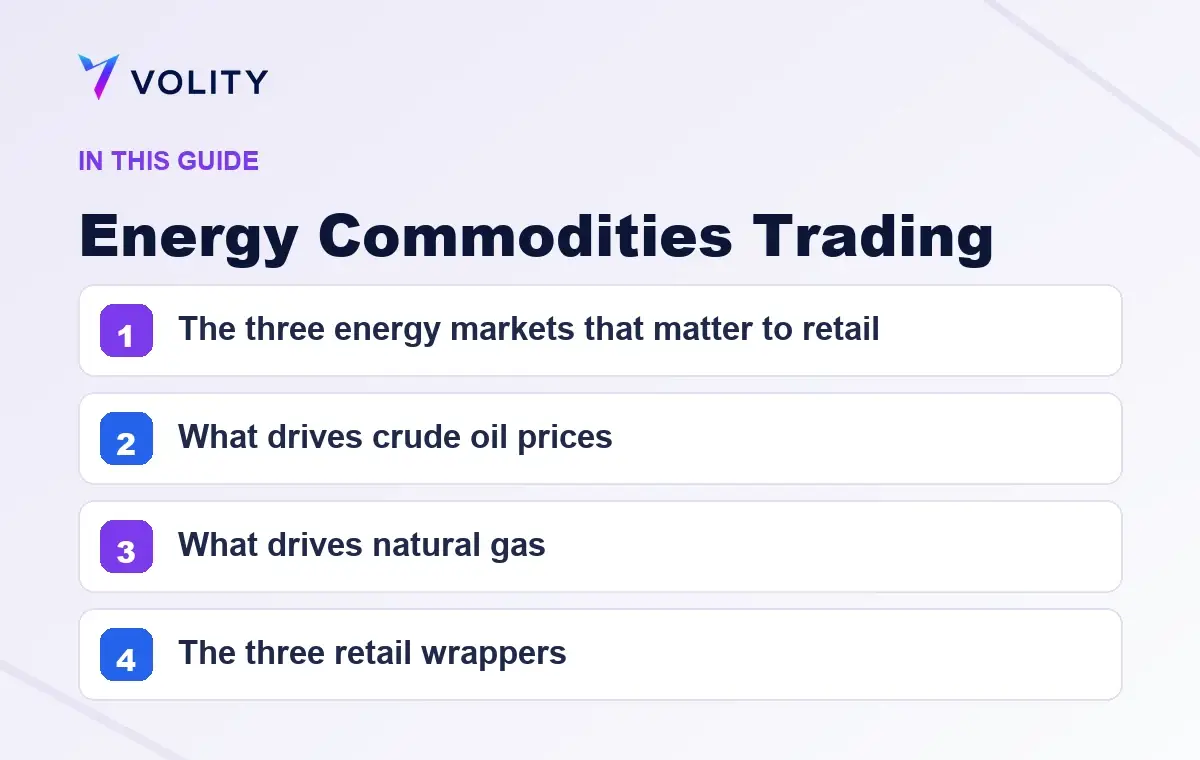
Energy commodities trading covers crude oil, natural gas, refined products (gasoline, heating oil, jet fuel), and increasingly power and carbon allowances. The flow is driven by physical supply (OPEC quotas, US shale rig counts, LNG terminal capacity), inventory data (EIA, API), weather (heating and cooling demand), geopolitics (sanctions, pipeline disruptions), and macro currency moves (a stronger dollar pressures dollar-denominated commodities). Retail traders express views via futures, futures-based ETFs, options, or CFDs on the underlying contracts.
The three energy markets that matter to retail
- Crude oil. Two main benchmarks: Brent (waterborne, global) and WTI (West Texas Intermediate, US-centric). The spread between them, Brent-WTI, is itself a tradeable structural number. Daily moves of 1-3% are routine; weekly moves of 5-10% on inventory or geopolitical news are common.
- Natural gas. The most volatile major commodity. Henry Hub (US) and TTF (Europe) are the benchmarks. Weekly moves of 10-20% in winter months are normal. Storage data on Thursday from the EIA drives the week.
- Refined products and power. Gasoline (RBOB), heating oil (ULSD), and increasingly European power and carbon. More specialised. Spreads to crude (the crack spread) are a structural trade for refiners and a directional trade for traders.
What drives crude oil prices
Five drivers, ranked by frequency:
- Weekly inventory data. EIA on Wednesday at 14:30 UTC. API on Tuesday evening as a preview. Surprise builds (more inventory than expected) are bearish; surprise draws are bullish.
- OPEC+ decisions. Monthly meetings, quarterly major reviews. Production quota changes move crude 3-8% on the day.
- Geopolitics. Middle East tension, Russia-Ukraine corridor, sanctions on Iran or Venezuela. Tail-risk-driven jumps.
- Demand prints. Chinese PMI, US ISM, eurozone industrial production. Macro demand signal.
- Dollar. Crude is dollar-priced. A stronger DXY is mechanically bearish for crude in non-USD terms.
What drives natural gas
Gas is mostly a weather story plus storage. Winter heating demand and summer cooling demand (gas-fired power) drive 60-70% of intra-year price variance. The other 30-40% is supply: US production, LNG export capacity, European import flow, and pipeline disruptions.
Practical implication: a 7-day weather forecast revision can move TTF or Henry Hub 5-15% in 24 hours. If you trade gas, watch the weather model updates from ECMWF and GFS as closely as the inventory data.
The three retail wrappers
- Futures. Direct exposure. One WTI contract is 1,000 barrels; at $80, that is $80,000 of notional. Margin runs $5,000-7,000 per contract. Highest fidelity, highest minimum size.
- Futures-based ETFs. USO for crude, UNG for gas. Smaller minimum size. Drag from futures roll cost can be material in contango markets (UNG has historically lost meaningful annual return to roll).
- CFDs. Contract-for-difference exposure on the underlying futures or spot index. No expiry on most retail CFD products (the broker handles the roll). Smallest minimum size, fractional contracts available.
Trading the inventory print
The EIA crude inventory release on Wednesday is the single biggest scheduled mover in oil. Three approaches:
- Pre-positioning on the API preview. API publishes Tuesday evening. If API shows a 5m barrel draw vs a 1m draw expected, crude usually rallies into the EIA print. High variance trade.
- Trade the surprise. Wait for the EIA print. If the actual diverges materially from consensus, the move in the first 30 seconds is usually 1-3% and continues for the day.
- Avoid the print entirely. Close positions 30 minutes before, re-enter after. The cleanest path for a swing trader who is not specifically trading the data.
What goes wrong
- Roll-yield blindness on ETFs. Holding USO or UNG through a contango market means you lose money even if spot is flat. Read the prospectus.
- Underestimating gap risk. Crude can gap 5-10% on a Sunday open after a Friday-evening Middle East event. A stop on the Friday close does not save you.
- Correlation collapse. Crude and gas are different markets. A long-crude / short-gas pair is two trades, not one.
- Position sizing in gas. Gas vol is roughly 2-3x crude vol. Sizing the same number of contracts as on crude leads to 3x the P&L variance.
Energy commodities at Volity
Volity provides CFD exposure to crude (Brent and WTI), natural gas, gasoline, and heating oil through MetaTrader 4 and MetaTrader 5. Retail leverage under ESMA product-intervention measures is capped at 1:10 on energy commodities. Negative balance protection applies. Execution is by UBK Markets Ltd (CySEC 186/12). Eligible retail clients are covered by the Cyprus Investor Compensation Fund up to EUR 20,000 per client per firm.
Volity operates a trading platform and also publishes educational and analytical content about trading. The content on this page is for educational purposes only and should not be considered financial advice. Volity may benefit commercially when readers open trading accounts through links on this site.
Our content is produced and reviewed under documented editorial standards; see our comparison and review methodology.