Quick answer
Crypto perpetual trading means trading perpetual swaps, derivatives that track a coin’s price with leverage but have no expiry, kept aligned to spot by periodic funding payments. Perpetuals let you go long or short with leverage, but funding costs and liquidation risk apply. They are the most traded crypto derivative and suit experienced, risk-aware traders.
The Crypto Trading Starter Kit
A plain-English PDF: what to check before you trade, how orders and risk really work, and the mistakes to skip. Get it free.
Crypto perpetual trading uses futures-style contracts without expiry. They stay anchored to spot prices through a funding rate paid every 8 hours between long and short holders. Most perps trade on offshore exchanges with high leverage and rapid liquidation. Volity offers a regulated CFD alternative with similar directional exposure under CySEC oversight.
Where you trade a perpetual matters as much as how the contract works, so it is worth reading how the venue models differ on custody, funding and liquidations in perp DEX versus centralised exchange.
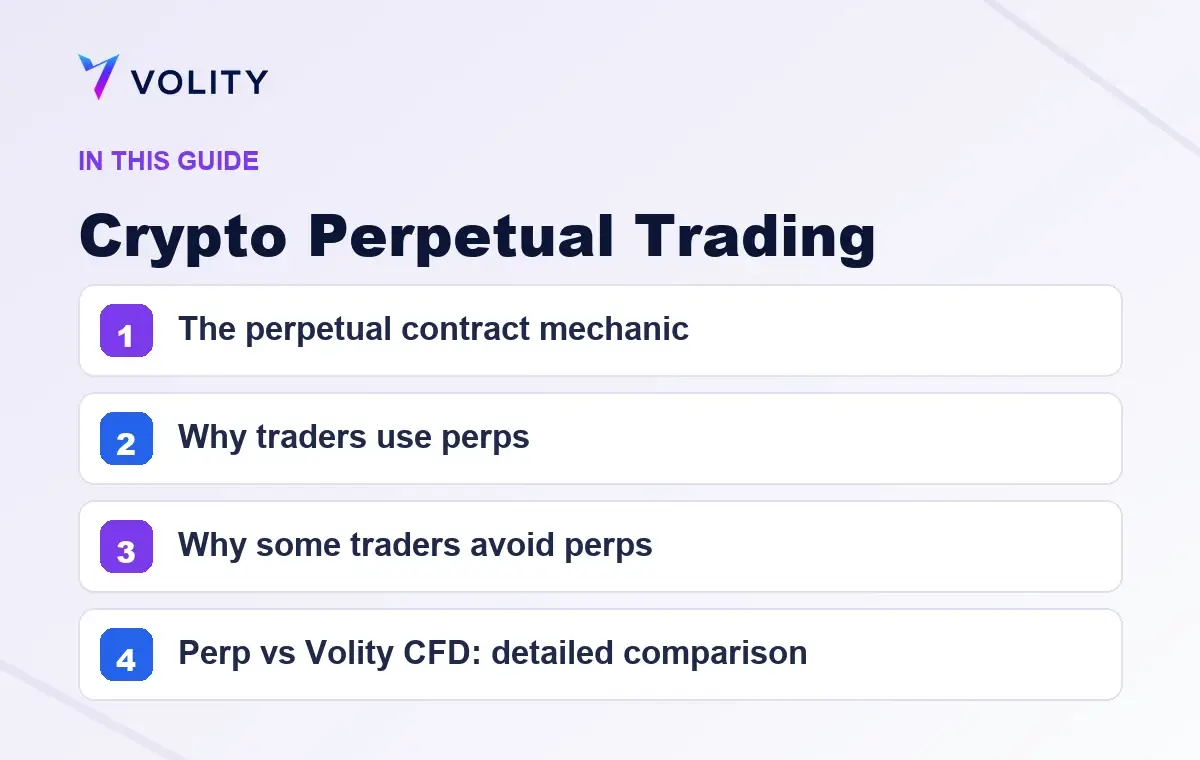
The perpetual contract mechanic
A perpetual contract (perp) is a leveraged crypto position that:
- Tracks the spot price of the underlying coin
- Has no fixed expiry date
- Uses a funding rate to keep the perp price anchored to spot
- Can be held indefinitely subject to margin maintenance
The funding rate is the central mechanic. Every 8 hours (or every hour on some venues), longs pay shorts (if the perp trades above spot) or shorts pay longs (if the perp trades below spot). The size of the payment is small but compounds, a +0.05% rate every 8 hours is +0.15% per day, +1% per week.
This funding mechanism creates a self-correcting price discovery: when perps trade rich (above spot), longs pay shorts, which discourages new longs and attracts new shorts, pushing perp price back toward spot. The same in reverse when perps trade discount.
Why traders use perps
Three reasons:
1. High leverage with no expiry. 1:50 to 1:125 on major venues. Holding indefinitely without expiry roll. Suits high-conviction directional bets and trend-following strategies.
2. Funding-rate trading itself. When funding rates skew extreme (above 0.1% per 8 hours, or below -0.1%), the rate becomes a tradable signal. Some strategies trade the rate alongside or instead of price.
3. Cross-margin efficiency. Most perp venues allow cross-margin (using positions and balances across multiple perps to share margin). This is capital-efficient for active multi-pair traders.
Why some traders avoid perps
1. Offshore venue concentration. Most perp liquidity sits on offshore exchanges (Binance, Bybit, OKX, BitMEX). Regulatory oversight varies; counterparty risk varies more.
2. Liquidation cascades. Highly leveraged longs liquidating during a sharp move accelerate the move. The 19 May 2021 cascade liquidated over $8 billion across major perp venues in a single day. Volatility events are amplified by the leverage stack.
3. Funding-rate unpredictability. A trade that looked profitable on price action can drain via funding if the rate flips strongly against your position.
4. Tax complexity. Perp P&L on offshore venues can be hard to import into tax software. Annual reconciliation is harder than on regulated brokers.
Perp vs Volity CFD: detailed comparison
| Feature | Offshore Perp | Volity CFD |
|---|---|---|
| Expiry | None | None |
| Carry cost mechanic | Funding rate every 8 hours | Swap fee at 22:00 GMT |
| Leverage | 1:50 to 1:125+ | Up to 1:50 |
| Custody | Exchange-held | Volity segregated |
| Regulation | Mostly offshore | CySEC 186/12 (Volity) |
| Liquidation | Exchange auto-liquidation | Volity threshold + NBP |
| Maximum loss | Deposit (most venues) | Deposit (NBP enforced) |
| Cross-margin | Common | Per-product (margin pool shared at account level) |
| Available globally | Restricted in many regulated jurisdictions | Available in Volity’s regulatory footprint (not US) |
| Tax statements | Variable, often manual | Volity provides annual P&L |
For retail traders who can access perps and prefer the funding-rate mechanic + higher leverage, perps may suit. For retail traders prioritising regulatory protection, segregated funds, and tax reporting, Volity CFDs are the practical equivalent.
Funding rates in numbers
Example: 1:20 long BTC perp position, $10,000 notional, funding rate +0.05% per 8 hours.
- Funding payment per 8 hours: $10,000 × 0.05% = $5
- Daily funding cost (3 cycles): $15
- Weekly funding cost: $105
- Annual funding cost at constant rate: ~$5,475
If the rate spikes to +0.1% per 8 hours during a hot market, the daily cost doubles to $30. If you are wrong about direction and the rate also goes against you, the position bleeds twice.
The same example on Volity CFD: $10,000 BTC long, 1:20 leverage, hold 7 days, swap rate (indicative) -0.01% per day on margin = $1 per day = $7 for the week. Plus spreads on entry/exit.
The trade-off: Volity CFDs cost less in carry on most days, perps have more leverage headroom.
Liquidation: how perps blow up accounts
Liquidation engines on perp venues are designed to close positions before equity goes negative (which would create an exchange loss). The exact mechanism:
- Maintenance margin level set per product (often 0.4-1% of notional)
- As price moves against the position, equity falls
- When equity reaches maintenance margin level, liquidation triggers
- The engine sells (longs) or buys (shorts) to flatten the position
- Liquidation fee (often 0.5-2% of notional) is deducted
In a fast-moving market, liquidation orders cascade: many positions hit liquidation at similar prices, the engine creates large market orders, prices gap further, more positions hit liquidation, and so on. Historical events: March 2020, May 2021, November 2022, March 2023.
Volity’s CFD model uses a similar mechanic but with negative balance protection: regardless of how fast price moves, your loss is capped at deposit. The 0.5-2% liquidation fee common on perps is not part of the Volity CFD model.
Risk management for perpetual-style trading
Whether on offshore perps or on Volity CFDs:
- Position size matters more than leverage. Risking 1% of account per trade with 1:20 leverage on a small position is safer than risking 5% with 1:5 leverage on a large position
- Stop-loss orders cap downside before liquidation triggers. Set them
- Funding rate awareness. Check funding skew before opening; avoid holding through high-funding windows on the wrong side
- Volatility regime. High-volatility periods require lower leverage. Adjust dynamically
- Cross-margin caution. Sharing margin across multiple positions concentrates risk; a sharp move in one can liquidate all
Funding an on-chain perpetual venue works the same way, with USDC as the collateral and the margin engine holding it rather than a broker. Our walkthrough covers how to fund a Hyperliquid account from your Volity wallet and how to read available balance against account value once a position is open.
Frequently asked questions
Perpetuals have to run somewhere, and the venue design decides what you can check for yourself. On an on-chain order book every order, cancel and liquidation is a consensus transaction rather than a line in a private database. Our explainer on what Hyperliquid is walks through that architecture.
Sources
Related crypto guides on Volity
More crypto-trading depth on Volity:
- Wash Trading Crypto: What It Is and How to Spot It
- Crypto Trading Liquidity and Volume: How They Affect Your Fills
- Crypto Options Trading Explained: Calls, Puts and Derivatives
- Crypto Futures Trading: How CFDs Compare on Volity
- Short-Term Crypto Trading: 1 Hour to 30 Day Strategies
- Is Crypto Trading Legal? A Country-by-Country Snapshot
- Is Crypto Trading Profitable? An Honest Look at the Data
- Crypto Trading Fees on Volity: Spreads, Commissions and Zero Wallet
- Crypto Trading Bot: The Three Styles and How They Work
Frequently asked questions
What is crypto perpetual trading?
Crypto perpetual contracts (perps) are leveraged crypto positions without expiry. They stay anchored to spot via a funding rate paid every 8 hours between longs and shorts. Most perps trade on offshore exchanges with high leverage. Volity does not offer perps directly but provides CFDs with similar directional exposure under CySEC regulation.
Does Volity offer crypto perpetual contracts?
No. Volity offers crypto CFDs which are open-ended like perpetuals but use a daily swap fee instead of an 8-hour funding rate. CFDs deliver similar directional exposure with simpler carry mechanics and CySEC-regulated execution.
What is a funding rate on a crypto perpetual?
The funding rate is a small payment between longs and shorts every 8 hours that keeps the perp price anchored to spot. Longs pay shorts when perp trades above spot; shorts pay longs when perp trades below. Typical rates: 0.01-0.05% per 8 hours, occasionally spiking to 0.1%+ in fast markets.
How does crypto perpetual liquidation work?
When equity falls to the maintenance margin level (often 0.4-1% of notional), the exchange’s liquidation engine automatically closes the position. In fast markets, liquidations cascade as orders gap through orderbooks. Liquidation fees of 0.5-2% of notional are typical. Volity CFDs use a similar threshold but with negative balance protection.
What is the difference between crypto perpetual and crypto CFD?
Perpetuals use 8-hour funding rates and trade on offshore venues with 1:50 to 1:125+ leverage. Crypto CFDs on Volity use daily swap fees and trade under CySEC regulation with up to 1:50 leverage. Both have no expiry. Perps offer higher leverage; CFDs offer regulatory protection and segregated funds.
Are crypto perpetuals legal?
Trading perpetuals on offshore exchanges is legally complex. Many regulated jurisdictions restrict or prohibit retail access to perpetual products from offshore venues. Where Volity operates, the CFD model provides regulated directional exposure under MiCA/MiFID II frameworks.
Is crypto perpetual trading profitable?
For disciplined traders with edge, possibly. The funding rate adds a continuous cost or benefit that affects P&L mechanics. Most retail perp accounts lose money due to over-leverage and liquidation cascades during volatility events. Risk management discipline matters more on perps than on CFDs because perp leverage is higher.