Crypto Market Opens June Under Pressure as Banks Keep Building
June has opened with crypto looking tired on the screen and busy behind the curtain.
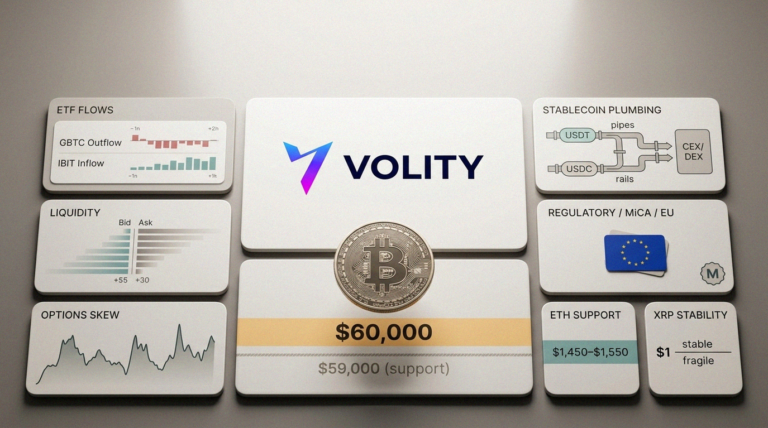
Bitcoin is slipping back towards the $60,000 support zone, while several large tokens trade with the same heavy feel. Ethereum looks fragile. BNB, XRP, Cardano and Dogecoin are also under pressure, as traders cut risk rather than argue with the tape.
However, the weakness in prices does not tell the whole story. Banks, exchanges and lawmakers are still moving deeper into digital assets. Tokenised bonds, stablecoins, deposit networks and new exchange products are advancing even as spot traders nurse losses.
That split matters. Crypto often sells off when speculative energy fades. Yet this time, the plumbing around the market keeps expanding. For investors, the question is now sharper. Is this a routine shake-out, or a market losing its audience?
Bitcoin Tests the Market’s Patience
Bitcoin’s fall towards $60,000 has become the market’s main stress test. A clean break could pull systematic sellers into the move. It could also force leveraged traders to unwind positions quickly.
Meanwhile, the mood has darkened beyond price charts. Network activity has weakened, with one measure falling to its lowest level in seven years. Options positioning is also adding pressure, as a large expiry hangs over an already nervous market.
Still, the bull case has not disappeared. Standard Chartered has stuck with its $100,000 Bitcoin forecast, arguing that the broader adoption story remains intact. Therefore, the market is split between bruised short-term traders and patient long-term holders.
That tension often defines important trading weeks. If buyers defend $60,000, Bitcoin could steady the wider market. If they do not, the next move may feel less like a dip and more like a proper reset.
Ethereum and Altcoins Show the Fracture
Ethereum is also stuck in a delicate setup. Traders are watching the $1,500 area, which has become a rough line between repair and deeper damage. A sustained move below it would likely weigh on decentralised finance tokens and layer-2 names.
XRP is facing a different problem. The price is soft, but the bigger debate is about demand. Banks may use the XRP Ledger without necessarily buying XRP itself. That distinction keeps dividing investors who blur network use with token value.
Cardano offers another awkward example. The token has lost nearly 40% in a month, even as active addresses reached a four-month high. Activity helps, but it does not automatically create bids.
Dogecoin is following the same risk-off pattern. After a sharp monthly decline, it is sliding towards a key danger zone. In this tape, humour and community are not enough. Liquidity decides.
Policy Becomes the Main Battleground
Beyond the charts, Washington is becoming the market’s most important venue. The CLARITY Act now sits at the centre of the industry’s regulatory fight. JPMorgan has warned that the legislative window may be closing quickly.
Ripple chief Brad Garlinghouse and JPMorgan’s Jamie Dimon have become useful symbols of the broader clash. One side wants clear rules that let crypto firms operate at scale. The other worries about risk, supervision and the shape of money itself.
However, the fight is not only about banks versus token issuers. Hester Peirce has raised hard questions about liability for DeFi developers. Those questions matter because open-source finance does not fit neatly inside old legal boxes.
Meanwhile, prediction markets are also being dragged into the debate. One lawmaker wants to ban legislators from using them. That proposal adds another layer to the larger argument over gambling, information markets and political conflicts.
For traders, regulation can feel slow until it suddenly reprices everything. A single clause may decide whether an exchange product scales, stalls or leaves the United States.
Banks Push Tokenisation While Traders Sell
While spot markets wobble, banks are still building. JPMorgan and HSBC have joined a Hong Kong working group focused on tokenised bonds. Separately, JPMorgan and rivals are backing a tokenised deposit network aimed at a 2027 launch.
That is not retail speculation. It is infrastructure work. Banks want faster settlement, programmable cash and cleaner collateral movement. Therefore, tokenisation is moving from conference slides into balance-sheet planning.
Stablecoins are moving in the same direction. Bybit has added support for Western Union’s USDPT stablecoin. Ripple is also expanding RLUSD access across 40 chains through Wormhole.
Meanwhile, the OCC’s stance on bank and stablecoin partnerships appears to be encouraging more serious experiments. Payments firms and lenders now see stablecoins less as a crypto trade and more as settlement rails.
This is the uncomfortable part for bears. Prices can fall while adoption work continues. In fact, weaker markets often give large institutions room to build without competing with retail mania.
New Products Blur the Old Borders
Real-world asset projects are gaining momentum as well. Ether.fi has committed $100 million to Plume, betting that demand for tokenised assets will keep growing. The theme now reaches beyond Treasury bills and into broader financial packaging.
ETFs are also widening the menu. 7RCC has launched a Bitcoin and carbon-credit ETF on NYSE Arca. That product combines two markets with very different investor bases, yet both depend heavily on rules and credibility.
Exchanges are pushing further too. Bitget is allowing tokenised Apple, Tesla and Nvidia stocks to be used as futures collateral. That move shows how quickly crypto venues are trying to absorb traditional market exposure.
Meanwhile, Binance Research has floated the idea of a $2 trillion equity wave from crypto exchanges. The number is ambitious. Still, the direction is clear. Exchanges want to become broad financial supermarkets, not just coin bazaars.
Risk Remains Easy to Find
The market is not short of warnings. ZachXBT has urged traders to avoid Rain Protocol, citing concerns around its $8.8 billion valuation. In a weaker tape, valuation anxiety can spread quickly.
Polymarket users in South Korea are also facing a gambling investigation. That case highlights how prediction markets remain legally exposed, even when user demand is obvious.
Zcash offers another reminder. Even after a bug fix, the token still fell sharply. Confidence can drain faster than developers can publish explanations, especially when supply fears appear.
Yet speculation has not vanished. Traders are still circling Hyperliquid, Pi Network and presale projects, hunting for asymmetric pay-offs. However, those corners now carry more danger. In thin markets, one whale can become the weather.
By the Numbers
- $60,000 – Bitcoin’s key support zone as June trading begins.
- $100,000 – Standard Chartered’s reiterated Bitcoin target.
- $1,500 – Ethereum’s watched downside area.
- 40% – Cardano’s approximate one-month decline.
- 2027 – Target launch year for a tokenised deposit network backed by major banks.
Related coverage on Volity
- Stocks to Watch: AVGO, CIEN, MARA as Clean Catalysts Win
- Bitcoin Price Dips as ETF Outflows Hit Crypto Markets
- CrowdStrike (CRWD) Leads AI Cyber Rally as Funding Risk Bites
- Bitcoin Price Eyes $73k as Regulation, Stablecoins Bite
- AI Stocks to Watch: NVDA, TSM, CRWV and MRVL in Focus
Key Takeaways
- Bitcoin needs to hold $60,000 to calm the broader market.
- Ethereum weakness could pressure DeFi and layer-2 tokens next.
- CLARITY Act headlines may move U.S.-listed crypto stocks and exchanges.
- Stablecoin and tokenisation news remains bullish for infrastructure firms.
- Speculative tokens carry higher gap risk while liquidity stays thin.