You have heard that an ETF and an index fund both “track the market”, and now you cannot decide which to buy. The short truth: they often hold the exact same basket of stocks. The real difference is the wrapper – how you buy it, when it prices, and how small you can start. Pick the wrapper that matches your account size and how hands-on you are, and you can place your first passive buy today.
TL;DR / Quick insight: An ETF and an index fund can track the same index, so the holdings are often identical. An ETF trades on an exchange like a single share, all day at a live price, and you can buy a whole share or a fraction of one. An index fund is bought from the provider and priced once a day after the market closes. Small account, want to start now at a live price – an ETF is the lower-friction first buy. Want hands-off automatic monthly saving – an index fund suits that rhythm. Neither is “better”; they do different jobs.
This is a decision query, not a vocabulary lesson. One quick definition: an index is just a published list of companies, a basket built to a recipe; a passive fund copies that basket instead of guessing winners. Both ETFs and index funds do this – the wrapper is where they differ.
The one-line difference, and why it is the only thing you must get right
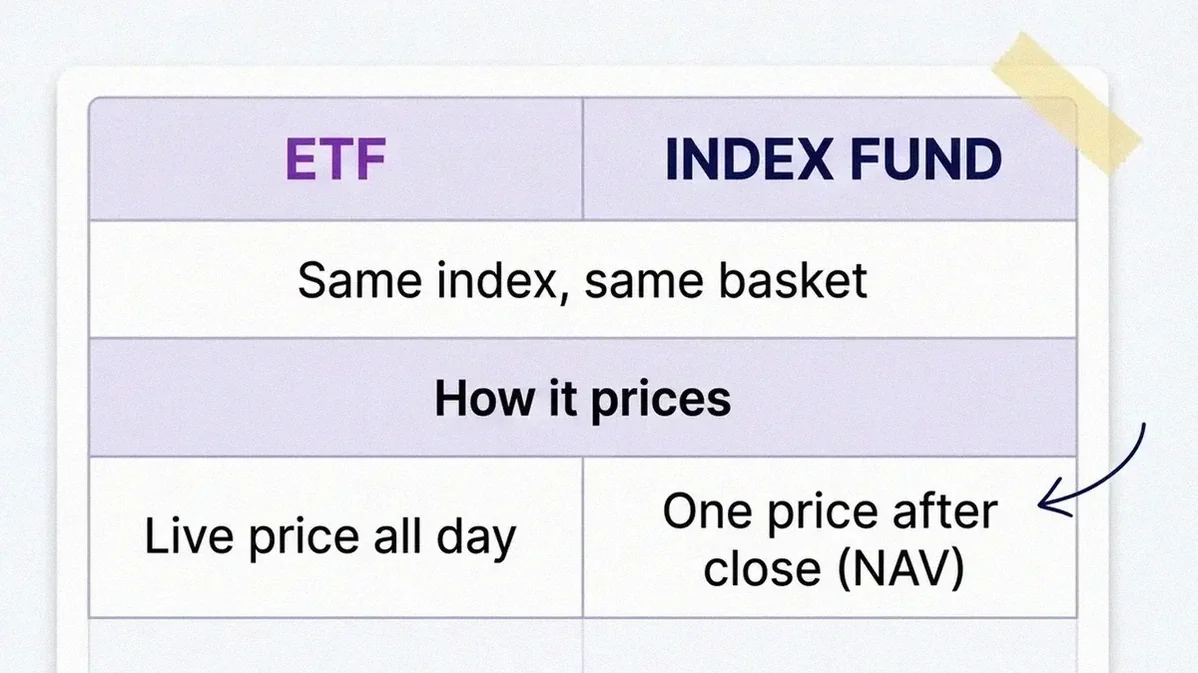
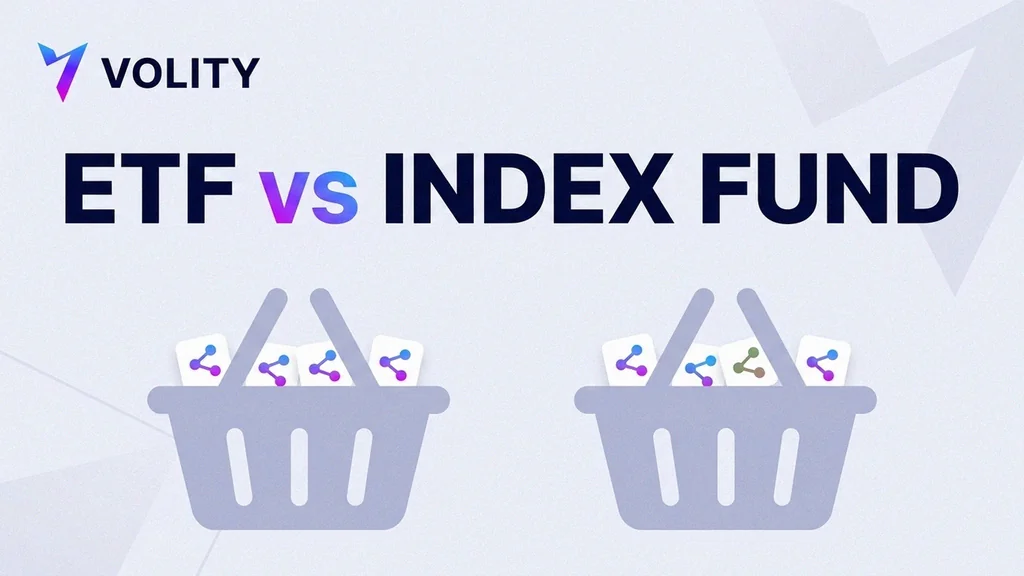
Same index, same basket of stocks – two different wrappers. An ETF (exchange-traded fund) trades on a stock exchange like a single share: buy or sell any moment the market is open, with the price moving in real time. An index fund here means an index-tracking mutual fund – bought directly from the provider, which sets one price per day after the close. That closing price is the NAV (net asset value), the fund’s total worth divided by the number of units.
That live-all-day versus once-a-day mechanic drives almost every other difference: minimums, dealing costs, automatic investing, and tax behaviour.
Do this now: write one sentence – live price during the day (ETF), or set and forget once a day (index fund)?
How an ETF trades, and why that matters to you
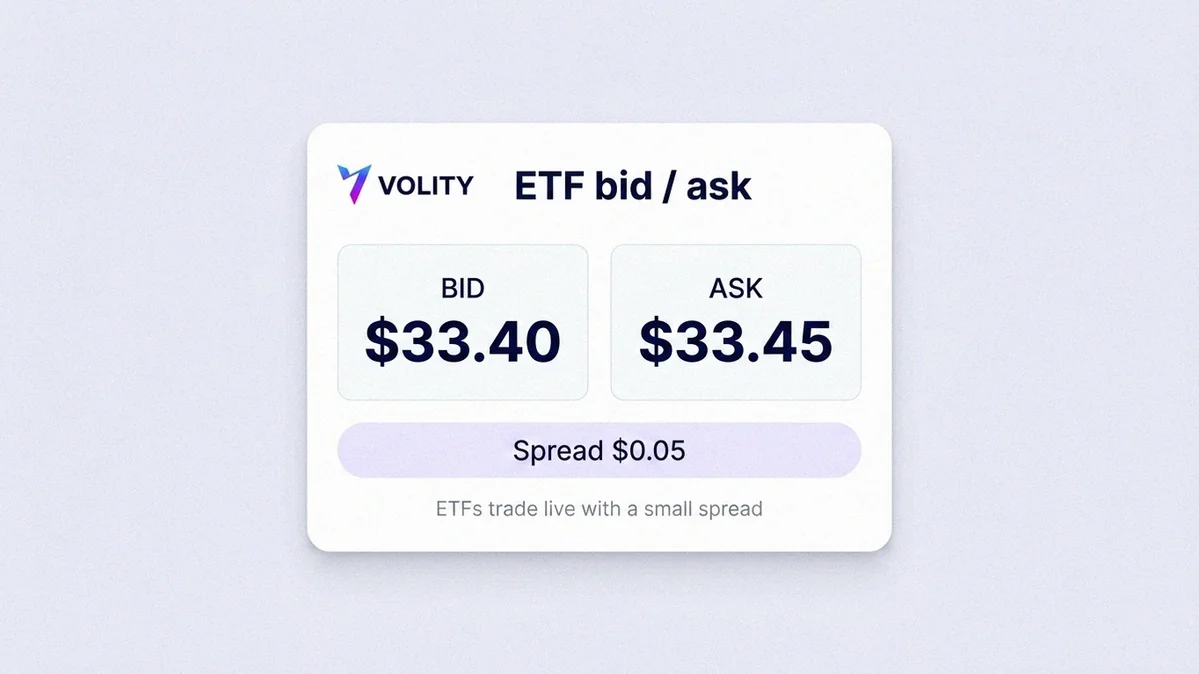
An ETF lists on an exchange and behaves like one share of a company. You search for it and buy at the current market price, the same way you buy a stock. Because it is priced live, you see exactly what you pay when you click, and you can sell any time the market is open.
The detail that matters most for a beginner: you do not need a big sum. With fractional shares you can buy a slice of one share for a small amount – if a share costs more than you want to spend, you buy, say, a fifth of it. One honest caveat: trading an ETF you may meet a small gap called the bid-ask spread – the difference between the buy and sell price at that instant – usually tiny on a popular ETF, but it exists. The Volity tie: an ETF trades like a share, so you buy it on a commission-free Markets account just like a stock, and fractional shares let you start small.
Do this now: set your starting buy amount – with fractional shares it can be small.
How an index fund works
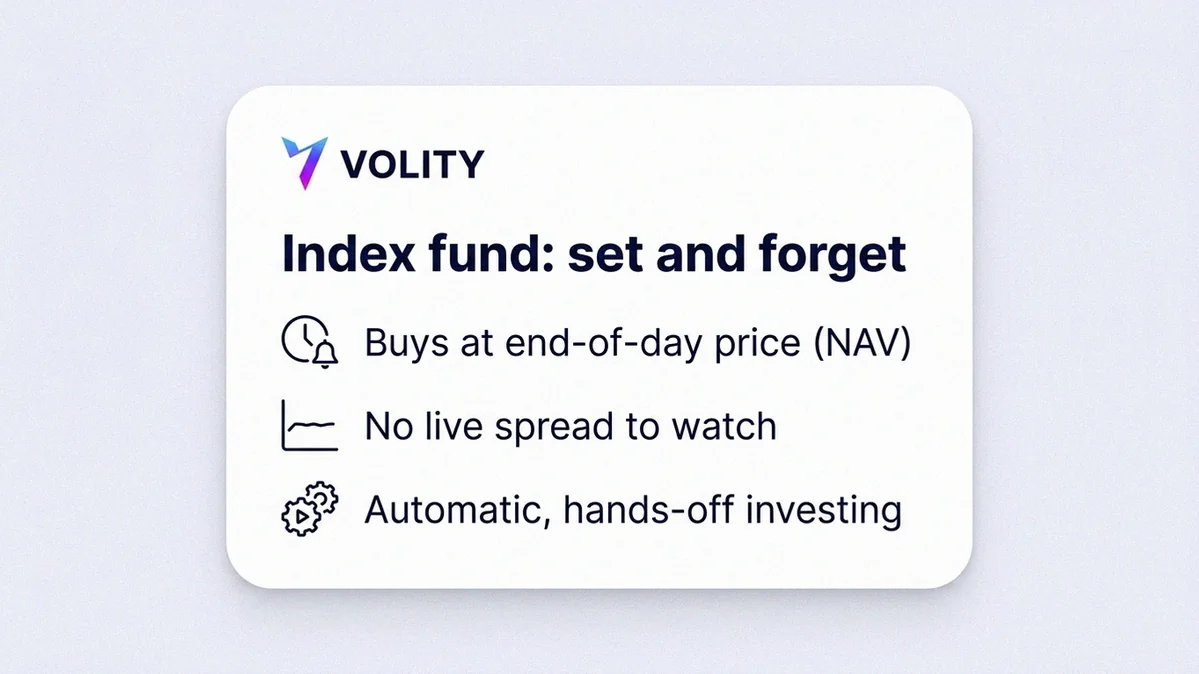
An index fund (the mutual-fund kind) is bought directly from the provider, not on an exchange. Instead of an instant live price, you get the one price set that day after the close – order in the morning and you still buy at the closing value. For a long-term, hands-off investor, that delay does not matter.
This once-a-day rhythm is the index fund’s strength for one habit: automatic regular investing, where the same amount goes in every month with no action from you. Two things to know: some index funds set a minimum initial investment (a floor to open the position, varies by fund), and buying directly usually has no per-trade dealing cost – the trade-off is giving up live pricing.
Do this now: ask whether your real priority is automatic monthly investing you never think about. If yes, an index fund’s set-and-forget style suits you.
Side by side: trading, cost, minimums, intraday, taxes
The comparison in one view. Every cell is directional – exact fees, minimums and tax depend on the fund and your country.
| Feature | ETF | Index fund |
|---|---|---|
| How you buy it | On an exchange like a share, through a trading account | Directly from the fund provider |
| When it prices | Any time the market is open, at a live price | Once per day, at the closing price (NAV) |
| Intraday trading | Yes – buy and sell during the day | No – one price set after the close |
| Minimum to start | Price of one share, or a fraction of a share | May set a minimum initial investment (varies) |
| Ongoing cost | Generally low ongoing fees | Generally low ongoing fees |
| Dealing cost | May carry a small bid-ask spread | Typically no per-trade dealing cost |
| Taxes / distributions | Generally more tax-efficient on distributions (structure-driven) | May pass through more capital-gains distributions |
| Best suited to | Starting with any amount today, live price, fractional buys | Hands-off, automatic monthly investing |
On the tax row, plainly: ETFs are generally a little more tax-efficient on distributions because of how their shares are created and redeemed behind the scenes. How any of this hits you depends on your country and account type – so check your local rules.
Do this now: run your situation down the table, tick the column that matches you on each row, and count the ticks. More ticks is your answer.
Which fits a beginner with a small account
The honest verdict depends on you, not on which product is “best”. Small account, want to start today with any amount, like seeing a live price – an ETF via fractional shares is the lower-friction first move. Prefer a hands-off automatic monthly contribution – an index fund fits that rhythm. Do not waste weeks deciding which is “smarter” when both hold the same basket: the wrapper you stick with wins.
Verdict: For most beginners starting with a small amount, an ETF is the simplest first passive buy – it trades like a share, you can buy a fraction of one, and there is no minimum to clear. If your whole plan is automatic monthly investing you never look at, an index fund’s once-a-day style is a clean fit.
On Volity the ETF route is the lowest-friction first passive buy: commission-free trading, fractional shares so you can start small, and a free demo account on every tier – a practice account funded with virtual money, so you learn the buttons without paying for the lesson.
Do this now: pick your wrapper from your tick count. If you lean ETF, open a free demo account and place a practice buy first.
Checklist: choosing and buying your first fund
Run this in order. It works for either wrapper and ends with a buy – or a demo rehearsal.
- Define the goal and time horizon – passive index investing is built for the long run.
- Decide intraday versus once-daily – live price points to an ETF; one price a day points to an index fund.
- Decide lump sum versus regular monthly – a steady automatic habit leans index fund; flexible buying leans ETF.
- Confirm you can start small – fractional shares let you begin an ETF position without the full share price.
- Check the ongoing-fee direction – both generally carry low fees, but read the fund’s own documents.
- Note the tax caveat – distributions and gains are taxed by your country and account type.
- Rehearse on a free demo so the real buy is muscle memory, not guesswork.
- Place the buy – on a commission-free Markets account, search the ETF, set your amount, and confirm.
ETFs sit in the stocks side of the platform, so the Volity stocks hub shows how buying an ETF like a share and using fractional shares works in practice; first-time investors can start at the trader education hub. One account covers shares, fractional shares, crypto, CFDs and a $0 multi-currency wallet, so you can open a Volity account when ready, or check the full fees and account types first.
Reviewed by: A. Bennett, Volity editorial desk.
Data accuracy: all Volity product and account facts are verified against the Volity site documentation and fee schedule as of June 2026. Fund-specific fees, minimums and tax outcomes are described qualitatively because they depend on the fund and your jurisdiction.
Related Volity guides
Related coverage on Volity
- Fractional Shares Explained: How to Start Investing With
- How to Start Stock Trading: A 2026 Beginner Guide
- Fundamental Analysis in Stock Trading: A Working Definition
- How to Avoid Common Stock Trading Mistakes
- Demo vs Live Trading Account: A 7-Step Checklist Before You Go Live
- Charlie Munger: mental models and investing legacy
If you would rather own an individual company than a fund, our guide on how to buy Barclays shares covers the share-dealing and CFD routes.
Frequently asked questions
Is an ETF or index fund better?
Neither is universally better – they often hold the same basket, so the choice is about the wrapper. An ETF suits starting with any amount today at a live price with fractional shares; an index fund suits hands-off automatic monthly investing. Pick by your habit.
Can you buy ETFs with little money?
Yes. You can buy a single share, and on platforms that support fractional shares you can buy a slice of one share for a small amount. On a commission-free account the cost barrier is essentially the amount you choose to invest.
Do ETFs pay dividends?
Many do. ETFs holding dividend-paying companies generally either distribute those dividends to you as cash, or automatically reinvest them inside the fund (often called accumulating). Which one a given ETF does is stated in its own documents.
What is the difference between an ETF and an index fund for beginners?
How and when you buy. An ETF trades like a share all day at a live price and can be bought as a fraction of one, ideal for starting small today. An index fund is bought from the provider at one daily price and is built for steady automatic monthly contributions.
Can I practise before buying with real money?
Yes, and you should. A free demo account is a practice account funded with virtual money that behaves like the live market, available on every Volity tier. Use it to rehearse the buy so your first real purchase is routine.
Sources
This guide draws on the following public sources.
- Bank of England – Why inflation erodes the real value of returns
- Bank of England – How interest rates and inflation interact
- Bank of England – The 2% inflation target and why it matters to savers
- ESMA – MiFID II rules on costs, charges and disclosure
- London Stock Exchange – Index families listed on the London Stock Exchange
- BIS – BIS Quarterly Review on the growth of passive investing
- European Central Bank – ECB Economic Bulletin on markets and household investment
- ESMA – ESMA investor corner on funds, ETFs and costs
- London Stock Exchange – London Stock Exchange listing and market structure