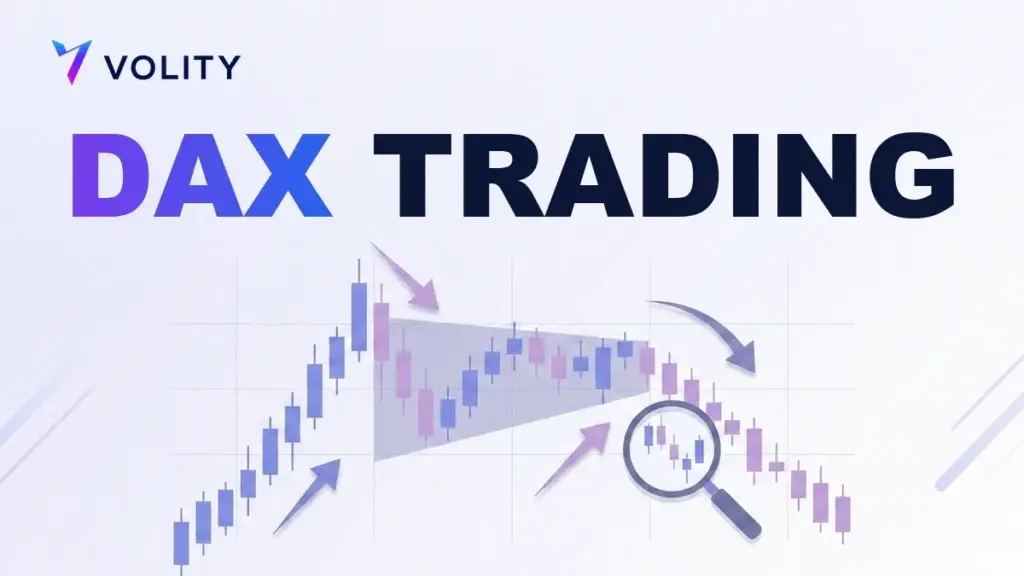
DAX trading means taking a position on the DAX, the index of the 40 largest companies on the Frankfurt Stock Exchange. On Volity you trade it as a CFD, listed as GER40 or Germany 40, going long or short from a single position on Volity MT with leverage of up to 1:500 depending on the instrument and no shares to own. This guide stays on the practical side: why the index suits active traders, the strategies people run on it, how to time the German session, and how to keep risk in check.
Why do traders like trading the DAX?
The DAX earns its place on a lot of watchlists for a simple reason: it moves. On an average day the index travels a wide intraday range, which gives short-term traders something to work with, and it stays deeply liquid through the main session so spreads hold tight when you need to get in or out. Its trading window is long, running from the early European morning through to the close of business in New York, so there is active price action for most of the working day.
That combination is why the DAX ranks among the most heavily traded index CFDs anywhere. It hands you one clean instrument for the German and wider European market instead of a basket of individual shares, and it reacts fast to the news that counts. For a trader who wants movement and depth in the same product, it is hard to beat. If you are still getting to grips with index products in general, our guide to how to trade indices covers the groundwork first.
What is the DAX, in brief?
The DAX tracks the 40 largest and most liquid companies on the Frankfurt Stock Exchange, compiled by Deutsche Börse and its index arm. It is Germany’s headline stock benchmark, much as the Dow Jones index is the headline gauge for the United States, and it leans heavily on big exporters in software, industry, cars, chemicals and insurance. That export tilt is the most useful thing to know about how it behaves, because it ties the index to global demand, the euro and trade with China. On Volity and most other platforms the same market shows up as GER40 or Germany 40. Our companion explainers on the Germany 40 index and its GER40 and DE40 tickers break down the full membership and history, so this guide can stay on how to trade it.
One quirk sets the DAX apart from indices like the FTSE 100 or the S&P 500 price index. The headline DAX is a performance index, which means it assumes dividends are reinvested back into the level. Most other headline indices are price-return and track share prices alone. Over the long run that makes the DAX look higher than a price-only version of the same companies, so if you study dax index historical data or line the DAX up against a price-return peer, remember you are not comparing like with like. It also explains why the DAX number can look large next to its European neighbours. Older charts add one more wrinkle: until September 2021 the index held 30 companies and traded as the DAX 30, before Deutsche Börse expanded it to 40 members, so pre-2021 history reflects the smaller version of the same benchmark.
How does DAX CFD trading work?
Trading the DAX as a CFD means agreeing to exchange the difference in the index price between the moment you open a position and the moment you close it. You trade the movement, not the shares. A contract for difference is not a holding in the 40 companies, nor an exchange traded fund, nor DAX futures with a fixed size and an expiry to roll.
- You can go long or short, so a falling DAX is as tradable as a rising one, and shorting needs no stock borrowing.
- You post margin rather than the full contract value. Volity offers leverage of up to 1:500 depending on the instrument, which magnifies losses as much as gains and asks for careful sizing.
- You own nothing directly, so there are no shares and no direct dividends, though a dividend adjustment applies when constituents pay out.
Volity lists the DAX alongside other global index CFDs, forex, commodities and crypto in one account, so you can trade index CFDs on Volity with CySEC-regulated execution under UBK Markets (licence 186/12).
What moves the DAX?
Rather than chase a single dax news today headline, experienced DAX traders watch the handful of drivers that reliably move the index.
- European Central Bank policy. Rate decisions and the outlook for eurozone rates push the DAX and the euro around together.
- The euro itself. A weaker euro tends to help the DAX’s exporters, while a stronger euro can weigh on them.
- German and eurozone data, especially the Ifo and ZEW sentiment surveys and the monthly PMI readings, which shape the growth outlook.
- Global demand and China, since cars and industrials tie the index to worldwide manufacturing.
- Energy prices, because chemicals and heavy industry make the DAX sensitive to gas and power costs.
Because so many of these drivers sit outside Germany, the DAX often takes its lead from abroad. A move in United States technology stocks, a shift in Chinese demand for German exports, or a swing in the euro can matter more on a given day than any domestic headline. Many DAX traders keep an eye on European Central Bank meeting dates and major United States data releases, and they watch US index futures through the European afternoon, since the two markets tend to move together once New York opens.
What are the main DAX trading strategies?
No single method owns the DAX, and most active traders lean on a few that suit its character. The four below cover the ground that comes up most often on the German index.
Ride the trend
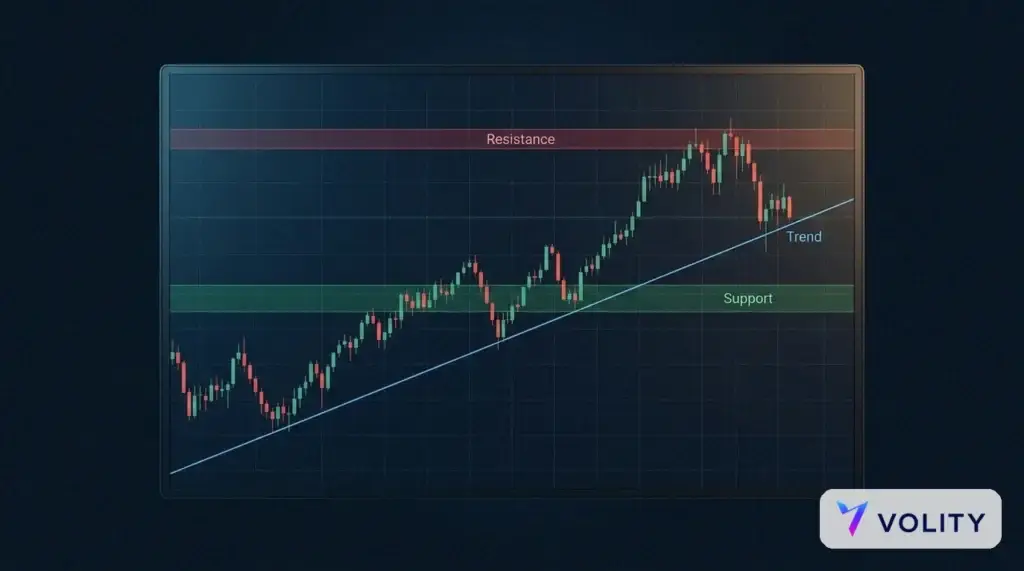
Trend trading works well on the DAX because strong phases can run for weeks. Mark the direction on a higher timeframe, wait for a pullback toward a rising trendline or a moving average, then enter with the move and place a stop beyond the last swing. The export tilt helps here. When global manufacturing is clearly improving or clearly rolling over, the DAX tends to trend cleanly rather than chop.
Trade the breakout
The DAX often coils in a range ahead of a data release or an ECB meeting, then breaks out hard. A breakout trader marks the range high and low, waits for a decisive close beyond one edge on rising volume, and joins the move with a stop back inside the range. The Frankfurt open and the New York open are the two moments when these breaks most often fire, because that is when fresh volume arrives.
Play the opening gap
The DAX cash market closes at 17:30 and reopens at 09:00 the next morning, and overnight moves in the United States and Asia often leave a gap between the prior close and the new open. Some traders fade the gap, betting it fills back toward the previous close, while others trade in its direction when strong news backs it. The first hour after the Frankfurt open is where this plays out, so know the prior day’s close and the overnight lead before the bell.
Time the session
Timing matters as much as direction on the DAX. The liveliest windows are the first hour or two after the 09:00 Frankfurt open, when European volume floods in, and the mid-afternoon overlap once New York opens and US data lands. The quiet stretch around the middle of the European day tends to drift, so many intraday traders concentrate their risk around those two busy windows and stand aside when the tape goes flat.
How do you manage risk when trading the DAX?
The same volatility that makes the DAX attractive is what can hurt an oversized position, so risk control is not optional on this index. A few habits do most of the work.
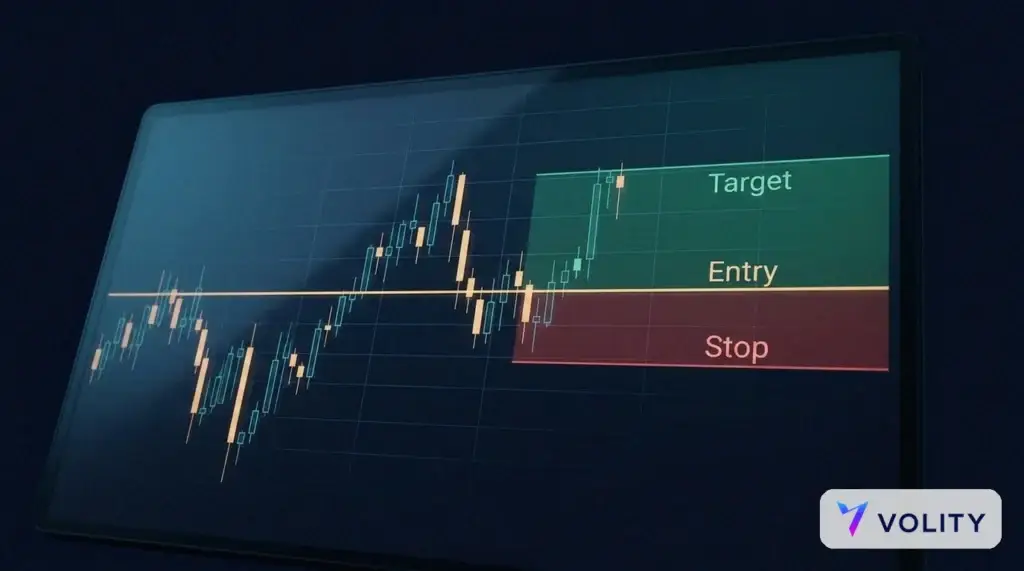
- Size from your stop, not your hope. Decide where the trade is wrong, measure the distance to that level, and set your position so a stop-out costs only a small share of your account, commonly one to two percent.
- Give the DAX room. It swings widely, so a stop placed too tight gets caught by ordinary noise. Many traders scale their stop to recent volatility using a measure like average true range.
- Respect the leverage. Up to 1:500 is available depending on the instrument, but using all of it turns a normal pullback into a margin call, so most steady traders use only a fraction of what is on offer.
- Count the holding cost. Positions carried past the daily rollover pay overnight financing, so a swing trade held for days needs a move big enough to cover that drag.
- Practise first. A free demo lets you test a strategy on the live German DAX chart with nothing at stake before you risk real capital.
One point is worth being clear about. On Volity you trade your own capital with leverage, not a funded or prop account, so every decision and every pound of risk stays in your hands. That is exactly why sizing discipline matters. Leverage is also why supervisors such as ESMA and the FCA expect clear risk disclosure on these products. Leveraged trading carries risk, so trade only with funds you can afford to lose.
When can you trade the DAX, and what does it cost?
The DAX constituents trade on Xetra, Frankfurt’s electronic platform, from 09:00 to 17:30 Central European Time, and that cash session is when the index is most liquid. The DAX CFD tracks the index across the trading week and commonly quotes for extended hours around the cash session, often from the early European morning into the evening, so you can trade reactions to United States moves and overnight news.
Your costs are the spread in index points, an overnight financing charge on positions held past the daily rollover, and a dividend adjustment when constituents pay out. Funding in a currency other than the quote currency involves a 1% conversion. Full pricing sits on the charges and fees page.
How to place your first DAX trade on Volity
- Open a Volity account and complete the quick KYC checks, or start on a free demo to practise first.
- Fund your wallet by card, SEPA or crypto. Opening an account is free and you can start trading from $1.
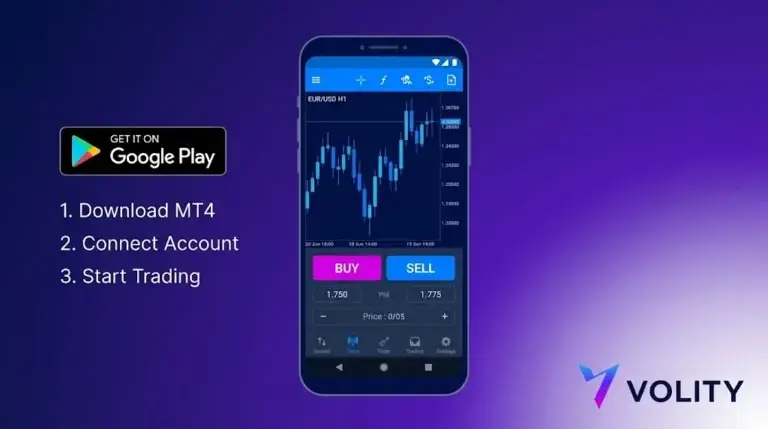
- Open the DAX instrument, listed as GER40, in Volity MT and study the live German DAX chart with the built-in TradingView charting.
- Pick a direction and a strategy from your own analysis, set your position size from the margin shown on the order ticket, and attach a stop-loss and a take-profit.
- Place the order, manage the position, and record the result so you can review what worked.
What are the DAX 50 and DAX 100 indices?
Searches for a dax 50 index or a dax 100 index usually mix up several German benchmarks. The headline index you actually trade is the DAX 40. The DAX 50 ESG is a separate, sustainability-screened index of 50 German companies. The historical DAX 100 combined the DAX with mid-cap names and was discontinued in 2003, succeeded by the HDAX, which now covers around 110 companies. For a trader, the DAX 40, listed as GER40 or Germany 40, is the one that matters.
Frequently asked questions
What is DAX trading?
DAX trading is taking a position on the DAX, the index of the 40 largest companies on the Frankfurt Stock Exchange. On Volity you trade it as a CFD, listed as GER40 or Germany 40, going long or short with leverage rather than buying the 40 shares one by one.
What is a good strategy for trading the DAX?
There is no single best strategy, but the DAX suits trend following in strong markets, breakout trading around ranges and news, and gap trading at the Frankfurt open. Whichever you use, size each position from your stop distance and risk only a small share of your account, because the index moves quickly.
When is the best time to trade the DAX?
The most active windows are the first hour or two after the 09:00 Frankfurt open and the mid-afternoon overlap once New York opens. Volume and volatility are highest then, while the middle of the European day is usually quieter.
Can a beginner trade the DAX?
Yes, and starting on a free demo is the sensible way to learn. Because the DAX CFD is leveraged it magnifies both gains and losses, so size positions from your stop distance, risk only a small share of your account per trade, and use money you can afford to lose.
Where can I see the live DAX chart?
The live German DAX chart is inside Volity MT, which includes TradingView charting. You can read the current price, draw support and resistance, and add indicators to build your own analysis before you trade.