There are two ways to buy Alibaba stock: own real shares through a share-dealing account with a stockbroker, or take price exposure to the stock through a contract for difference. Alibaba trades as the ADR ticker BABA on the New York Stock Exchange and as ordinary shares under the code 9988 on the Hong Kong Stock Exchange. On Volity you trade Alibaba as a share CFD, so you follow the price without owning the underlying shares.
- Alibaba Group is listed as the ADR ticker BABA in New York and as ordinary shares under the code 9988 in Hong Kong.
- To own the shares outright, you open a share-dealing account with a regulated stockbroker that can reach one of those markets.
- To trade the price without owning shares, you use a CFD, which lets you go long or short and apply leverage.
- Chinese ADRs tend to be more volatile than developed-market blue chips and carry their own regulatory considerations, so risk controls matter.
- On Volity you can trade Alibaba as a share CFD from the same account you use for forex, indices and crypto.
How can you buy Alibaba stock?
You have two routes. The first is direct ownership: you open a share-dealing account with a stockbroker, deposit funds, and buy Alibaba shares like any listed company, becoming a part-owner who can receive dividends. This is what most people mean when they ask how to buy Alibaba shares. The second is price exposure through a CFD, where you do not own the shares but open a position that tracks Alibaba’s price, going long or short with leverage. Volity offers Alibaba the second way, and the rest of this guide covers both in turn.
Where is Alibaba listed, and what is an ADR?
Alibaba Group Holding is a Chinese technology company known for Taobao, Tmall, AliExpress and Alibaba Cloud, as summarised on its company profile. Its shares trade in two places. In New York it trades as an American Depositary Receipt under the ticker BABA, first listed on the New York Stock Exchange on 19 September 2014 in what was then the largest listing ever on a US exchange. In Hong Kong it trades as ordinary shares under the code 9988 on the Hong Kong Stock Exchange, where it listed in November 2019 and converted to a full primary listing on 28 August 2024, per the company’s own announcement.
An ADR is a certificate issued by a depositary bank that represents shares in a foreign company, letting that company trade on a US exchange in dollars. In Alibaba’s case, one BABA American Depositary Share represents eight ordinary shares, and the New York ADSs and the Hong Kong shares are fully fungible, meaning one can be converted into the other, according to Alibaba’s investor information. Because it holds a dual primary listing, Alibaba sits in both markets at once.
One structural detail is worth knowing before you buy. Like many Chinese technology companies listed abroad, Alibaba uses a variable interest entity structure. Shareholders own stock in an offshore holding company that has contractual rights over the mainland Chinese operating business, rather than owning that business directly. This is standard across the sector, and it is one reason Chinese ADRs are treated as higher risk than a typical Western large company.
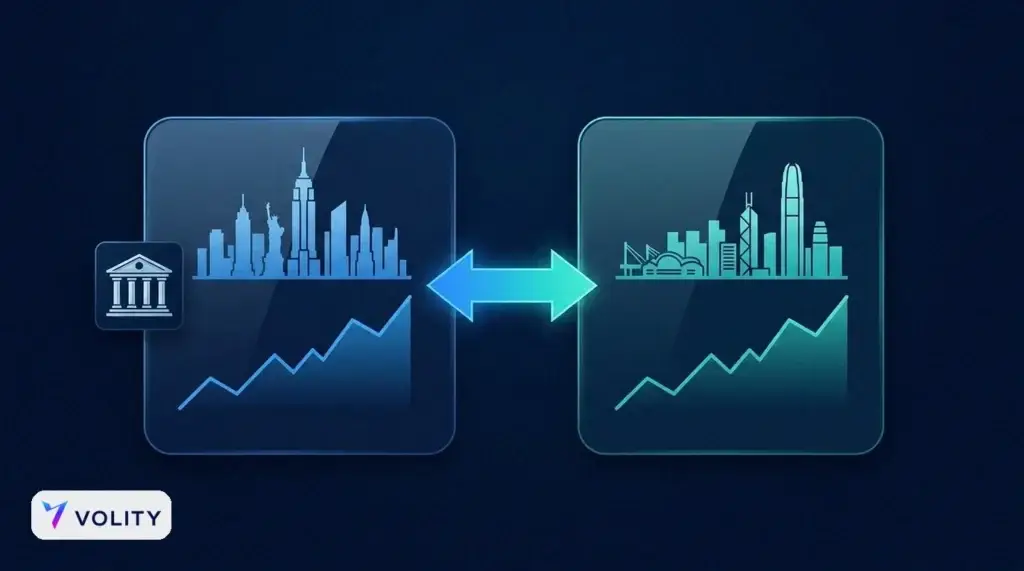
If you want to own the shares, the process is the same wherever you live. Choose a regulated stockbroker whose platform can reach either the New York or the Hong Kong market, complete the account opening and identity checks, and deposit funds in the account currency. You then search for BABA if you want the New York ADR or 9988 if you want the Hong Kong line, enter the number of shares, and place a buy order. Our guide to stock investing for beginners walks through order types and account setup in more detail.
Owning the shares means you are entitled to any dividends and, in principle, voting rights, and you can hold for years if you choose. The trade-offs are that you pay the full price of each share up front, you only profit if the price rises, and you may face currency conversion and custody costs on a foreign listing. If the full share price is a barrier, some brokers offer fractional shares, which let you buy a slice of one share rather than a whole one.
How to trade Alibaba as a CFD on Volity
Trading Alibaba as a CFD is different from owning it. A contract for difference is an agreement to exchange the change in Alibaba’s price between opening and closing a position. You never take delivery of the shares, so you receive no dividends directly, though share CFDs usually carry a dividend adjustment when the underlying goes ex-dividend. What you gain is flexibility.
- You can go long or short, so you can aim to profit from a falling Alibaba price as well as a rising one.
- You post margin rather than the full share value, so a smaller deposit controls a larger position. Volity offers leverage of up to 1:500 depending on the instrument, and single shares typically sit well below that headline figure because they move more sharply than an index.
- You trade from one account. Alibaba sits alongside forex, indices, commodities and crypto on Volity MT, with execution under UBK Markets, which holds CySEC licence 186/12.
The catch with leverage is that it works both ways. It magnifies losses as readily as gains, so position sizing and a stop-loss are not optional extras. You can practise the mechanics first on a free demo account before committing real money, and you can read the full spread and financing costs on the charges and fees page.
How to invest in Alibaba, step by step
The practical steps for trading Alibaba as a CFD on Volity look like this, and our guide to getting started with stock trading covers the same groundwork.
- Open a Volity account and complete the KYC checks, or start on a free demo to practise first.
- Fund your wallet by card, SEPA or crypto. Opening an account is free, you can fund from as little as $1, and you can start trading from $1.
- Open the Alibaba share CFD in Volity MT and study the live chart using the built-in charting tools.
- Decide your direction, set your size from the margin shown on the order ticket, and attach a stop-loss and take-profit.
- Place the order and manage the position, watching Chinese economic data, earnings and regulatory headlines.
What are the risks of buying Alibaba stock?
Alibaba is a large, established company, but Chinese ADRs carry a risk profile that developed-market blue chips usually do not. It pays to understand these before you size a position.
- Higher volatility: Chinese technology shares can swing more sharply than Western large caps on policy news, so daily moves tend to be larger.
- Regulatory and delisting risk: US-listed Chinese ADRs have gone through periods of delisting uncertainty tied to audit-oversight disputes between US and Chinese authorities, which is part of why the Hong Kong line exists as an alternative.
- The VIE structure: shareholders hold a contractual interest in the Chinese business through an offshore company rather than owning it directly, which adds legal complexity.
- Currency: BABA is priced in US dollars and 9988 in Hong Kong dollars, so exchange-rate moves affect your return if your account is held in another currency.
- Leverage on CFDs: trading with leverage magnifies gains and losses alike, so a modest adverse move can have an outsized effect on your margin.
None of this puts Alibaba off-limits. It is the context to weigh when you choose your size and timing. Regulators take the same view of leveraged products: both the FCA and ESMA cap the leverage retail clients can use on share CFDs and require clear risk warnings, precisely because a leveraged position can lose money as fast as it can make it. This article is general information, not personal advice. Trade with a stop, size from your own risk tolerance, and use only money you can afford to lose.
Frequently asked questions
Yes. You can buy Alibaba shares through a regulated stockbroker that can reach the New York Stock Exchange, where it trades as the ADR ticker BABA, or Hong Kong, where it trades under the code 9988. You own the shares and may receive dividends. On Volity you instead trade Alibaba as a CFD, which is price exposure rather than ownership.
What is the difference between BABA and 9988?
BABA is Alibaba’s American Depositary Receipt on the New York Stock Exchange, where one ADS represents eight ordinary shares. 9988 is the same company’s ordinary shares on the Hong Kong Stock Exchange. The two lines are fully fungible, and Alibaba has held a dual primary listing across both markets since August 2024.
How much money do you need to buy Alibaba stock?
To own the shares you need at least the price of one share plus any broker fees, though some brokers offer fractional shares for less. To trade Alibaba as a CFD on Volity, opening an account is free, you can fund from as little as $1, and you can start trading from $1, with leverage that lets a smaller deposit control a larger position.
Is Alibaba stock a high-risk investment?
Alibaba is a large company, but Chinese ADRs are generally treated as higher risk than developed-market blue chips because of greater volatility, the VIE ownership structure, and periodic regulatory and delisting uncertainty. Trading it with leverage as a CFD adds further risk. Use risk controls such as a stop-loss and size positions carefully.