Risk gets repriced around chips and supply chains
The market has not quit the artificial intelligence trade. It has started asking harder questions about it.
That shift matters. Investors are still buying technology leadership, still using the Nasdaq 100 as a risk switch, and still circling semiconductor pullbacks. However, they are no longer treating every AI-linked ticker as sacred ground.
Instead, the tape now rewards selectivity. Geography, margins, subsidies, energy costs and balance sheets all matter again. In semiconductors, that puts Intel and Taiwan Semiconductor Manufacturing in an unusually sharp contest.
Intel versus tsmc
Taiwan Semiconductor Manufacturing, ticker TSM, remains the stronger business today. It leads the most advanced chip manufacturing market, serves the largest AI chip designers, and runs with better efficiency.
However, that strength comes with a map problem. Much of TSMC’s most important capacity still sits in Taiwan. For investors, that creates a geopolitical discount which never fully disappears.
Intel, ticker INTC, offers the opposite profile. Its foundry push remains unfinished, costly and under heavy scrutiny. Yet its U.S. footprint gives it strategic value that quarterly earnings cannot fully capture.
Washington wants more advanced manufacturing on American soil. Therefore, Intel’s plants in Arizona, Ohio and elsewhere sit inside a broader industrial policy bet. The CHIPS Act has turned factories into financial assets with political backing.
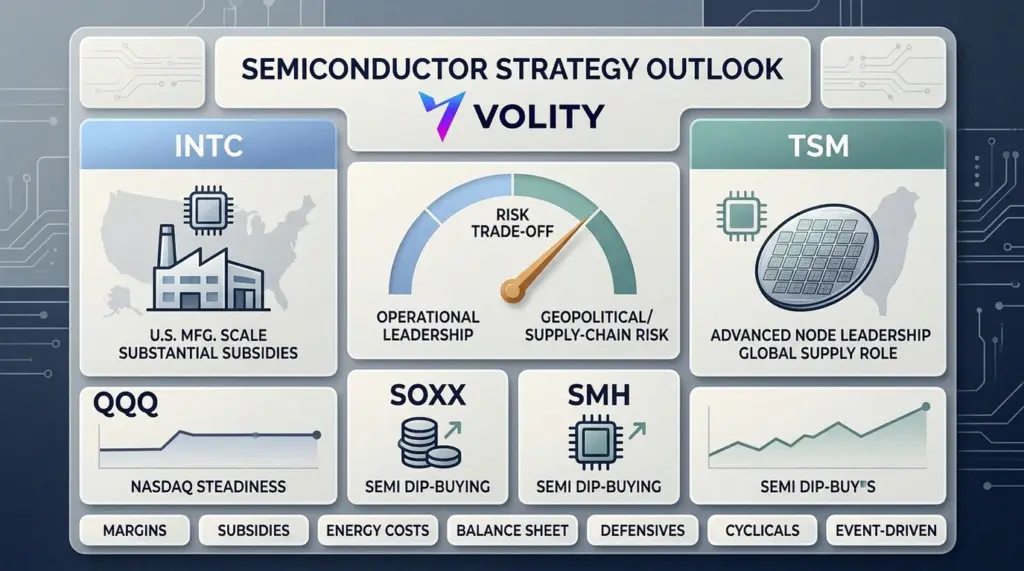
Still, investors should not confuse a national priority with a near-term earnings winner. TSMC has the customers, scale and execution record. Intel has the optionality, subsidies and geopolitical hedge.
That makes INTC versus TSM less a beauty contest than a choice of risk. One owns operational excellence with Taiwan exposure. The other owns strategic safety with execution risk.
Watch: INTC, TSM
Nasdaq holds the line
Meanwhile, the Nasdaq has shown why traders still treat technology as the market’s main engine. Large-cap tech has absorbed selling better than many cyclical groups.
The Invesco QQQ Trust, ticker QQQ, remains the cleanest read on broad risk appetite. When buyers return to QQQ, they usually return first to megacap software, chips and AI infrastructure.
However, the rally has narrowed in several places. Investors now separate chip designers from foundries, data-centre landlords from speculative AI shells, and profitable platforms from promise-heavy stories.
That is a healthier tape, but not an easier one. The trade is no longer “own AI at any price”. It is “own the profitable bottlenecks and avoid the weak links”.
Outside pure technology, earnings are sending a similar message. Domino’s Pizza, ticker DPZ, has shown how a revenue beat can still leave investors unimpressed. Top-line resilience helps, yet margin pressure can spoil the order.
For short-term traders, DPZ has become a split decision. Bulls see steady demand. Bears see cost pressure and limited room for mistakes.
Watch: QQQ, DPZ
Signals from staples and cyclicals
Defensive stocks are not sleeping through this market either. Yum! Brands, ticker YUM, is approaching a possible death cross. That happens when the 50-day moving average moves below the 200-day line.
Such patterns do not predict the future by magic. However, they can trigger systematic selling and keep momentum traders cautious.
Coca-Cola, ticker KO, sits in a different lane. It remains a blue-chip earnings and positioning story. Investors will watch pricing, volume and foreign-exchange effects more than grand strategy.
3M, ticker MMM, also faces a credibility test. The dividend still attracts income investors. Yet restructuring costs and legal overhangs make the yield harder to value.
In energy services, Halliburton, ticker HAL, offers a sharper read on the oilfield cycle. Guidance may matter more than the latest quarter. Traders want evidence that drilling demand can last.
Homebuilders add another important clue. D.R. Horton, ticker DHI, remains tied to mortgage rates, affordability and buyer confidence. Any surprise in orders or cancellations can move the whole group.
Watch: YUM, KO, MMM, HAL, DHI
Semiconductor funds stay bid
Semiconductor ETFs have taken money even during chip-stock wobbles. That matters because flows often reveal conviction before price does.
The iShares Semiconductor ETF, ticker SOXX, and the VanEck Semiconductor ETF, ticker SMH, remain favoured vehicles for broad chip exposure. However, they carry concentrated bets on a handful of giants.
Investors are using these funds to buy weakness, not flee the sector. Therefore, chip declines still look like rotations within a bull theme, not a full retreat.
Even so, the supply-chain problem is real. TSMC’s Taiwan concentration leaves the world exposed to a single critical manufacturing hub. New fabs in the United States and Europe help, but they will not remake the industry overnight.
Intel’s foundry effort fits here as a political hedge. It is not yet a full substitute for TSMC. However, it could become more valuable if governments keep pushing supply-chain security above pure efficiency.
Watch: SOXX, SMH, NVDA, AMD, MU, INTC, TSM
Defense and oversold technology
Geopolitics has also kept defence-adjacent growth stocks on trading screens. Archer Aviation, ticker ACHR, has drawn attention through its work with Anduril on hybrid autonomous VTOL aircraft.
The market likes companies that sit between commercial technology and national security. However, these stocks often move faster than their revenues.
Meanwhile, traders are hunting in oversold technology names. Applied Digital, ticker APLD, and Aurora Innovation, ticker AUR, both sit in volatile corners of the market.
APLD gives investors exposure to AI infrastructure. AUR offers a play on autonomous transport. Yet both require tolerance for sharp swings and unforgiving earnings reactions.
That creates tactical opportunity, not comfort. A small guidance improvement can spark a squeeze. Poor execution, however, can reset the range lower in one session.
Watch: ACHR, APLD, AUR
Banks and energy structure
Financials remain selective rather than broadly loved. Truist Financial, ticker TFC, shows the problem. A quarterly beat can help, but investors still want cleaner signals on net interest margins and credit.
Regional banks need more than relief rallies. They need evidence that deposit costs have stabilised and loan losses remain manageable.
Energy is also less simple than the headline oil price suggests. Gasoline above $4 brings USO and BNO back onto watchlists. Yet refining bottlenecks, crude grades and inventories can twist the trade.
Therefore, energy now behaves more like a structure trade. Products, logistics and spreads matter as much as the front-month barrel.
Watch: TFC, USO, BNO, XLE, HAL
Event trades stay lively
Finally, the event-driven corner remains noisy. GameStop, ticker GME, has revived speculative attention around eBay, ticker EBAY, after reports of a 9.8 per cent stake.
Traders will debate whether that signals a strategic pivot or another narrative burst. With GME, cash flows rarely tell the whole trading story.
Travel and emerging-market finance add two more pressure points. Ryanair, ticker RYAAY, and HDFC Bank, ticker HDB, show how weaker earnings can quickly hit premarket sentiment.
When indices feel stuck, these single-name catalysts matter more. They give fast-money traders movement while the broader market waits for its next cue.
Watch: GME, EBAY, RYAAY, HDB
Key takeaways
- INTC versus TSM: TSM owns the better business today, while Intel owns the political hedge.
- QQQ: Nasdaq resilience shows investors are rotating within AI, not abandoning it.
- SOXX and SMH: ETF inflows suggest chip pullbacks still attract buyers.
- Energy: Treat oil exposure as a spread and logistics trade, not just a price bet.
- Event names: GME, EBAY, RYAAY and HDB offer catalysts when indices go quiet.
Related coverage on Volity
- What Is a P/E Ratio and How to Use It
- Fundamental Analysis in Stock Trading: A Working Definition
- Growth Investing vs Value Investing: Which Style Fits You?
- Fractional Shares Explained: How to Start Investing With $50
- How to Start Stock Trading: A 2026 Beginner Guide
- Dividend Investing for Beginners: How to Start