A prediction market is a market where you buy and sell contracts whose payoff depends on how a real event turns out. Instead of arguing about whether something will happen, you trade a share that pays a fixed amount if it does and nothing if it does not. Economists describe them as markets where participants trade contracts whose payoffs are tied to a future event, so the resulting prices can be read as a forecast. This guide explains what an event contract is, why its price behaves like a probability, and what to check before you buy one.
The Crypto Trading Starter Kit
A plain-English PDF: what to check before you trade, how orders and risk really work, and the mistakes to skip. Get it free.
TL;DR / Quick insight: A prediction market share trades between $0.00 and $1.00 and pays exactly $1.00 if the outcome happens, or nothing if it does not. That price is the market’s implied probability, so a share at $0.35 means the crowd is pricing roughly a 35% chance. You can sell before the event resolves. The whole contract lives in its resolution rules, so read those before you read the headline.
Nothing here is personal advice. An event contract can settle at zero, which means losing the full amount you paid for it.
What a prediction market actually is
The instrument is simpler than the name suggests. A market poses a question with two possible answers, and each answer is a tradable share. The regulator’s own explainer describes an event contract as a derivative whose value comes from the outcome of an event, usually built on yes-no scenarios with a fixed payout and an expiration. Buy the side you think is right, and if you are right, each share pays out a fixed $1.00.
On a venue like Polymarket, a market is a single binary question with Yes and No outcomes, and an event is a container that groups related markets together. That is how a four-way election question gets built: not as one contract with four answers, but as several Yes/No markets sitting side by side under one heading.
None of this is new, and none of it started with crypto. The Iowa Electronic Markets have been run by the University of Iowa for research and teaching since the late 1980s, using real money on a small scale, precisely so that researchers could study whether a market price forecasts an outcome better than a survey does.
Why a price between $0.00 and $1.00 is a probability
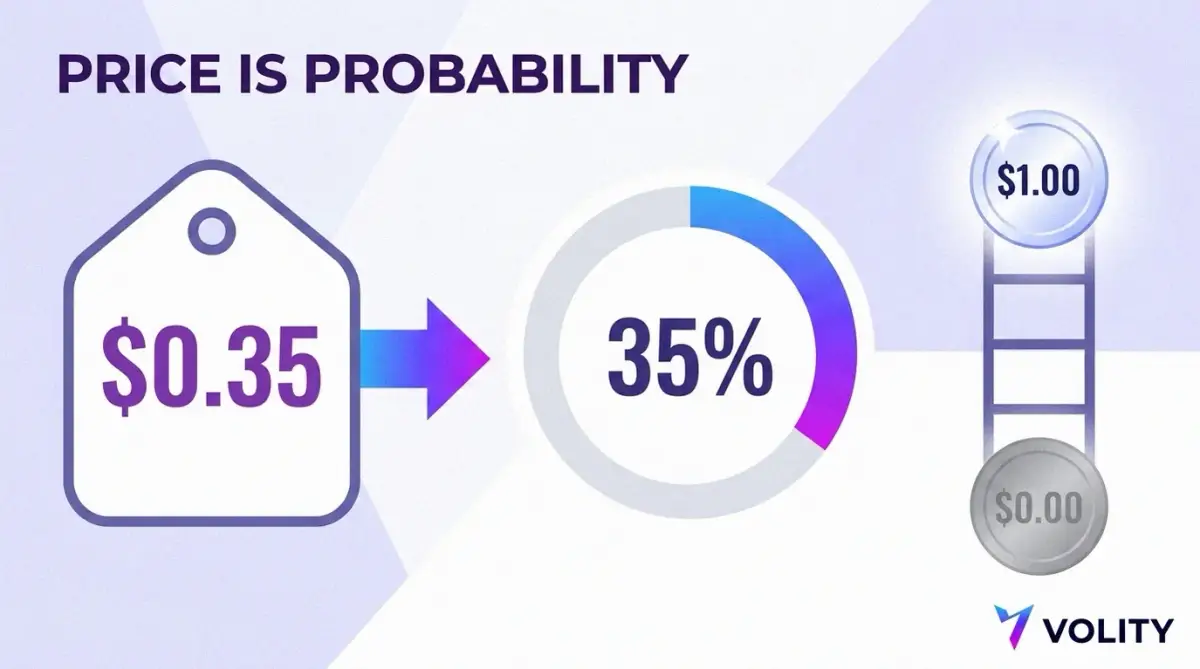
Because the payout is fixed at $1.00, the price of a share has nowhere to go except between zero and one. Polymarket’s documentation states it plainly: every share is priced between $0.00 and $1.00, and the price represents the market’s belief in the probability of that outcome. The conversion is direct, with $0.25 reading as 25%, $0.50 as 50% and $0.75 as 75%. Every cent of price is one percentage point of implied probability.
The arithmetic holds because the two sides must sum to $1.00. A trader buying Yes at $0.60 is matched against a trader buying No at $0.40, and that combined dollar creates one Yes share and one No share. This is not one company’s design quirk. Kalshi, a separate venue, uses the same convention, describing a contract price as directly tied to the probability, expressed as a percentage from 0% to 100%.
Reading probabilities out of market prices is also ordinary central-bank practice. The Bank of England has published methods for extracting option-implied probability distributions for future inflation as an input to policy decisions. The prediction market simply makes the probability the price itself rather than something you have to derive. If you want the conversion drills and the common misreadings, our guide to prediction market odds covers them in detail.
You own a claim that pays $1.00 if your side wins and $0.00 if it loses. Winning shares are redeemable for a dollar each and losing shares are worth nothing. Here is what that looks like with round numbers, buying 100 Yes shares at $0.35.
| Outcome | Payout per share | Total on 100 shares | Cost | Profit or loss |
|---|---|---|---|---|
| Event happens (Yes resolves) | $1.00 | $100.00 | $35.00 | +$65.00 |
| Event does not happen (No resolves) | $0.00 | $0.00 | $35.00 | -$35.00 |
There is no third ending in a standard binary market. Your maximum loss is the amount you paid, and you reach it whenever the market resolves against you. Buying Yes at $0.35 is a position that the real probability is above 35%; buying No at $0.65 is a position that it is below 35%. The cheaper side risks less and can win more because it is backing the less likely outcome, so a $0.35 share is not better value than a $0.65 share. It is a different position at a different price.
One detail trips up almost everyone. The price you see is usually the midpoint between the best bid and the best ask, so the price you actually transact at is different. If a market displays $0.35, the book might be bid $0.34 and ask $0.36. Buying 100 shares costs $36.00 rather than $35.00, which quietly moves your break-even to 36%. Sell again immediately and you receive $34.00, down $2.00 without the event moving at all. That gap is the spread, and on thin markets it is wider than beginners expect.
What resolution means and when you get paid
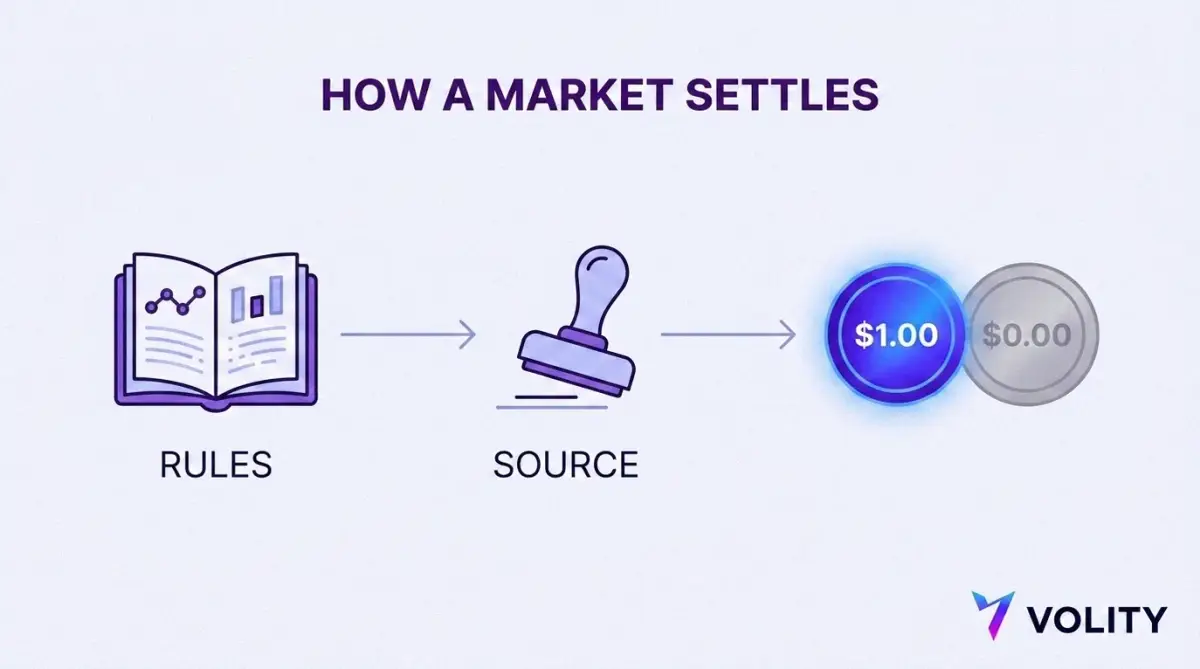
Resolution is the moment the market decides which side won and pays it out. Every market carries pre-defined rules published before trading opens, covering the resolution source, the end date and how edge cases are handled. The documentation puts it better than any paraphrase: the market title describes the question, but the rules define how it resolves. On the consumer side those rules sit directly under the market’s order book, which is where you should read them.
The mechanics on Polymarket run through an external oracle rather than a company decision. Someone proposes the outcome and posts a bond, typically $750, which they forfeit if the proposal is wrong. A two-hour challenge period follows, in which anyone can dispute by posting a matching bond. Undisputed markets settle roughly two hours after the proposal. A disputed one escalates to a token-holder vote and takes four to six days. According to UMA’s own documentation, the optimistic oracle resolves 99.8% of requests without escalating at all, so disputes are rare rather than impossible.
Two edge cases are worth knowing. A market that cannot be settled either way can resolve 50-50, in which every share redeems for $0.50 regardless of the side it was on. And if something unforeseen happens mid-market, the venue can publish a clarification, though a clarification cannot change the fundamental intent of the question. Settlement machinery differs by venue, so the venue-neutral rule is to know who decides, from which source, and on what date. Our walkthrough of how prediction markets resolve goes through the disputed path in full.
Where the prices come from when there is no house
A bookmaker quotes odds and takes the other side of your bet. A prediction market does neither. You trade shares with other users on an order book, and prices emerge from supply and demand rather than being set by the platform. The regulator makes the same point about regulated venues, noting that the exchange and broker do not take a side of the trade and are not competing against you.
That structure is what gives the price its informational value. Wolfers and Zitzewitz argued in the Journal of Economic Perspectives that market-generated forecasts are typically fairly accurate and beat most moderately sophisticated benchmarks. The strongest evidence is long-run: comparing Iowa Electronic Markets prices against 964 polls across five presidential elections from 1988 to 2004, Berg, Nelson and Rietz found the market closer to the eventual outcome 74% of the time, with a mean absolute error of 1.82 percentage points against 3.37 for the polls.
The honest counterweight matters just as much. Clinton and Huang studied more than 2,500 political markets across four venues in 2024 and found accuracy varying sharply by venue, at 93%, 78% and 67%, with prices for identical contracts diverging between exchanges. Polymarket publishes its own calibration figures, self-reported, showing 90.1% accuracy one month before resolution rising to 98.6% four hours out. Treat a market price as a well-informed estimate that is usually well calibrated, and not as a forecast that is settled.
What actually gets traded, from elections to weather
Anything with a date and an unambiguous answer can become a contract. Venues list politics, sport, crypto, finance, geopolitics, technology, culture, economics and weather. Scheduled policy decisions suit the format especially well: the Bank of England’s Monetary Policy Committee meets eight times a year and held Bank Rate at 3.75% on 30 July 2026, with the next decision due on 17 September. A known date and a binary answer is exactly the shape an event contract needs.
Volume is far less evenly spread than the category list suggests. Tracker data for July 2026 puts sport at about $2.25 billion, politics at $448.8 million, finance at $107.5 million and weather at $1.4 million. Weather markets exist, and they are a rounding error next to sport. That gap matters more than it looks, because a thin market has a wide spread and little depth, so your entry price gets worse as your size grows.
The overall market has grown quickly. Pew Research Center found combined monthly volume across the two largest venues rising from under $5 billion in September 2025 to roughly $24 billion in April 2026. CNBC reported that in June 2026, Polymarket’s international exchange traded more than $10.8 billion in notional volume while Kalshi traded more than $31 billion. Polymarket runs that international exchange alongside a separately operated US-regulated venue.
These contracts also work as hedges, which is the part most explainers skip. The CFTC’s example is a citrus farmer buying a weather contract against a freeze, so a bad harvest is partly offset by a contract that pays. Used that way, an event contract transfers a risk you already carry rather than adding a new one.
Before you commit money to any single market, work through the following.
- The resolution rules, not the headline. The title is a summary; the rules are the contract. Read them first, every time.
- The resolution source. Know which official announcement, dataset or named site decides the outcome.
- The end date and the edge cases. Check what happens if the event is delayed, cancelled or only partly satisfied.
- The spread, not just the displayed price. The quoted price is a midpoint. Look at the actual bid and ask before you size up.
- Order book depth. A large order in a thin market moves the price against you as it fills.
- The settlement timeline. Roughly two hours undisputed, four to six days if disputed. Do not commit money you need back on a fixed date.
- The downside. The whole stake is at risk, and a losing share pays nothing at all.
If you are weighing this against a bookmaker, the structural differences are covered in prediction markets versus betting. For the venue mechanics behind the order book, see how Polymarket works, and browse the rest of our crypto guides for the wider context.
Where Volity fits
The Markets screen in your Volity dashboard lets you connect a Polymarket account, fund it from your Volity USD wallet and track the balance from the same place you manage everything else. Dollars leave your wallet and arrive at the venue as a dollar stablecoin balance on the Polygon network, which is the unit these contracts are collateralised in. Each Yes and No pair is fully backed one for one.
Your position lives at the venue, not with us. Balances and positions are held on the external platform, and trading, availability and withdrawals are subject to that platform’s own terms. Volity does not place or manage orders on your behalf. The step-by-step version is in our guide to funding a Polymarket account.
It means the market is pricing roughly a 35% chance of that outcome. You pay $0.35 now, and the share pays $1.00 if the outcome happens or $0.00 if it does not. Buying at that price is a position that the true probability is higher than 35%. Bear in mind the displayed price is normally a midpoint, so you will pay slightly more than $0.35 once the spread is included.
Do prediction markets predict better than polls?
Often, though not always. Berg, Nelson and Rietz compared Iowa Electronic Markets prices against 964 polls across five elections and found the market closer to the outcome 74% of the time, with roughly half the average error. Later work by Clinton and Huang found accuracy varied a lot by venue in 2024, from 67% to 93%. A market price is a well-informed estimate, not a guarantee.
Can you sell before the event resolves?
Yes. Shares can be bought and sold at any time while the market is open, so you are not locked in until settlement. If a share you bought at $0.35 rises to $0.55 on new information, you can sell and take the difference without ever learning how the event ends. Liquidity varies, so a thin market may not let you exit at the displayed price.
What happens if the event never happens?
The market’s rules say so in advance, which is why reading them matters. Most rulebooks define how a delayed, cancelled or ambiguous outcome is treated. Where neither side can fairly be called, a market can resolve 50-50, and every share redeems for $0.50 regardless of which side it was held on.
Are prediction markets the same as betting?
They are structurally different. A bookmaker sets the odds and takes the other side of your bet, whereas a prediction market matches you against other traders on an order book and the platform does not take a position. That means prices move with supply and demand, you can exit before resolution, and your loss is capped at what you paid for the share.