Crypto crossroads: yield, regulation, and the quiet power shift
Crypto markets look calm on the surface, but the machinery underneath is moving fast.
Today’s action is not really about a single token breakout. Instead, the industry is drifting toward a more grown-up fight over yield, accounting, market structure and settlement rails. That may sound dry. However, dry plumbing is exactly where financial empires usually get built.
Solana Company’s second-quarter numbers show the promise and pain of crypto treasury strategies. Meanwhile, Africa Finance Corporation has pushed tokenised debt into regulated markets at serious size. In Washington, the SEC has pulled back a crypto vote with almost no explanation. Yet the White House is preparing to host industry executives next week.
For traders, this is the real tape. Price still matters, of course. However, the larger move is from speculative heat toward rules, infrastructure and yield.
Solana company: staking income meets public-market punishment
Solana Company, a Nasdaq-listed treasury firm built around SOL, has become a useful test case for crypto-native balance sheets.
The company reported a $30.3 million net loss for the second quarter. Yet it generated about $2.5 million in revenue, almost entirely from staking its SOL holdings. During the period, it earned roughly 31,200 SOL in staking rewards. Those rewards were automatically restaked, increasing the company’s exposure.
That sounds elegant until accounting enters the room.
Most of the quarterly loss came from non-cash impairment and mark-to-market adjustments on digital assets. In plain English, SOL’s price swings hit the income statement hard. Meanwhile, the staking engine kept running in the background.
Investors face two exposures in one wrapper. They are buying SOL price risk and staking yield at the same time. When the token rallies, that can look clever. When it chops lower, the reported numbers can look ugly fast.
That tension matters for every listed crypto treasury vehicle. Public markets reward clean earnings, but digital assets rarely provide them. So, even if the economics look better than the headline loss, the stock market may still punish volatility.
Africa’s digital bond: tokenisation leaves the slide deck
While US crypto stocks wrestle with regulatory theatre, tokenised finance is making quieter progress elsewhere.
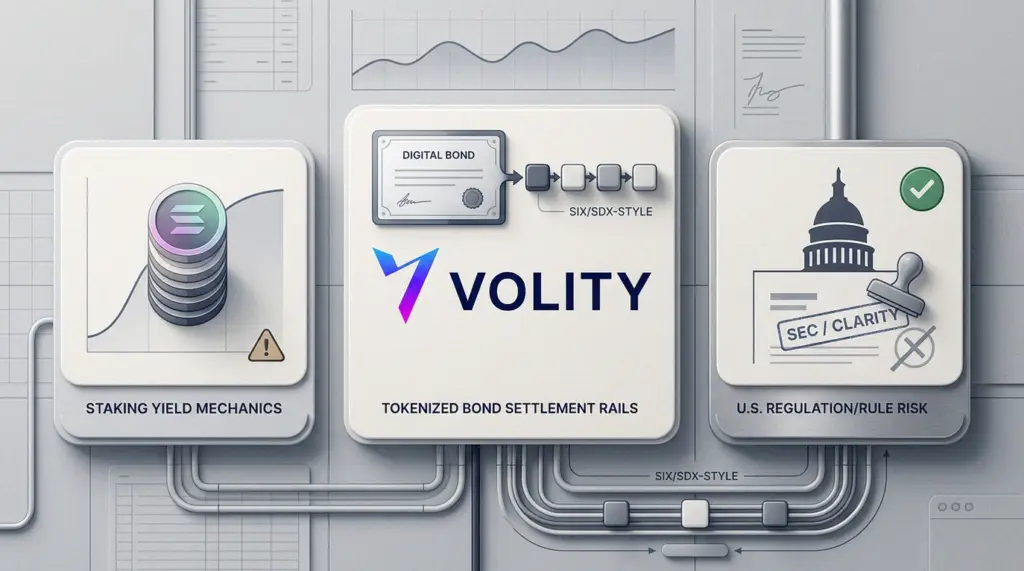
Africa Finance Corporation has issued a $431 million equivalent digital bond, raising 350 million Swiss francs. The five-year instrument carries a 1.4925% coupon. It was listed and processed on Switzerland’s SIX exchange using the SDX digital platform.
That makes it the first digital bond from an African institution to move through both a regulated exchange and a central securities depository.
This was not a token experiment with a glossy name and tiny size. The money will fund infrastructure across Africa. The structure used conventional credit terms, a conventional coupon and regulated market infrastructure.
However, the rails looked different. Settlement moved through a digital platform designed for tokenised securities. That is the important part.
For investors, the lesson is practical. Real-world assets are not waiting for perfect crypto legislation in Washington. They are finding regulated channels where issuers, custodians and exchanges can operate now.
As a result, tokenisation is becoming less about speculative tokens and more about capital markets plumbing. Once large issuers trust the rails, programmable securities become a legal and commercial question. The technical argument starts to fade.
Sec vote: the rule that vanished
In Washington, the loudest crypto event this week was the one that did not happen.
The SEC abruptly cancelled its August 14 open meeting on “Regulation Crypto”. Commissioners had been expected to vote on a roughly 400-page proposed rule. The cancellation arrived one day before the meeting, with only an “unforeseen scheduling issue” offered publicly.
That thin explanation landed poorly because the proposal was already moving through the federal rulemaking pipeline. The White House Office of Information and Regulatory Affairs had received the notice under tracking number RIN 3235-AN38.
The draft carried real market consequences. It would have created three possible exemption paths for token offerings. One covered start-ups raising up to $5 million. Another covered fundraising up to $75 million a year. A third offered a decentralisation safe harbour for tokens that had moved beyond issuer control.
Then, suddenly, the vote disappeared.
Meanwhile, Congress is in recess and the CLARITY Act is frozen until September. That leaves token issuers, exchanges and market makers stuck in the usual American crypto fog. Rules may be coming, but nobody can trade a maybe.
For markets, the delay extends uncertainty around new launches and secondary trading. It also keeps enforcement risk alive. When rulemaking stalls, regulators often fill silence with case-by-case action.
White house meeting: coinbase, ripple and the clarity clock
Even so, the executive branch is pulling crypto executives closer to the table.
On August 19, the White House is expected to host crypto and prediction-market firms. Coinbase and Ripple executives are among the expected attendees. So are representatives from a16z, Chainlink, Paradigm and Kalshi.
Senior regulators may also be involved, including leadership from the SEC and CFTC.
The timing is not accidental. The CLARITY Act sits over the meeting like a market catalyst. The bill would put spot markets for qualifying digital commodities under CFTC oversight. Securities-classified crypto assets would remain under the SEC.
That split sounds technical, but it cuts to the core of US crypto trading. It could define who supervises exchanges, how tokens list and what disclosures issuers must provide.
The Senate calendar currently points to a key procedural vote on September 15, with a 2:15 p.m. slot and a 60-vote threshold. The industry has less than a month to shape the politics.
For traders, the calendar now matters as much as the chart. Leaks, meeting readouts and committee signals may move thematic names quickly. Bitcoin and Ether may react less sharply, but exchange stocks and tokenisation plays could swing harder.
By the numbers
- $30.3 million – Solana Company’s second-quarter net loss.
- 31,200 SOL – staking rewards earned during the quarter.
- 350 million Swiss francs – Africa Finance Corporation’s digital bond raise.
- $75 million – proposed annual fundraising cap under one SEC exemption path.
- September 15 – expected Senate procedural vote on the CLARITY Act.
Trading read: yield, rails and rule risk
Three themes stand out from the day’s news.
First, staking yield is real, but it does not erase token volatility. Solana Company can compound SOL rewards and still report a heavy loss. Investors in crypto treasury equities should model the token first and the income second.
Second, tokenised debt is moving into regulated markets. Africa Finance Corporation’s bond shows that serious issuers can use digital settlement without frightening traditional investors. Meanwhile, exchanges and custody platforms may become the quieter beneficiaries.
Third, US regulatory risk remains tradable. The SEC’s cancelled vote adds uncertainty, while the White House meeting creates a fresh event window. The CLARITY Act then gives markets a hard date in mid-September.
In the old crypto cycle, traders watched weekend candles and celebrity wallets. Now they also need to watch federal calendars, exchange infrastructure and accounting footnotes. That is less romantic. However, it is probably more profitable.
Related coverage on Volity
- How to Avoid Crypto Scams: A Beginner Safety Checklist
- How to Choose a Trading Platform: A 10-Point Checklist
- Demo vs Live Trading Account: A 7-Step Checklist Before You Go Live
- How to Size a Trade: Position Sizing and Risk Per Trade for Beginners
- Risk-Reward Ratio Explained: How to Set It and Why It Matters
- ETF vs Index Fund: The Difference and Which to Pick