Every broker says its gold pricing is tight, yet published spreads are hard to compare: some are minimums, some are averages and some carry a commission on top. The best gold trading platform for you is the one with the lowest total cost for the way you trade (spread, commission and overnight charges together), at a firm whose execution you have tested. Below, seven platforms are compared on their own published figures, with a cost calculator and an execution checklist.
TL;DR: Published gold spreads are mostly best-case minimums, so convert each to US dollars per ounce first. Spread plus commission decides the cost of a same-day trade, and on trades held for several nights, overnight financing can cost many times the spread. Price your usual trade in the calculator below and test two platforms on a free demo before funding either.
Volity publishes this guide and includes its own account in it; every competitor figure below was read on that broker’s own website on 28 September 2026 and is linked so you can check it, because prices change.
Gold is a deep market, with liquidity the World Gold Council ranks at levels comparable to many global stock markets. Retail rules in the UK, the EU and Australia are alike: gold leverage is capped at 20:1 (ESMA, FCA, ASIC), positions close automatically when funds run low (at half the required margin in the UK and EU), and losses cannot exceed the account balance.
How to compare gold trading platforms on total cost
Every platform here offers gold as a contract for difference (CFD): you gain or lose the difference between your opening and closing price without owning the metal. The quote, XAU/USD, is the dollar price of one troy ounce (XTB), and the spread is the gap between the buying and selling price: 0.30 means 30 cents an ounce. IG and IC define a lot as 100 ounces (IG, IC), so that spread costs $30 a lot, or $3 on 0.1 lot (10 ounces).
Brokers publish a minimum (the best case), an average over a period they choose, or a live snapshot. IG’s “points” on spot gold are dollars per ounce. An all-in spread includes the broker’s charge, while a raw spread has no mark-up and comes with a commission.
To compare platforms on one number:
- Note your usual size in lots and whether you close the same day or hold for nights.
- Convert each spread into US dollars per ounce, noting its type and the contract size.
- Add commission twice per lot, for opening and closing: $3.50 per side is $7 a round trip.
- Add overnight financing (the swap) for each night past the daily rollover, often 22:00 UK time, including any midweek triple charge.
- Check deposit, withdrawal and currency conversion costs, and any inactivity fee.
- Compare the totals in the calculator below, never the headline spreads.
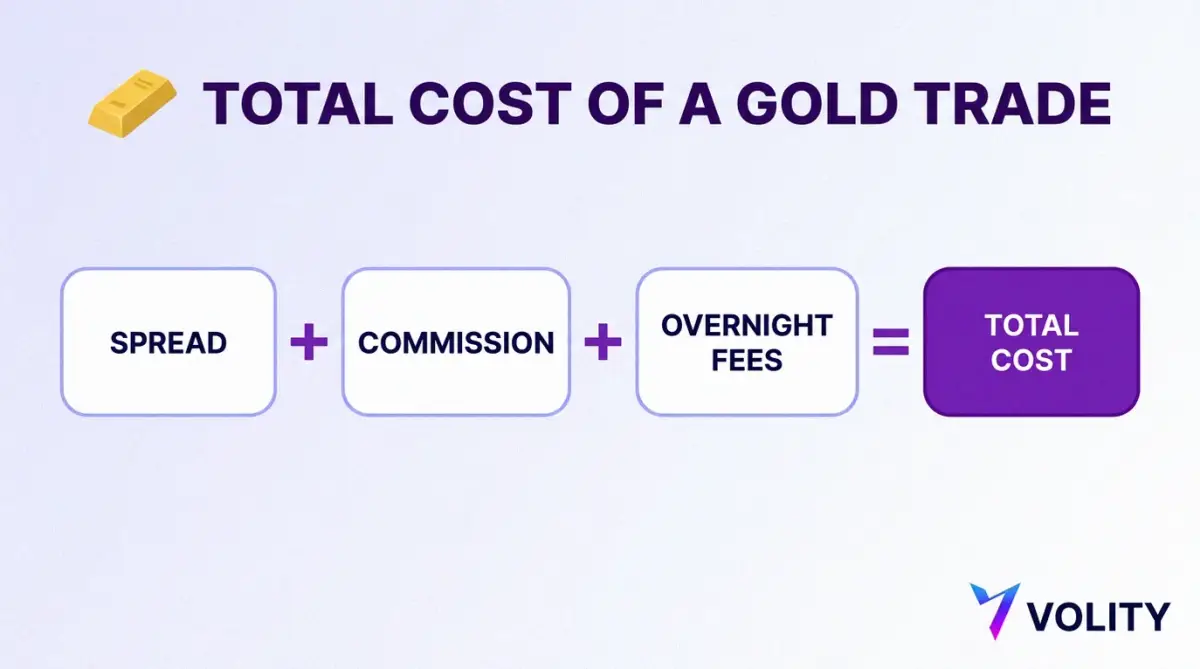
The ranking can flip: a 0.05 raw spread plus $7 of commission costs $12 per lot, more than a 0.10 all-in spread at $10. Our guides to gold spreads and XAU/USD trading costs and to CFD gold trading go deeper.
The gold trading platforms at a glance
The table lists spot gold figures as published on 28 September 2026, alphabetically, in US dollars per ounce (UK sites for IG, Pepperstone, XTB and CMC Markets).
| Platform | Gold spread as published | Commission on gold | Minimum to start | What it suits |
|---|---|---|---|---|
| CMC Markets | 0.20 minimum | None | Not published | Traders who want holding costs shown up front. |
| eToro | 0.01% of position value, charged on opening and on closing (trades at raw market prices) | None (the 0.01% is charged as a spread) | First deposit $10 to $10,000, by region | Traders who prefer a percentage charge. |
| IC (formerly IC Markets) | Raw: 0.05 minimum, 0.09 average. Standard: 0.1 minimum | Raw: $3.50 per lot per side. Standard: none | $0 | High-volume traders who want raw pricing. |
| IG | Spot 0.3, futures 0.6 (minimums) | None on gold CFDs | No minimum by bank transfer | Traders choosing between spot gold and futures. |
| Pepperstone | Razor: 0.08 minimum. Standard: 0.15 minimum | Razor: from £2.25 per lot per side. Standard: none | £10 (no minimum by bank wire) | Traders who want raw or all-in pricing. |
| Volity | Dynamic, shown live on the platform and in the free demo | None on Markets; $2 per lot per side on PRO | Trade from $1 (funding from EUR 10) | One account for gold, forex, indices, shares (including fractional), crypto and a $0 wallet. |
| XTB | 0.9 minimum | None (0% on CFDs) | No minimum | Traders who want spread-only pricing. |
Minimum spreads are best-case figures, and live spreads are usually wider at the daily rollover and around major data releases. The calculator below turns any quote into a cost per trade. Terms can differ by entity, so check the one named in the site footer.
On Volity you trade spot gold as a CFD on XAU/USD and XAU/EUR, long (buying for a rise) or short (selling for a fall), in the same account as forex, indices, commodities, crypto, real and fractional shares and a $0 multi-currency wallet. Gold CFDs run on the Volity MT platform; the gold trading platform page has details.
Start with what is free: trading on a Volity Markets account is commission-free, crypto deposits (BTC, ETH, USDT) and all withdrawals are free, and closing a position priced in another currency carries no FX fee. A Markets account starts from $1, with funding from EUR 10, PRO charges $2 per lot per side, and the full fee schedule is public.
Spreads on Volity, gold included, are dynamic, with the live figure for each instrument shown on the platform. Use the free demo, available on every tier, to note the live XAU/USD spread at the hours you trade and enter it in the calculator below. Positions held past 22:00 GMT pay or receive an overnight fee at the rate the platform shows, and swap-free (Islamic) accounts are available.
Trades are executed at the best available market price under the execution policy. Client money is held by UBK Markets in segregated bank accounts, separate from the firm’s own funds, and eligible retail clients of UBK Markets are covered by the Cyprus Investor Compensation Fund up to EUR 20,000 if the broker becomes insolvent (safety of funds). Volity operates under CySEC licence 186/12 through UBK Markets, with entities in Saint Lucia, Cyprus and Hong Kong. Try the free demo before you fund anything.
How the other popular gold brokers compare
CMC Markets
CMC Markets applies holding costs at 10pm UK time, positive or negative (trading costs); on 28 September 2026 its gold holding cost was a charge of 0.01386% a day on a buy and a credit of 0.00780% a day on a sell. Its weekend gold market runs from 10pm Friday to 10pm Sunday, with typically wider spreads.
eToro
On a $40,000 position, eToro’s 0.01% charge is $4 on opening and $4 on closing. Overnight fees apply every weeknight at 22:00 UK time, tripled on Wednesdays for most commodities.
IC (formerly IC Markets)
At IC, metals swaps are tripled on Wednesday nights, and dynamic leverage applies to gold from three hours before the Friday close to 30 minutes after the Monday open. The global site belongs to IC’s Seychelles-regulated entity; EU clients use a separate CySEC-regulated one.
IG
IG’s spot positions still open after 22:00 UK time get a daily funding adjustment based on the tom-next spread (the market cost of rolling a position to the next day), including an admin fee of 0.3% a year, shown as 0.8% on IG’s international site. Futures have a wider spread but no overnight funding.
Pepperstone
On USD accounts, Pepperstone’s Razor commission comes to USD 7 per lot, opening and closing combined, and swaps are paid or earned at the market rate shown on the platform for positions open past 5pm New York time.
XTB
XTB lists a 0.01 lot minimum order and runs its own xStation 5 platform and app. With 0% commission on CFDs, the spread is the main cost of a same-day trade.
Work out the real cost of your next gold trade
Enter the live gold spread from any platform (for Volity, read it in the free demo), your position size in lots, and any commission and overnight fee that apply.
Gold trade cost calculator
Enter the numbers your platform shows for XAU/USD. The values below are examples only, not any broker’s quote.
| Spread cost | – |
| Commission (open and close) | – |
| Overnight fees (0 nights) | – |
| Total cost of the trade | – |
Gold has to move – per ounce in your favour before this trade breaks even.
If your platform quotes the overnight rate as a percentage, multiply it by one lot's value (100 ounces times the gold price) to get the fee per lot per night. For the spread alone on other markets, use the spread cost calculator.
A worked example: you buy 0.10 lot (10 ounces) at an illustrative $4,000, a $40,000 position. Account A has an all-in spread of $0.30 an ounce and no commission. Account B has a raw spread of $0.08 plus $3.50 per lot per side. The overnight rate is 0.01386% a day, the buy rate CMC Markets displayed on 28 September 2026, or $5.54 a night here.
| Scenario | Spread | Commission | Overnight fees | Total |
|---|---|---|---|---|
| A, closed the same day | $3.00 | $0.00 | $0.00 | $3.00 |
| B, closed the same day | $0.80 | $0.70 | $0.00 | $1.50 |
| A, held 5 nights | $3.00 | $0.00 | $27.72 | $30.72 |
| B, held 5 nights | $0.80 | $0.70 | $27.72 | $29.22 |
Closed the same day, B costs half as much. Over five nights, the overnight charge is about nine times A's spread, and the accounts differ by only $1.50 on about $30, so price your trade the way you actually hold it. Enter the last row's inputs (price 4,000, spread 0.08, 0.10 lots, commission 3.50, overnight fee 55.44, 5 nights) to see $29.22 and a $2.92 break-even move.
Check execution before you fund an account
Execution is what happens between your click and your fill. Slippage, the gap between the price you asked for and the price you got, tends to be largest around scheduled news, so a week on a demo tells you more than any spread table.
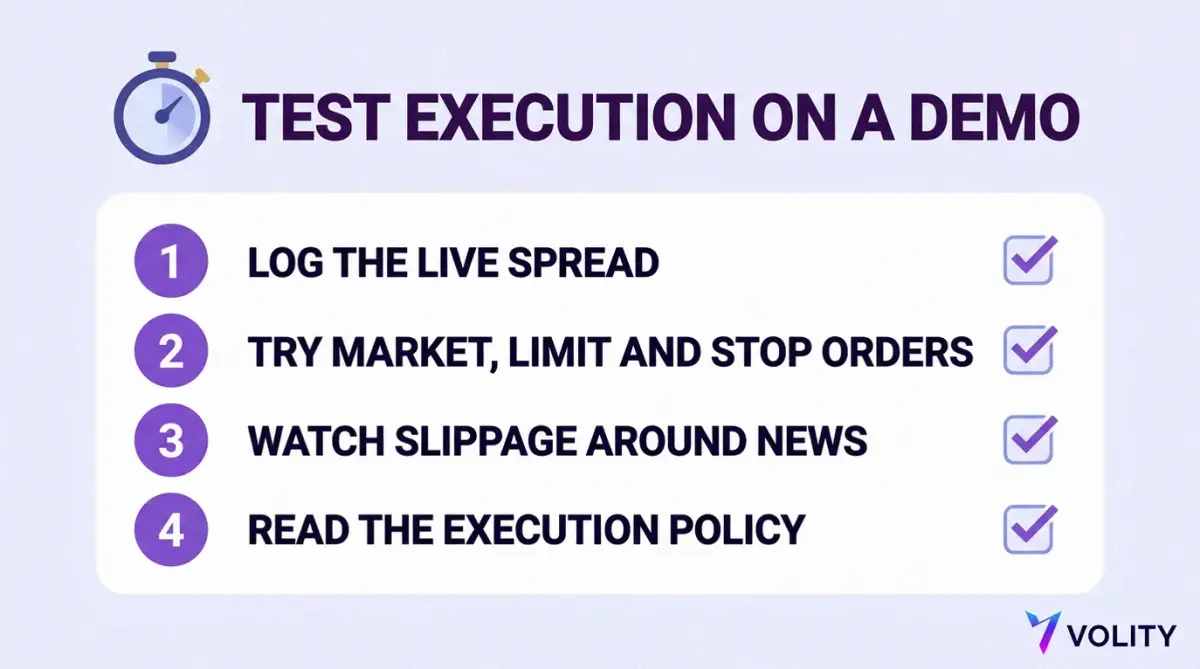
- Open a free demo with each shortlisted platform.
- Log the live gold spread at the London open, in the London and New York overlap and around the daily rollover for a week.
- Place small market orders around a scheduled data release and note any slippage.
- Test a market order (fills now at the best available price), a limit order (fills only at your price or better) and a stop order (triggers at a level you set).
- Read the execution policy, and check the trading hours, the daily break and the weekend rules for gold.
- Confirm the entity that will hold your account, its regulator and your retail protections.
Our guide to the best time to trade gold covers the sessions. UK rules require a firm to take all sufficient steps to get clients the best possible result on price, costs, speed, likelihood of execution and settlement, size and nature (FCA Handbook, COBS 11.2A), even when it deals as the other side of your trade. Whichever platform you choose, look the firm up on its regulator's public register before you fund an account.
Still deciding whether to buy at all? Read is it a good time to buy gold? for a checklist after the 2026 record, and gold vs a savings account for five years of numbers.
Match the platform to the way you trade gold
The best broker for gold trading is the one whose costs fit your style.
- Scalpers and day traders may pay less with a raw spread plus commission, so compare commission as closely as spread.
- Swing traders pay more in overnight financing than in spread, so compare overnight rates and watch for midweek triple charges.
- Beginners gain most from a low entry amount, no commission, a free demo and the smallest size, often 0.01 lot (one ounce).
- Traders who also invest save transfers with one account for gold, shares, crypto and cash.
Volity is built for that last group and suits the others too. Beginners get a Markets account from $1 (funding from EUR 10) with no commission and a free demo on every tier, frequent traders can pick PRO, which pairs tighter spreads with $2 per lot per side, and swap-free (Islamic) accounts are available. Open a Volity account or start with the demo, and compare its live gold spread with the figures above. See also how to trade XAU/USD and the best online trading platforms. For market insights, education and platform updates, subscribe to "Start Your Days Smarter" at the foot of this page.
Fact check: Broker figures were read on each broker's own website on 28 September 2026 and are linked where they appear. Leverage caps and retail protections: ESMA (27 March 2018), FCA PS19/18 (July 2019), ASIC 20-254MR (23 October 2020). Volity figures: its fee schedule and safety of funds page.
Frequently asked questions
What is the best platform for trading gold?
The one with the lowest total cost for your own trades, a regulator you recognise and execution you have tested. Price your usual trade for each shortlisted platform in the calculator above, then test the two cheapest on a free demo.
Which broker has the lowest spread on gold?
Among the brokers checked on 28 September 2026, published minimum gold spreads ran from $0.05 to $0.90 an ounce. The lowest minimums come on raw accounts that add a commission, so the lowest spread is not always the lowest cost: price your own trade in the calculator above. Volity's spreads are dynamic, and the free demo shows the live gold spread.
Is it better to trade gold as a CFD or buy a gold ETF?
Choose by holding period. A CFD suits moves over days or weeks, long or short, with overnight financing for each night held; a physically backed fund or bullion suits holding for years, with fund or storage costs instead. Volity offers gold as CFDs on XAU/USD and XAU/EUR; see physical gold versus gold ETFs.
How much money do I need to start trading gold?
Enough for the margin plus a buffer: at the 5% retail margin, a 0.01 lot trade (1 ounce) at an illustrative $4,000 needs $200. A Volity Markets account starts from $1, with funding from EUR 10; crypto deposits and all withdrawals are free, and card deposits carry a 2.99% fee. Start on the free demo.
What leverage can I use on gold?
Retail clients of firms regulated under ESMA, FCA and ASIC rules are capped at 20:1 on gold, a 5% margin (ESMA, FCA PS19/18, ASIC). The maximum available depends on your client category and the entity holding your account. Higher leverage magnifies losses as well as gains: at 20:1, a 5% move against you costs the whole margin. See leverage in gold trading.
Is gold CFD trading suitable for beginners?
Yes, with a demo first, the smallest size and a stop-loss on every trade. CFD providers regulated in the UK or the EU must show the share of their retail accounts that lose money (FCA, ESMA): read it, and learn the basics in our gold guides before trading live.