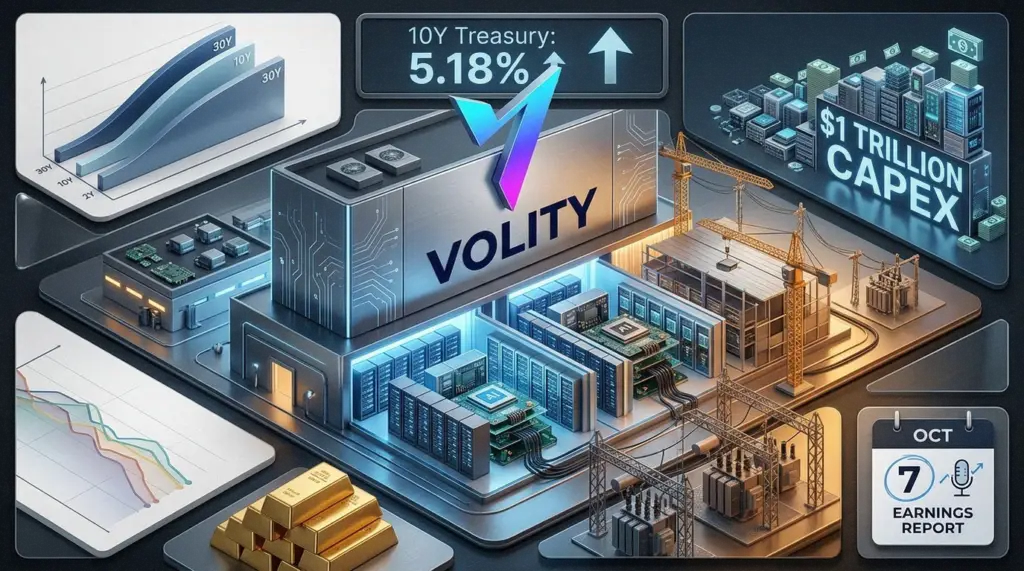
AI’s trillion-dollar test: Where traders are looking on October 5
Wall Street enters the week between AI euphoria and a punishing cost of money.
The 10-year Treasury yield sits near 5.27%, while long-dated Treasuries remain under pressure. That leaves traders with one hard question.
Can expensive growth keep outrunning expensive capital?
Company reports, clinical data, insider filings and analyst revisions may offer parts of the answer. Yet financing conditions still set the market’s mood.
Applied Digital faces an earnings test
Applied Digital reports on October 7, putting AI infrastructure spending under a microscope. Analysts expect roughly $258.7 million of revenue and a loss near $0.39 a share.
APLD recently traded around $25. It remained below its 50-day and 200-day moving averages, and well below its $50.72 peak.
That makes the shares an earnings-volatility vehicle, rather than a settled uptrend.
A rally before results would carry more weight with rising volume and a break above nearby resistance. Otherwise, the AI label may prove insufficient.
Investors will focus on data-centre demand, financing needs and forward guidance. Growth can be genuine, yet still consume more shareholder capital than expected.
Delta offers a different economic bet
Delta Air Lines gives traders exposure to travel demand instead of GPUs, data centres and cloud contracts.
Its outlook depends on passenger volumes, unit revenue, labour costs, capacity and jet-fuel prices. The contrarian case improves if consumers keep travelling and fuel costs stay contained.
However, the thesis can unravel quickly if costs outrun ticket revenue. Lower guidance would also test confidence in the consumer economy.
DAL may therefore become a useful check on whether household spending remains resilient beyond technology.
GameStop needs more than a burst of attention
Reported insider purchases linked to Ryan Cohen could attract momentum traders to GameStop. Still, insider buying does not establish a business turnaround.
Traders should inspect the relevant SEC filings before acting. Transaction dates, purchase prices, share counts and ownership vehicles all matter.
The more convincing signal would be sustained volume and price acceptance above resistance. A single session of excitement rarely settles the investment case.
Vaxcyte brings binary biotech risk
Vaxcyte gained attention after positive topline VAX-31 Phase 3 data. The result could strengthen its regulatory path, although the commercial journey remains long.
PCVX also shows why traders must check prices carefully. Reports have placed the shares at a 52-week high and near $56.48, down 7.7%.
Those figures may reflect different timestamps or a sharp reversal. Either way, the initial news reaction matters less than follow-through.
A failed breakout, heavy selling or a close beneath the news-day range would weaken the setup. Clinical success does not remove regulatory, commercial or valuation risks.
Tesla’s delivery number is only the opening act
Tesla can attract buyers after better-than-expected deliveries, especially if investors entered the report defensively positioned.
Yet deliveries alone cannot resolve the valuation debate. Margins, vehicle pricing, product mix, energy growth and autonomy expectations matter more.
TSLA could react very differently to a delivery beat accompanied by margin pressure. Stable prices and stronger guidance would offer a sturdier signal.
In other words, Tesla remains a catalyst trade rather than a final judgement on the business.
Nu Holdings and the danger of tidy explanations
Nu Holdings remains sensitive to Brazilian rates, the real, credit quality, regulation and political expectations.
Election headlines can move emerging-market shares, but traders should resist overly neat explanations for daily price swings. Several forces often collide at once.
A political explanation needs clear contemporaneous evidence before it becomes a trading premise. Otherwise, it risks turning noise into false certainty.
Momentum names require disciplined exits
Quantum-Si, Kodiak Sciences and Iovance Biotherapeutics have drawn attention after RSI readings above 80. Such readings show unusually powerful recent momentum.
They do not, however, provide an automatic sell signal. Strong shares can stay strong longer than short sellers expect.
- Watch: failed breakouts above recent highs
- Watch: falling volume during price advances
- Watch: bearish momentum divergence
- Watch: closes beneath prior breakout levels
RSI measures intensity, not timing. Price action and liquidity still decide the exit.
HubSpot faces an estimates question
HubSpot sits on the weaker side of the tape after a reported analyst downgrade. The reaction matters most if the analyst also cut forecasts or the price target.
A rating change without lower estimates may create temporary selling pressure. Lower revenue or earnings assumptions can alter the underlying investment case.
Traders should verify the firm, the previous rating, the new rating and the action date. Those details separate a headline from a fundamental shift.
The real trade is the AI financing bill
Hyperscaler capital-spending forecasts for 2026 range from roughly $690 billion to $800 billion. Some projections put combined spending above $1.3 trillion during 2027.
The estimates differ by company and category. Still, they point in the same direction.
Data centres, chips and power infrastructure are consuming a growing share of corporate cash flow. That spending may look wise if AI revenue scales rapidly.
But investors will scrutinise debt issuance, free cash flow, power availability and returns on capital if monetisation lags.
Higher Treasury yields hurt both sides of the equation. They raise borrowing costs while reducing the present value of distant profits.
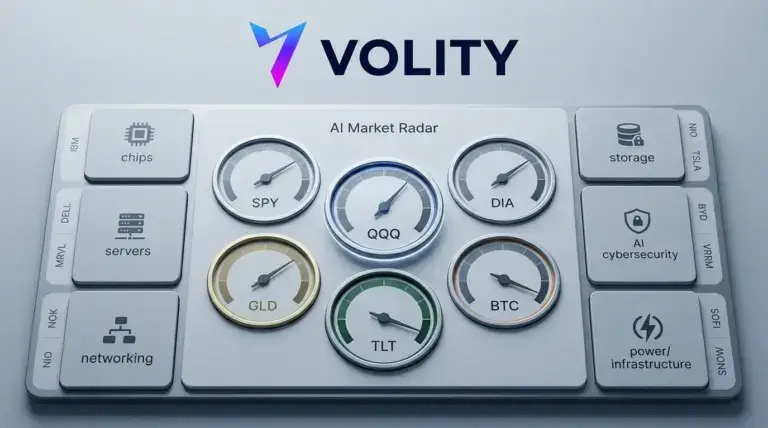
TLT and GLD offer useful macro signals in that environment. Rising yields weigh on TLT, while gold can benefit from inflation fears, fiscal concerns and currency uncertainty.
Gold’s strength does not prove inflation is accelerating. It does suggest investors want protection from several risks at once.
What traders are watching
- APLD: data-centre demand, funding plans and October 7 guidance
- PCVX: whether clinical-news gains hold above the initial reaction range
- TSLA: margins and pricing after deliveries
- DAL: consumer travel demand versus labour and fuel costs
- TLT: whether yields keep rising and tighten valuation pressure
The week’s theme is simple. Headlines create attention, but financing conditions decide what that attention is worth.
AI winners need demand, capital discipline and credible returns. Until then, every optimistic forecast carries a rising interest-rate bill.
Related coverage on Volity
- What Is a P/E Ratio and How to Use It
- Fundamental Analysis in Stock Trading: A Working Definition
- Growth Investing vs Value Investing: Which Style Fits You?
- Fractional Shares Explained: How to Start Investing With $50
- How to Start Stock Trading: A 2026 Beginner Guide
- Dividend Investing for Beginners: How to Start