The market’s best ideas are the ones that know what they are
Markets are generous with stories and stingy with certainty. One day, a stock looks like a breakout candidate. The next, it is merely a headline wearing a price chart.
That distinction matters when traders build a watchlist. The strongest setups rarely offer the loudest forecasts. Instead, they carry a catalyst, a condition for entry and a visible reason to exit.
Ultralife Corp. is the cleanest example in the current slate. Vertiv needs a breakout to hold. Boston Scientific needs weakness to deepen. Super Micro Computer needs earnings to settle the argument.
ULBI is a merger spread, not momentum
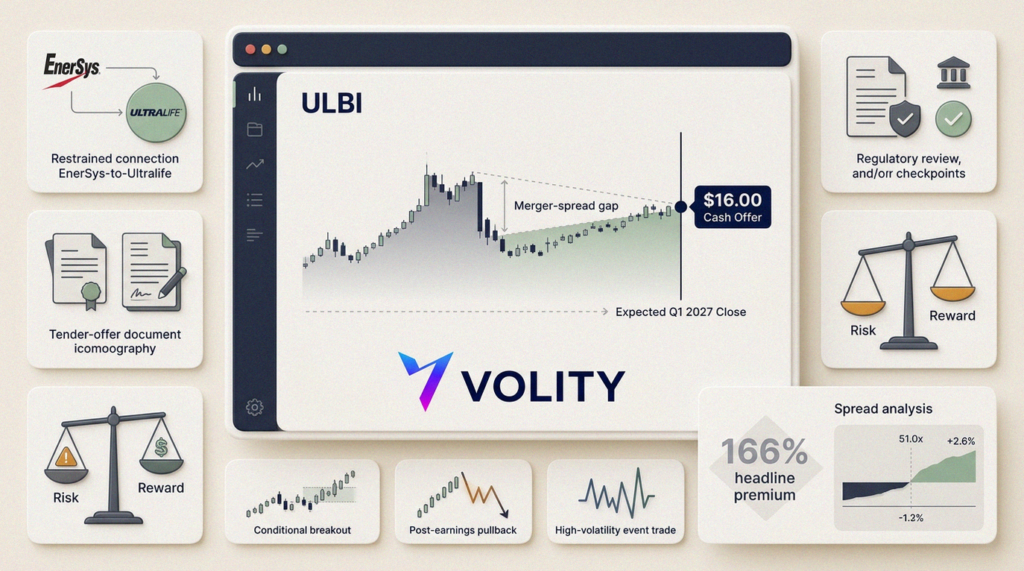
EnerSys has agreed to acquire Ultralife Corp. for $16 a share in cash. The transaction values Ultralife at roughly $320 million.
The companies expect closing during the first quarter of 2027. Investors still need to tender a majority of Ultralife’s shares. Regulators must also approve the deal.
That puts ULBI in the merger-arbitrage bucket. Traders should not judge it like a conventional momentum stock.
The relevant question is simple. How far does ULBI trade below the promised $16 consideration?
The gross spread equals the difference divided by the current share price. A wider spread can offer more return. Yet it also signals greater doubt about timing or completion.
- Offer price: $16 a share in cash
- Deal value: About $320 million
- Expected close: First quarter of 2027
- Key condition: Majority of outstanding shares must be tendered
The stated 166% premium needs careful handling. It compares the offer with Ultralife’s unaffected October 26 closing price.
It does not describe the return available after the announcement. Buying near $16 leaves little upside, while retaining every risk.
Those risks are concrete. Regulatory delays could extend the holding period. A failed tender condition could break the deal entirely.
Changes to the merger agreement could also reshape the calculation. ULBI belongs on a watchlist, but under merger arbitrage.
VRT must show that the breakout can stand
Vertiv offers the more familiar momentum case. Strong earnings and raised guidance can draw fresh institutional buying.
The company sits near the centre of the data-centre build-out. Investors continue to prize suppliers of power and cooling equipment.
But an earnings gap does not automatically begin a durable trend. Some gaps become launch pads. Others offer an orderly exit for earlier buyers.
A constructive VRT trade needs a defined test. The shares should hold above the earnings-day high, or another verified breakout level.
Volume should support that move. A stock already far above its initial reaction zone may deserve patience instead of pursuit.
If VRT closes back inside its prior range, the thesis weakens. That move would suggest the headline outran underlying demand.
BSX needs a second act from sellers
Boston Scientific presents the mirror image. A company can beat earnings estimates and still fall sharply.
Investors may dislike margins, guidance or the risks surrounding a business. In that situation, the first red candle offers information, not confirmation.
A bearish BSX setup needs follow-through. Sellers should break and close below the verified post-results reaction low.
Until then, the shares may simply be digesting disappointment. Stabilisation would weaken the short case.
A reclaim of the reaction zone would matter even more. It would show buyers looking beyond the initial guidance concerns.
BSX is therefore a confirmation trade. It is not an invitation to short the first burst of selling.
SMCI remains a high-voltage earnings watch
Super Micro Computer remains built for event risk. Its business sits inside the same artificial-intelligence infrastructure boom supporting other technology suppliers.
Large price swings attract attention before every report. They also make prediction expensive when options markets price a violent move.
Traders should avoid decorative targets without a verified earnings date. They also need current resistance, implied volatility and a clear risk limit.
A practical plan starts with the pre-earnings range. After results, mark the first high and low.
Then let price decide which side controls the tape. Reacting may feel less heroic than predicting, but it usually costs less.
The Fed can turn a quiet chart into a trap
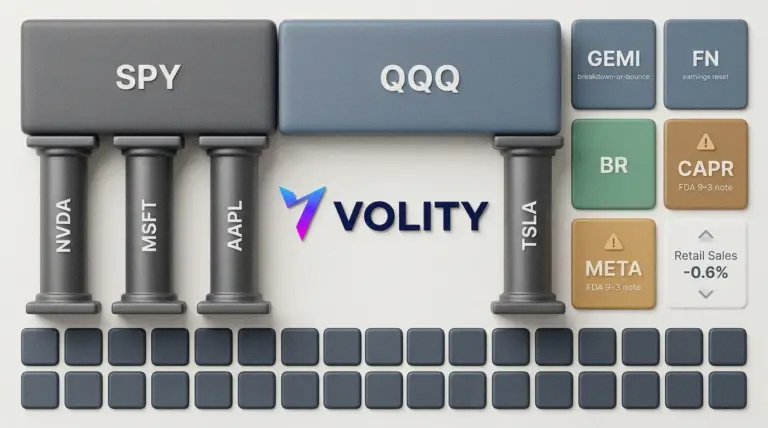
SPY and QQQ become event-risk instruments around a Federal Reserve decision. The first move often proves the least reliable.
Algorithms react to the headline first. Bond yields then shift. Traders reread the statement and change their minds.
That sequence can punish correct economic views entered at the wrong moment. Smaller positions and defined levels matter more than bold forecasts.
DIA, GLD, TLT and bitcoin deserve similar caution. Without freshly verified prices, they work better as correlation monitors than target machines.
Three names require longer clocks
Boeing, Visa and Lowe’s may still belong in an investment notebook. Their cases simply run on different clocks.
Higher fuel costs can strengthen demand for efficient aircraft. Yet Boeing needs evidence from orders, deliveries, production or cash flow.
Visa’s scale can support a relative-strength thesis. Still, a trade requires a current chart structure and a defined catalyst.
Lowe’s historical outperformance offers useful context. It does not create a fresh setup without new evidence.
- ULBI: Measure the merger spread against $16.
- VRT: Wait for a breakout level to hold.
- BSX: Demand a close below the reaction low.
- SMCI: Trade the post-earnings range, not the rumour.
- SPY and QQQ: Treat Fed hours as volatility events.
The useful discipline is to label each idea honestly. ULBI is arbitrage. VRT is conditional momentum. BSX is post-earnings confirmation.
SMCI is an event-risk watch. Boeing, Visa and Lowe’s are longer-horizon themes.
That framework may sound less exciting than a page of price targets. It gives traders something better: a reason to act, and a reason to walk away.
Related coverage on Volity
- What Is a P/E Ratio and How to Use It
- Fundamental Analysis in Stock Trading: A Working Definition
- Growth Investing vs Value Investing: Which Style Fits You?
- Fractional Shares Explained: How to Start Investing With $50
- How to Start Stock Trading: A 2026 Beginner Guide
- Dividend Investing for Beginners: How to Start