Is day trading halal? There is no single ruling to quote. Recognised fatwa bodies split on whether fast buying and selling is speculation or gambling, and on whether you own a share you sell before it settles. On trading with borrowed money and paying interest on overnight positions, the councils quoted here say it is not permissible. This guide shows who says what, with dates, so you can list the points your own trading raises and take them to a scholar you trust.
TL;DR: Named bodies disagree. Egypt’s Dar al-Ifta, Islamweb and Darul Ifta Birmingham accept share trading for profit with conditions, while two Deoband fatwas differ on selling before delivery. The Muslim World League’s Fiqh Council and Jordan’s Iftaa Department reject margin trading. A swap-free account removes the overnight swap, which is one issue among several. Take your questions to a scholar you trust.
Each view below is credited to the body or scholar who gave it, with the date on its page or a note that the page is undated. This guide gives no ruling of its own.
Why day trading raises extra questions
Day trading means opening and closing positions within the same day, often many times, to profit from small price moves. The day trading guide for beginners covers the mechanics. Islamic rules add a second test. They look at how a deal is made as well as at what is bought.
A review by Saiti and Abdullah in Al-Shajarah (2016) lists the prohibited elements scholars test for, including riba, gharar, qimar and maysir:
- Riba is interest, a gain charged on a loan or for delaying payment.
- Gharar is excessive uncertainty in a contract, such as selling what you may be unable to deliver.
- Maysir and qimar mean gambling. The Quran names maysir in Surah al-Ma’idah 5:90-91.
ShariahBoard.org, in an answer by Mufti Mohammed Ataur Rahman Sajid (16 September 2020), says what decides such trades “is first of all the possession of shares, their delivery and the transfer of risks”. For that board, the holding period is not the test.
Your own trading may raise any of these points, taken one at a time below:
- Is fast buying and selling an accepted form of speculation, or is it gambling?
- Do you own what you sell when you close the same day?
- Is any part of the position paid for with borrowed money?
- Does the position pay or receive interest if it stays open overnight?
Speculation versus gambling in scholarly discussion
Darul Iftaa Leicester reports that most contemporary scholars, including Shaykh Taqi Usmani and Dr Wahba al-Zuhayli, accept buying shares for a price gain. Its answer by Mufti Muhammad ibn Adam al-Kawthari, published by SeekersGuidance on 7 August 2010, says “speculation is not, in of itself, unlawful or disliked”. It draws a hard line where shares are never owned and only price differences are settled, and calls that a form of gambling. Trading is permitted only “if the transaction is at spot and one owns the shares.”
Egypt’s Dar al-Ifta answered on stock market speculation in general, in fatwas of 15 April 2009 and 24 July 2013. It allows it when the aim is trading and not manipulating the market, and the company is lawful with known and established assets. In its words, “the stock market is an instrument of finance and not a gambling market.”
Islamweb speaks about day trading directly. Its fatwa 314083 of 26 January 2016 says: “Day trading that is carried out in accordance with the Islamic sharee’ah is not similar to gambling.” Darul Ifta Birmingham, in an answer approved by Mufti Mohammed Tosir Miah (undated on the page), says day trading “is similar to the normal form of buying and selling for profit”.
Others are more cautious. Dr Monzer Kahf wrote on IslamOnline in 2009: “Trade is different from speculation and I see many problems in speculations from Shari’ah point of view.” He defines speculation as “having one concern only that is the price change”. Mufti Faraz Adam, one of two muftis who answer readers on the Islamic Finance Guru (IFG) forum, wrote there on 30 September 2020: “I’m currently reserved on day trading and don’t have a definitive answer. The senior scholars are against it and this is more prudent and wise to follow.”
Same-day settlement and ownership
When you buy a share, the legal transfer of the share and the cash comes later. That transfer is called settlement. UK trades settle two business days after the trade date, written T+2. According to HM Treasury, the government will mandate T+1 from 11 October 2027. A day trader who buys in the morning and sells after lunch has sold before settlement.
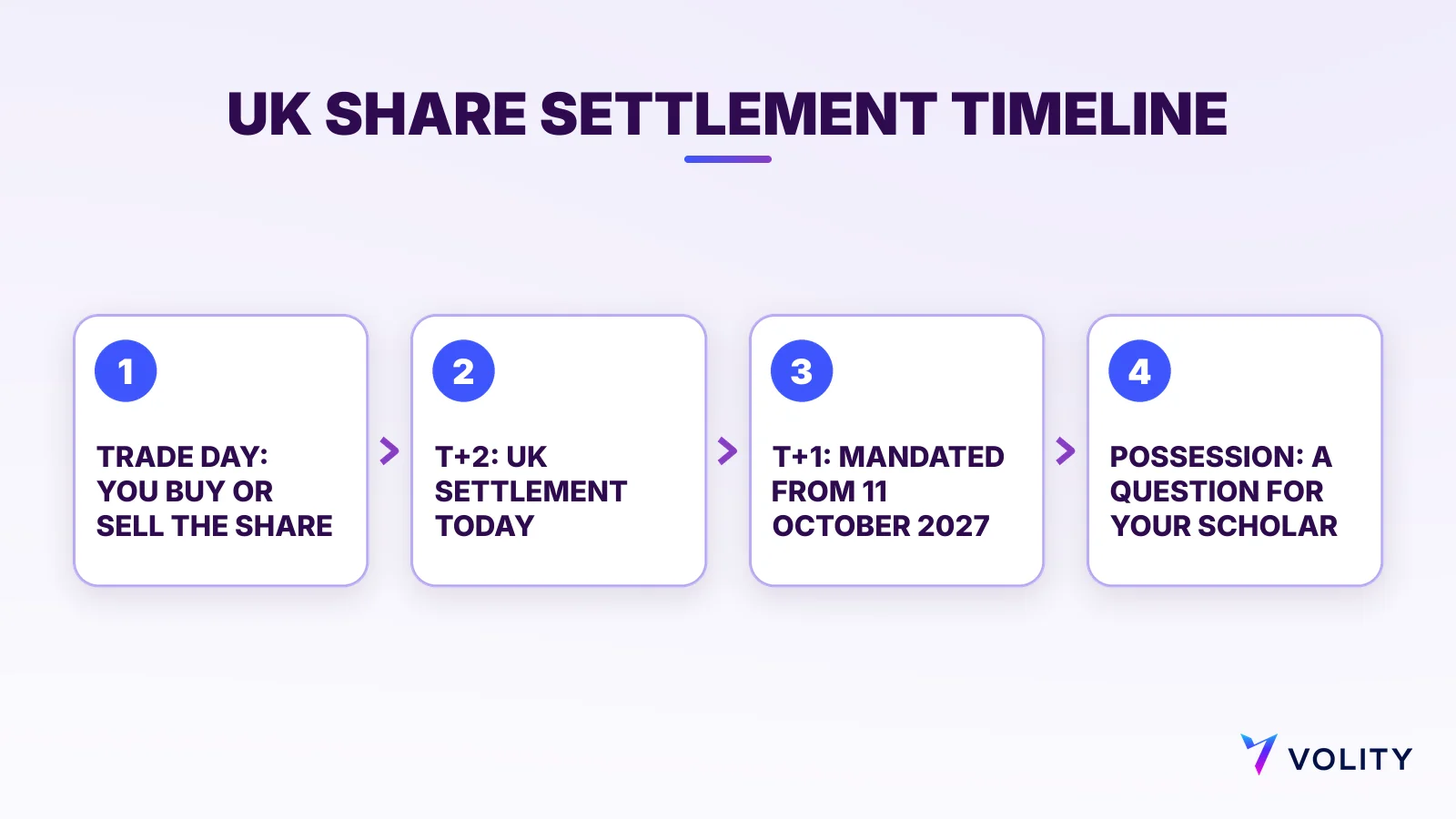
Scholars frame this as qabd, or possession. The International Islamic Fiqh Academy accepted constructive possession, such as a credit to a bank account, in Resolution 53 (4/6) of 1990, “even though the physical possession has not taken place.” AAOIFI, a standard setter for Islamic finance, ties possession to customary practice in Shariah Standard 18. On selling the same day, named bodies differ:
| Source | Reference or date | Selling before delivery |
|---|---|---|
| Darul Uloom Deoband | Fatwa 1538/1172=H/1429 | If shares take days to pass to you, “it is unlawful to sell the shares before that” |
| Darul Uloom Deoband | Fatwa 57/L=43/TL=1433 | Lawful once the risk passes to you, even on the same day. Waiting for delivery is better |
| Islamweb | 26 January 2016 | Registration in your account counts if exchange practice treats it as possession |
| Shaykh Taqi Usmani, via Darul Iftaa Leicester | 7 August 2010 | Selling before the share certificate arrives “may be permitted”, “although better to avoid” |
| Mufti Faraz Adam, IFG forum | 6 December 2020 | Many scholars say not before T+2. He says the issue “needs further research” |
So the legal settlement date and possession in a scholar’s sense are separate questions. The law sets the first. Only a scholar can answer the second for your broker and your product.
Leverage, interest and swaps in short-term trades
Leverage lets you open a position larger than the cash you put down, which is called the margin. The guide to margin and leverage explains both. Islam Question & Answer, in an answer of 7 August 2023, puts the religious problem plainly: “Using financial leverage when dealing with an organisation means taking a loan from that organisation.”
On borrowing and deferred payment, the councils quoted here point one way:
- The Islamic Fiqh Council of the Muslim World League, at its 18th session in Makkah in April 2006, judged trading in margins not permissible. As printed by Islam Question & Answer, its reasons include riba through fees for delaying the deal and a loan combined with a sale.
- Darul Iftaa Jordan says margin trading is forbidden, partly because “any loan which provides benefit to the lender is considered usury” (undated on the page).
- Malaysia’s National Fatwa Committee, at its 98th session in February 2012, prohibited individual spot forex through electronic platforms. The JAKIM e-Fatwa text cites rollover interest, leverage and unclear possession. The council’s chairman clarified, as reported by The Star, that it did not cover forex trading by money changers or between licensed banks.
- The International Islamic Fiqh Academy’s Resolution 102 (5/11) of 1998 says: “It is not permissible in Shariah to sell currencies by deferred sale”.
Short selling means selling borrowed shares and buying them back later, hoping for a lower price. Here bodies split. Malaysia’s Securities Commission Shariah Advisory Council ruled on 18 April 2006 that regulated short selling is in line with Shariah (resolution reproduced by Maybank Islamic). Abdulazeem Abozaid of Qatar Foundation wrote in 2021 that AAOIFI’s Shariah Standard 21 prohibits it.
Then there is the overnight swap or rollover. On Volity, positions held past 22:00 GMT may pay or receive an overnight (swap) amount, based on the interest-rate differential or on the leverage cost for non-forex CFDs. The rate for each instrument is shown on the platform. The guide to forex swap rates explains how the amount arises.
A swap-free account, often called an Islamic account, is built to remove that overnight swap. Volity offers swap-free (Islamic) accounts. Islam Question & Answer, in an answer of 12 April 2015, says the “Islamic” version “may avoid one infraction, which is fees for delaying the deal”. It adds that abolishing these fees “does not mean that the dealings are halal”. Shaykh Muhammad Carr, writing for SeekersGuidance on 12 October 2025, says of swap-free forex: “Even without interest, forex trading remains impermissible.” The comparison of Islamic forex brokers shows how such accounts differ.
Habits that keep trading disciplined
The religious questions sit beside a practical one. A study of Brazilian equity futures (FGV EESP working paper 525, 2020) followed everyone who began day trading in 2013-2015 and kept going for at least 300 days. It found “97% of them lost money”, and only 0.4% earned more than a bank teller. In Taiwan over 1992-2006, fewer than 1% of day traders could “predictably and reliably earn positive abnormal returns net of fees” (Journal of Financial Markets, 2014). In the UK, the FCA requires CFD firms to tell retail customers what percentage of their retail accounts make losses.
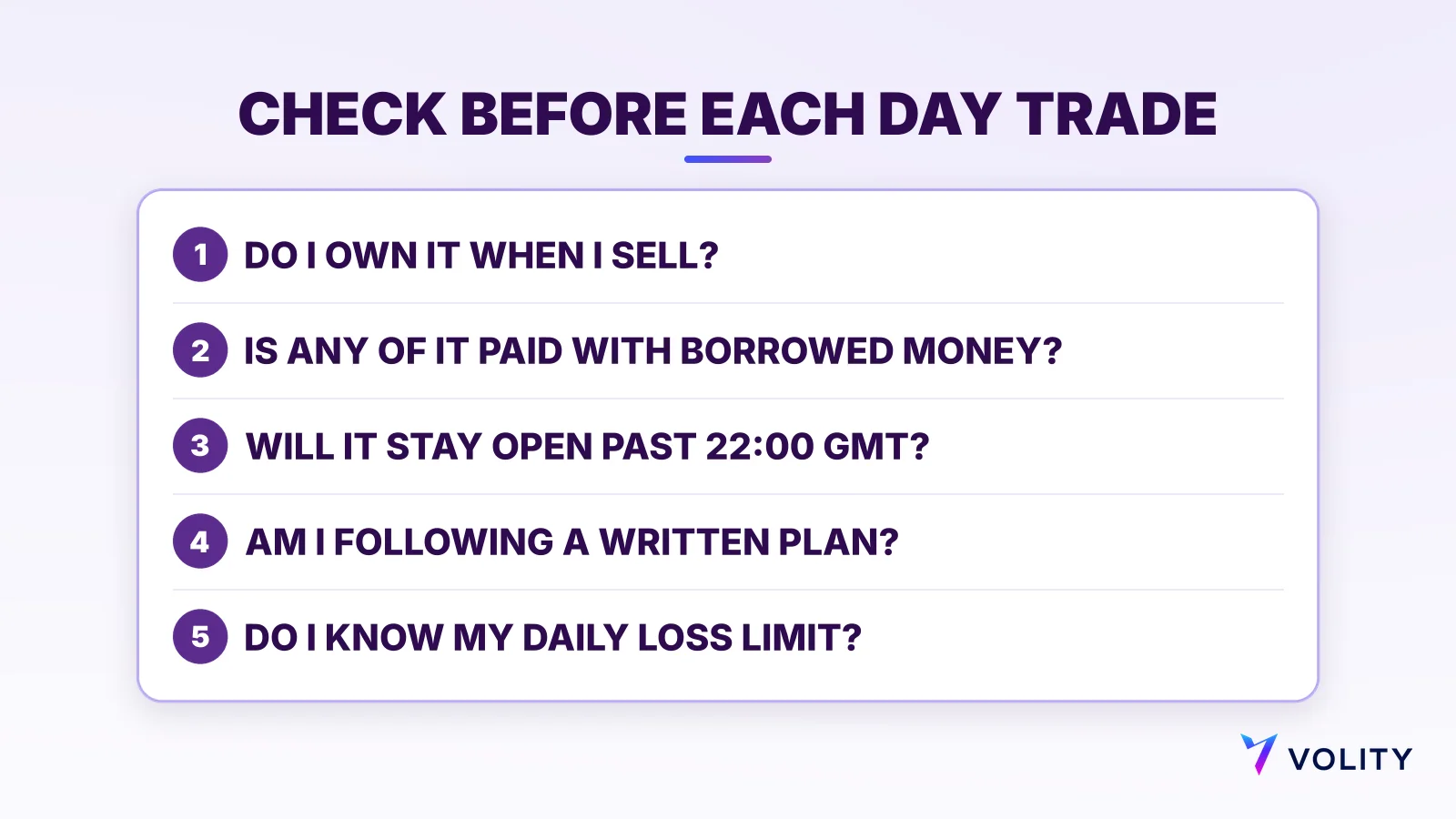
Habits cannot settle a religious question. They do keep each decision deliberate:
- Write a plan before each session: the market, the entry, the exit and the size.
- Set a daily loss limit in advance, and stop for the day when you reach it.
- Close positions before 22:00 GMT if you want none open overnight.
- Keep a journal of each trade and the reason for it, and review it every week.
- Stop after a run of losses instead of trading to win the money back. The guide to controlling your emotions when trading covers this habit.
Practise on a free demo
A demo account uses virtual money on live prices, so you can test your plan before real money is at stake. A free demo is available on every Volity account tier. The comparison of demo and live trading accounts explains what changes when you switch. Work through these steps in order:
- Write down which points from the first section your trading touches.
- Add the product details: shares or contracts, with or without leverage, closed the same day or held overnight.
- Take that note to a scholar you trust and ask about your exact way of trading.
- Open an account, start on the free demo and read the swap-free (Islamic) account terms.
- Trade your written plan on the demo for a fixed period, such as four weeks, and keep a journal.
- Review the journal for broken loss limits and positions held past 22:00 GMT.
- Read the charges and fees page before you fund a live account.
A demo shows how you trade. It cannot tell you whether that trading is permitted. That answer belongs to your scholar, and the list from this guide is what to bring. Companion guides ask the same question under the titles “Is forex trading halal?” and “Is trading halal?”.
Fact check: Positions come from the published pages of the bodies named above, including the Muslim World League’s Fiqh Council (as printed by Islam Question & Answer), Egypt’s Dar al-Ifta, Darul Uloom Deoband, Islamweb, Malaysia’s National Fatwa Committee, the International Islamic Fiqh Academy and AAOIFI. Settlement dates come from HM Treasury. All sources were read on 10 November 2026.
Frequently asked questions
Is day trading haram?
No single ruling covers it. Egypt’s Dar al-Ifta, Islamweb and Darul Ifta Birmingham accept trading shares for profit with conditions. Mufti Faraz Adam wrote in 2020 that he is reserved on day trading. The Muslim World League’s Fiqh Council, in 2006, judged margin trading not permissible.
Is intraday trading halal?
In the fatwas quoted here, it turns on possession. One Darul Uloom Deoband fatwa says selling before the shares pass to you is unlawful. Another allows a same-day sale once the risk has passed to you. UK shares settle at T+2 today.
Is scalping allowed in Islam?
Scalping is very short-term trading for small price moves. ShariahBoard.org says the holding period is not the test: possession, delivery and the transfer of risk are. Darul Iftaa Leicester calls trading where nothing is owned a form of gambling.
Is day trading the same as gambling?
Islamweb says day trading carried out according to the Sharia “is not similar to gambling”. Egypt’s Dar al-Ifta calls the stock market “not a gambling market” when its conditions are met. Dr Monzer Kahf says he sees “many problems in speculations”.
Can I day trade on a swap-free account?
Volity offers swap-free (Islamic) accounts. Such an account removes the overnight swap, which arises only on positions held past 22:00 GMT. Islam Question & Answer says such a version may avoid one infraction, fees for delaying the deal, but is not safe from others, such as lending combined with getting something in return. Ask your scholar about each point.
Is trading for a living halal?
None of the fatwas quoted here rules on trading as a job. They look at each transaction. The financial risk is a separate matter: in a Brazilian study, 97% of day traders who kept going for at least 300 days lost money.