Crypto under pressure as rates, outflows and security risks reshape the market
November 14, 2026 – Crypto heads into the weekend under pressure from rates, ETF withdrawals and fresh security concerns. Bitcoin slipped below $70,000, while Ether lost the $2,000 level.
Traders also faced $1.4 billion of liquidations during the past 24 hours. Most came from bullish positions, which amplified an already uneasy retreat.
Bitcoin loses its footing
Bitcoin fell towards $69,000 on Friday as investors cut risk across global markets. The move looked modest at first, but forced sales soon accelerated it.
US spot Bitcoin ETFs recorded withdrawals on every session between November 9 and November 13. The funds lost about $1.07 billion over the week.
That brought November’s first two weeks of net ETF outflows to roughly $2.35 billion. BlackRock’s iShares Bitcoin Trust, IBIT, also suffered several consecutive redemption days.
Still, the longer view remains much stronger. Cumulative net inflows into US spot Bitcoin ETFs stood near $54.7 billion through November 13.
Yet markets trade on the next buyer, not the previous one. That buyer has become harder to find while bond yields remain attractive.
- Bitcoin: near $69,000 after losing $70,000
- Bitcoin ETF outflows: about $1.07 billion for November 9-13
- Crypto liquidations: more than $1.4 billion in 24 hours
- Fed funds range: 3.75% to 4.00%
Inflation leaves little room for comfort
US producer prices rose 0.3% in October, slightly below the 0.4% forecast. Annual producer inflation, however, reached 6.5%.
Core PPI also increased 0.3% from September and held a 5% annual pace. The data briefly lifted Bitcoin towards $70,000, before sellers returned.
Boston Fed President Susan Collins said further rate rises might still be needed. Her remarks landed poorly with investors already trimming volatile holdings.
The Federal Reserve meets again on December 9. Traders now see that decision as crypto’s next major macroeconomic test.
Higher yields offer investors a clear alternative to tokens without income. They also make leveraged trades more expensive to hold and refinance.
Bitcoin’s recent trading has mirrored equities more closely than gold. Since 2022, it fell on 92% of the stock market’s worst sessions.
Ether breaks below $2,000
Ether changed hands near $1,935 after breaking below $2,000. Roughly $249.8 million in Ether-linked positions were liquidated over 24 hours.
Spot Ethereum ETFs added to the weakness. They lost about $144.8 million on November 11 alone.
BlackRock’s ETHA accounted for roughly $129.8 million of that total. Such concentration makes individual fund flows especially visible during thin sentiment.
Chart traders now watch $1,900. A decisive break could expose $1,850, followed by $1,750.
Conversely, Ether needs to reclaim $2,000 before its near-term picture improves. That level has become both a technical marker and a confidence test.
Ethereum developers continue work beneath the price action. A new draft proposes generic proof verification and sponsored batch processing.
The approach could let several transaction claims share a single proof. Sponsors could then cover retained parts of each batch separately.
Lower costs may help users and applications. However, cheaper transactions could also weaken fee income and token-burning activity.
Security problems reach beyond wallets
Security concerns again reached the industry’s less glamorous machinery. Attackers have used exposed Microsoft SQL Servers to install Monero miners and Gh0st RAT malware.
The remote-access trojan can give intruders control of compromised systems. Mining malware may be the visible symptom, rather than the main objective.
Trezor also tightened its distribution after finding three compromised wallets with implants. The hardware-wallet company reportedly cut its reseller network by 80%.
Bitcoin Core developers disclosed a Tor-related weakness affecting thousands of nodes. Network flaws can expose users to surveillance, disruption or possible deanonymisation.
Custody does not end with a hardware wallet or a vault provider. Supply chains, employee permissions, endpoints and network settings all shape the risk.
Telegram’s gift market offers a brighter spot
Telegram’s collectible gifts generated about 40.8 million TON in sales during the 30 days through November 13. That amounted to roughly $44.8 million across 1.91 million transactions.
MRKT led activity in the emerging market. The sales suggest digital collectibles can find demand inside platforms with established daily users.
Questions over liquidity and speculation remain. Still, the numbers stand out against a broader NFT market producing about $33.63 million in sales.
Regulators focus on prediction markets
Prediction markets now face louder political and regulatory scrutiny. A federal dispute involving the CFTC and Justice Department challenges Arkansas restrictions aimed at Kalshi.
Representative James Comer has also urged a ban on government trading through prediction platforms. The argument reaches far beyond one company.
Officials must decide whether event contracts resemble financial instruments, gambling products or something new. That choice will shape access, surveillance and disclosure rules.
Wall Street firms are also pushing into crypto perpetual futures. Their advance raises familiar questions about leverage, liquidations and market oversight.
What traders will watch next
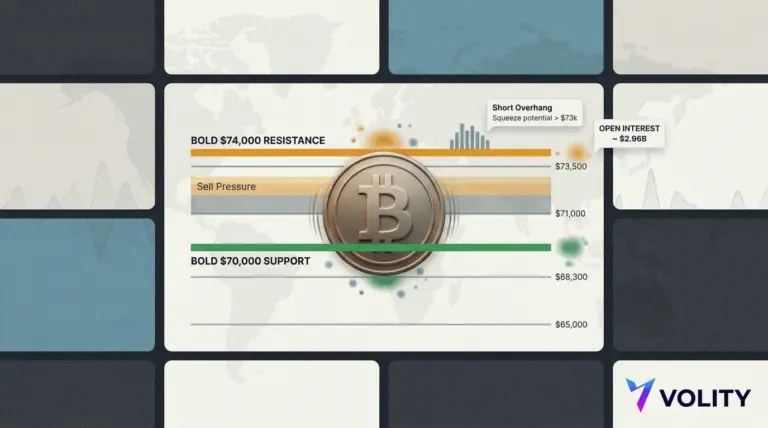
- Bitcoin needs to regain $70,000, while the mid-$60,000s form the next broad support area.
- Ether needs $2,000 back before traders can call the latest breakdown temporary.
- Daily ETF flows remain the clearest gauge of institutional demand.
- The December 9 Fed decision could reset risk appetite across tokens and equities.
Crypto no longer trades apart from the wider financial system. Rates, equity weakness, fund flows and operational failures now move through the same market.
That makes liquidity and risk controls more valuable than grand forecasts. In the present market, patience may prove a better asset than leverage.
Related coverage on Volity
- How to Avoid Crypto Scams: A Beginner Safety Checklist
- How to Choose a Trading Platform: A 10-Point Checklist
- Demo vs Live Trading Account: A 7-Step Checklist Before You Go Live
- How to Size a Trade: Position Sizing and Risk Per Trade for Beginners
- Risk-Reward Ratio Explained: How to Set It and Why It Matters
- ETF vs Index Fund: The Difference and Which to Pick