...

What is Depth of Market (DOM) and Level 2 Data in Forex?

Table of Contents
Quick Summary
Depth of Market (DOM) data, also known as Level 2 data, provides real-time visibility into an asset’s order book, showing pending buy and sell orders beyond the best bid and ask prices. This information helps Forex traders gauge market sentiment and identify areas of liquidity or potential price movement. It is a critical tool for understanding market microstructure.

Understanding DOM and Level 2 data is crucial for traders seeking an edge in the competitive Forex market. These advanced tools offer insights beyond standard price charts, enabling more informed decision-making.

What is Depth of Market (DOM)?

Depth of Market (DOM) data, also known as Level 2 data, provides real-time visibility into the order book, showing pending buy and sell orders beyond the best bid and ask, according to Investopedia. This comprehensive view helps traders assess market sentiment and identify areas of significant liquidity or potential price pressure. It is a critical tool for understanding market microstructure.

The primary purpose of Depth of Market (DOM) is to offer a broader picture of market activity than a simple price chart. While charts show past price movements, DOM reveals the intentions of market participants by displaying the volume of buy and sell orders waiting to be executed at various price levels.

This real-time data is particularly valuable in forex trading, where understanding underlying demand and supply can inform tactical decisions. It allows traders to see the “depth” of interest, indicating how much buying or selling pressure exists at different price points.

While understanding Depth of Market (DOM) is important, applying that knowledge is where the real growth happens. Create Your Free Forex Trading Account to practice with a free demo account and put your strategy to the test.

What is Level 2 Data and the Order Book?

Level 2 Data is the specific information displayed within the Depth of Market (DOM), detailing the entire order book for a given currency pair. It expands beyond the single best bid and ask prices to show multiple layers of these orders, providing a more granular view of market depth. This data is essential for analyzing order flow.

The order book serves as the central engine for both DOM and Level 2 data. It is a real-time electronic list of buy and sell orders for a specific financial instrument, organized by price level.

On one side, the bid side, traders see the prices at which market participants are willing to buy (bid) a currency, along with the corresponding quantities. On the other side, the ask side, it displays the prices at which participants are willing to sell (ask), also with their associated volumes.

This detailed structure allows for a clear visualization of supply and demand dynamics, highlighting where liquidity clusters.

What information does a DOM window show?

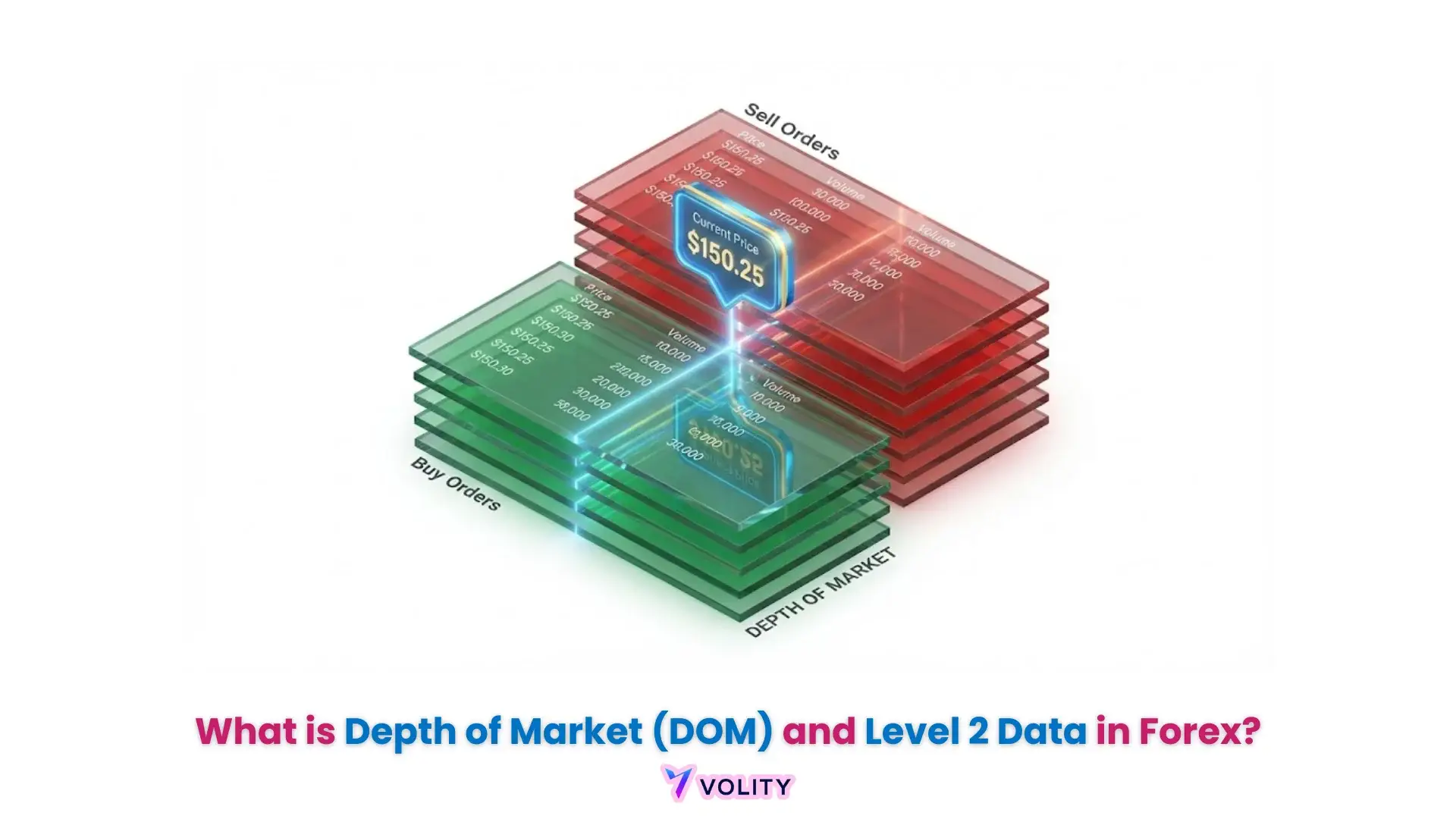
A DOM window typically displays a vertical price ladder with bid prices on one side and ask prices on the other, showing the volume of pending orders at each price level. It provides a visual representation of market depth, including the best bid and ask, along with deeper layers of liquidity.

This window is central to visualizing market depth.

A typical DOM window presents a dynamic, vertical display of prices. At the center, the current market price is often highlighted. Above it are the ascending ask (sell) prices, each paired with the total quantity of currency units waiting to be sold at that level.

Below the current market price are the descending bid (buy) prices, similarly showing the cumulative volume of units buyers are willing to purchase. This layout reveals the immediate supply and demand landscape, allowing traders to identify significant buy walls and sell walls that could act as support or resistance.

💡 KEY INSIGHT: A DOM window provides a real-time “x-ray” of market intentions, revealing where significant buying and selling interest is concentrated beyond the immediate best bid and ask.

How does DOM differ from Level 1 data?

Depth of Market (DOM), or Level 2 data, fundamentally differs from Level 1 data by providing a comprehensive view of the entire order book, not just the best bid and ask prices. While Level 1 offers a snapshot of current market prices, Level 2 reveals multiple layers of pending orders at various price levels, offering deeper insight into market liquidity and potential price movements. This distinction is crucial for advanced analysis.

The distinction between Level 1 data and Level 2 data is fundamental for any trader looking to move beyond basic market observation. Level 1 data, which is widely available and often free, provides only the most basic information: the current best bid price and the current best ask price.

This is what most retail traders see on their charting platforms or brokerage interfaces. It tells you the highest price a buyer is willing to pay and the lowest price a seller is willing to accept at that exact moment.

Level 2 data, conversely, offers a multi-dimensional view of the market. It shows not only the best bid and ask but also the quantity of buy and sell orders at various price levels above and below the current market price.

This expanded view reveals the “depth” of the market, indicating where significant pools of liquidity are located. For instance, a large cluster of buy orders at a specific price level suggests strong support, while a large cluster of sell orders indicates resistance. Analyzing these bid and ask prices across multiple levels provides a significant advantage.

Level 1 Data: The Basic View

Level 1 data represents the most basic market quote, showing only the best bid and ask prices for a financial instrument. This is the top-level information that provides an immediate, single-point snapshot of the market. While useful for quick price monitoring, Level 1 data offers limited insight into the broader market dynamics or the underlying supply and demand. It does not reveal the volume of orders waiting at other price levels.

Level 2 Data: revealing Hidden Liquidity

Level 2 data contrasts sharply with Level 1 by highlighting its comprehensive view of the order book, revealing multiple price levels and corresponding order sizes. This deep insight into market data allows traders to see beyond the immediate best bid and ask. It reveals hidden liquidity, showing where large quantities of orders are clustered, which can act as dynamic support and resistance levels. This detailed view is critical for understanding actual market depth.

Level 1 Data vs. Level 2 Data

FeatureLevel 1 DataLevel 2 Data
Information ShownBest Bid/Ask PriceMultiple Bid/Ask Levels + Order Sizes
Market InsightLimited (Snapshot)Comprehensive (Market Depth, Order Flow)
VisibilityTop of the Order BookDeeper into the Order Book
Use CaseBasic Price MonitoringAdvanced Analysis, Entry/Exit Optimization

Ready to Elevate Your Trading?

You have the information. Now, get the platform. Join thousands of successful traders who use Volity for its powerful tools, fast execution, and dedicated support.

Create Your Account in Under 3 Minutes

Why is Level 2 data important for traders?

Level 2 data is important for traders as it provides crucial insights into liquidity and order flow, enabling a more nuanced understanding of market dynamics beyond simple price charts. By revealing pending orders, it helps identify potential support and resistance levels, anticipate price movements, and optimize entry and exit points within a trading strategy. This comprehensive view enhances decision-making.

For serious traders, especially those engaged in day trading or scalping, Level 2 data is not merely an optional extra; it is an essential component of their trading strategy. It moves beyond showing what the price is doing to reveal why it might be doing it.

The ability to visualize the entire order book allows traders to see where significant buying and selling interest lies, which can significantly impact short-term price movements. This deeper insight helps in validating trade ideas and improving the timing of executions.

Gaining Insight into Liquidity and Order Flow

Level 2 data offers direct insight into market liquidity by showing the volume of orders at various price levels, indicating where significant capital is poised to enter or exit the market. This data forms the basis of order flow analysis, which tracks the real-time buying and selling pressure to gauge market sentiment and potential directional bias. Understanding order flow is key to a robust trading strategy.

Liquidity refers to the ease with which an asset can be bought or sold without significantly affecting its price. In the Forex market, high liquidity is common, but Level 2 data allows traders to pinpoint where that liquidity is concentrated. Large clusters of pending buy orders (a “buy wall”) suggest strong demand and potential support, while substantial sell orders (a “sell wall”) indicate strong supply and potential resistance.

Observing these concentrations helps traders anticipate areas where price might stall or reverse. Order flow is the study of these individual buy and sell orders as they enter, execute, and exit the market. By analyzing the speed, size, and location of these orders on the DOM, traders can infer the short-term intentions of market participants.

Identifying Support, Resistance, and Potential Price Movements

One of the most practical applications of Level 2 data is its ability to help identify dynamic support and resistance levels. Unlike static lines on a chart, these levels on the DOM are fluid, represented by large quantities of pending orders.

A significant build-up of buy orders below the current price can act as a floor, preventing further declines. Conversely, a large concentration of sell orders above the current price can cap upward movement.

Traders use this information to anticipate potential price movements. If price approaches a strong sell wall and the orders begin to diminish, it might signal an impending breakout. Conversely, if price repeatedly bounces off a strong buy wall, it reinforces that level as reliable support.

Combining these observations with price action analysis provides a more robust signal for potential entry or exit points.

The Role of ECN Brokers in Forex DOM

In the decentralized Forex market, the quality and transparency of Level 2 data are heavily influenced by the type of broker a trader uses. ECN brokers (Electronic Communication Network) typically offer more transparent and direct access to Level 2 data compared to market maker brokers, according to LiteFinance.

ECNs aggregate price feeds from multiple liquidity providers, offering a more representative, though still not universal, view of the market’s depth.

Market maker brokers, on the other hand, often create their own internal order books, meaning the Level 2 data they provide reflects only their internal liquidity. This can be less insightful as it doesn’t represent the broader market.

Therefore, for traders who rely on DOM and Level 2 analysis, choosing an ECN broker is often a preferred component of their trading strategy to access more reliable market data.

Tip: When choosing a Forex broker for DOM analysis, prioritize ECN brokers known for transparent liquidity sources. Their aggregated data offers a more reliable view than market maker brokers.

How to read and interpret Level 2 data?

To effectively read and interpret Level 2 data, traders must analyze the bid and ask prices alongside the corresponding order sizes displayed in the order book. Key indicators include large order clusters, significant imbalances between buy and sell volumes, and the speed at which these orders appear or disappear.

level 2 data dom analysis

This analysis helps gauge market sentiment and potential short-term directional bias.

Interpreting the Depth of Market (DOM) window requires a systematic approach, focusing on key elements that reveal market dynamics. The primary goal is to understand the balance of power between buyers and sellers at various price levels. Start by observing the best bid and ask prices, as these represent the immediate trading range.

Then, expand your focus to the deeper levels of the order book, paying close attention to the size of orders. Large orders, often referred to as “blocks” or “icebergs,” can signal institutional interest.

A sudden appearance of a large buy order at a specific bid price suggests strong support, while a large sell order at an ask price indicates significant resistance.

Spotting Imbalances and Potential Reversals

Spotting imbalances in Level 2 data involves identifying significant disparities between the liquidity on the bid side versus the ask side of the order book. A large concentration of buy orders compared to sell orders indicates potential upward pressure, while the inverse suggests bearish sentiment, signaling potential price reversals or continuations.

This analysis is a key part of interpreting order flow.

One of the most powerful aspects of DOM analysis is the ability to spot imbalances. If the buy side of the order book (bid prices) shows significantly larger aggregate volumes than the sell side (ask prices), it suggests a strong underlying demand.

This imbalance can signal that the price is likely to find support and potentially reverse upwards, or continue an existing uptrend. The opposite holds true for a dominant sell side, indicating potential resistance and downward pressure. However, while Level 2 data offers strong predictive potential, it is not a guarantee for price movements.

Integrating DOM with Price Action for Stronger Signals

For stronger and more reliable trading signals, it is highly advisable to integrate DOM insights with traditional price action analysis. Price action refers to the study of how prices move over time, often through candlestick patterns, chart formations, and support/resistance levels visible on a standard chart.

When DOM confirms what price action is already suggesting, the conviction behind a trade setup significantly increases.

For example, if a currency pair is approaching a historical support level on a chart, and the DOM simultaneously shows a substantial build-up of buy orders at that same price, it provides a powerful confluence of signals.

This combination suggests that both historical price behavior and current market interest align, increasing the probability of a bounce. Conversely, a breakout of a chart pattern might be confirmed by a sudden clearing of orders on the DOM, indicating a lack of opposing interest. This integrated approach forms a robust trading strategy.

What are the limitations of DOM in Forex?

The primary limitation of Depth of Market (DOM) in the Forex market stems from its decentralized nature, meaning the data often represents an aggregated view from a single ECN broker’s liquidity pool, not a global market snapshot.

Unlike centralized exchanges, this fragmented data can be influenced by High-Frequency Trading (HFT) and spoofing, making interpretation more complex and less universally representative.

The Forex market operates as a decentralized, over-the-counter (OTC) market, fundamentally different from centralized exchanges where stocks and futures are traded. This structural difference imposes significant limitations on the Depth of Market (DOM) data available to retail Forex traders.

While DOM is standardized in centralized exchanges, its representation in the decentralized Forex market can vary significantly between ECN brokers, reflecting their specific liquidity pools, according to MultiCharts.

This means that the Level 2 data you see from your broker is often an aggregation of orders from their specific liquidity providers, not a complete, global picture of all market participants.

Many traders question the true efficacy of DOM in Forex due to this decentralization, often asking, “Does DOM really work in Forex, or is it just for stocks/futures?” The answer is that it does work, but with caveats. Traders must understand that they are viewing a slice of the market, not the entire pie.

Understanding Aggregated vs. True Level 2 Data

The concept of aggregated data is central to understanding Level 2 data in Forex. Even when using ECN brokers, the data presented is typically an aggregation of orders from the various liquidity providers that broker works with.

This aggregated view is valuable, as it still provides a representation of supply and demand within that specific liquidity pool. However, it is not a universal, consolidated order book that encompasses every single pending order across the entire global Forex market.

This distinction is crucial for interpreting “true” market sentiment. A large order block visible on one broker’s DOM might not reflect a global institutional order, but rather a significant order within that broker’s specific network.

Traders should factor this into their analysis, using DOM as a strong indicator of local liquidity and short-term order flow, rather than an absolute predictor of global market moves.

The Impact of High-Frequency Trading (HFT) and Spoofing

The modern Forex market is heavily influenced by High-Frequency Trading (HFT) firms, which execute millions of trades in milliseconds. HFT algorithms can rapidly place and cancel orders on the DOM, creating fleeting liquidity that can disappear before a retail trader can react.

This rapid order flow can make interpreting the DOM challenging, as apparent buy or sell walls might vanish in an instant.

Furthermore, spoofing, the act of placing large orders without the genuine intent to execute them, is a common tactic in liquid markets, and advanced order flow analysis is required to identify it, as stated by Optimus Futures.

Spoofers aim to trick other market participants into believing there is significant buying or selling pressure, only to cancel their orders at the last moment. This can lead to retail traders being “whipsawed,” entering trades based on misleading signals.

Recognizing the signs of spoofing, such as large orders appearing and disappearing quickly without actual price movement, is an advanced skill for DOM users.

How can I use DOM and Level 2 data in my trading strategy?

Advanced Depth of Market (DOM) and Level 2 data strategies involve not just reading the order flow but also identifying deceptive tactics like spoofing and iceberg orders. Traders integrate DOM with tools like VWAP and Volume Profile for comprehensive market context, while simultaneously managing the psychological impact of rapid order shifts to avoid emotional pitfalls.

This holistic approach refines trading decisions.

For traders seeking to truly master Depth of Market (DOM) and Level 2 data, moving beyond basic interpretation requires incorporating advanced strategies. These techniques focus on extracting genuine signals from the noisy market environment and combining them with other analytical tools for a more robust trading strategy.

The goal is to discern the true intentions of larger market participants and to avoid being misled by fleeting or deceptive order flow.

Identifying and Countering Spoofing & Iceberg Orders

Successfully navigating the DOM involves more than just seeing large orders; it requires discerning genuine interest from deceptive tactics. Spoofing, as discussed, involves placing and canceling large orders to manipulate perception. To counter this, traders look for rapid order cancellations without corresponding price movement, or large orders that consistently “walk” away from the market.

Genuine interest often remains in place longer and is accompanied by actual price action towards those levels.

Another advanced concept is iceberg orders. These are large institutional orders that are intentionally broken down into smaller, visible limit orders that replenish as they are filled. On the DOM, an iceberg order appears as a consistently re-appearing small order at a specific price level, even as visible volume at that level gets hit.

Traders identify these by observing a level that seems to have an endless supply of bids or offers, indicating hidden, deeper liquidity. Addressing the common pain point, “How do I filter out fake orders or spoofing?” , the key lies in observing the persistence and reaction of orders, rather than just their size.

Combining DOM with VWAP and Volume Profile

For a more comprehensive understanding of market dynamics, advanced traders often combine DOM insights with other powerful tools such as VWAP (Volume Weighted Average Price) and Volume Profile. VWAP provides a benchmark for the average price at which an asset has traded throughout the day, weighted by volume.

Prices trading above VWAP suggest bullish sentiment, while prices below indicate bearishness. Combining this with DOM allows traders to see if significant order flow is occurring above or below this institutional benchmark.

Volume Profile displays the total volume traded at each price level over a specified period, typically overlaid on a chart. This creates a horizontal histogram showing areas of high and low volume. When DOM shows a large order cluster at a price level that also aligns with a high-volume node on the Volume Profile, it significantly strengthens the potential for that level to act as strong support and resistance. This integrated approach elevates the trading strategy by providing multiple layers of confirmation.

The Psychology of Order Flow: Avoiding Emotional Pitfalls

A crucial, yet often overlooked, aspect of advanced Depth of Market (DOM) trading is understanding its psychological impact. The rapid, real-time nature of order flow can induce strong emotional responses, such as fear of missing out (FOMO) when large orders appear, or panic when they disappear.

Studies suggest that up to 70% of retail traders fail due to poor risk management and emotional decision-making, often exacerbated by misinterpreting market data like DOM, according to Earn2Trade.

This makes managing emotional pitfalls a key differentiation point. Traders must cultivate discipline to avoid impulsive decisions based on fleeting order imbalances or the visual drama of a fast-moving DOM.

Recognizing psychological levels—round numbers or previous significant highs/lows where order clusters might form—and observing how price interacts with them on the DOM, can help in maintaining perspective. The goal is to use DOM as an analytical tool, not an emotional trigger, to make rational decisions aligned with a predefined trading strategy.

WARNING: The rapid changes on the DOM can trigger emotional responses. Always combine DOM analysis with a disciplined trading plan to avoid impulsive decisions driven by fear or greed.

Is DOM available for all Forex brokers?

Depth of Market (DOM) data is not available from all Forex brokers; it is primarily offered by ECN brokers who provide direct market access to their aggregated liquidity pools. Market maker brokers typically do not offer true Level 2 data, as their order books are internal. Accessing this data usually involves selecting a specialized broker or platform.

Accessing reliable Level 2 data for Forex market trading is a critical step for any trader looking to implement advanced order flow strategies. However, not all Forex brokers provide access to this detailed market depth. As highlighted earlier, the type of broker significantly impacts the availability and quality of DOM data.

ECN brokers are generally the go-to choice for traders seeking Level 2 data. These brokers connect directly to multiple liquidity providers, aggregating their order books to present a deeper view of pending orders. Platforms like NinjaTrader, MultiCharts, and TradingView (for some instruments) often integrate DOM functionality, either natively or through add-ons, allowing traders to visualize market depth. When choosing a platform, look for intuitive interfaces that clearly display bid/ask prices, order sizes, and the ability to place orders directly from the DOM ladder.

What are the costs associated with Level 2 data subscriptions?

The costs associated with Level 2 data subscriptions for Forex market trading can vary, ranging from free (bundled with some ECN accounts) to $10-50 per month for premium feeds.

Whether it is “worth it” for retail Forex traders depends on their trading style, capital, and commitment to learning advanced order flow analysis, as the insights require significant skill to translate into profitable trades.

The cost of Level 2 data subscriptions can vary widely. Some ECN brokers may offer basic DOM access as part of their standard account package or for a minimal fee, especially if you meet certain trading volume requirements.

More comprehensive or faster data feeds, particularly those from independent data providers, can cost anywhere from $10 to $50 per month, or even more for institutional-grade access. Traders should investigate these costs carefully and factor them into their overall trading expenses.

The question of whether Level 2 data is “worth it” for retail Forex market traders is a common one. For beginners with limited capital, the learning curve and subscription costs might outweigh the immediate benefits.

However, for intermediate to advanced traders who are committed to understanding order flow and integrating it into a disciplined trading strategy, the insights provided by DOM can be invaluable. It offers a distinct edge over relying solely on price charts, potentially leading to better entry/exit points and improved risk management.

Verifying Data Quality and Broker Transparency

Given the decentralized nature of the Forex market, verifying the quality and transparency of the Level 2 data provided by your broker is paramount. Traders should not hesitate to ask their broker specific questions about their liquidity sources. Inquire about the number and type of liquidity providers they aggregate data from.

A broker that is transparent about its data feed sources is generally more reliable.

Additionally, pay attention to the speed and refresh rate of the DOM data. Lagging or inconsistent data can be detrimental to real-time order flow analysis. Look for brokers and platforms that offer fast, real-time updates.

Testing the DOM in a demo environment before committing real capital is also a prudent step to make sure the data quality meets your trading strategy requirements.

Tip: Always inquire about your broker’s liquidity sources and test their DOM data in a demo environment. This makes sure the data quality and refresh rate meet your specific trading strategy needs.

Common User Challenges & Expert Solutions

Even with a solid understanding of Depth of Market (DOM) and Level 2 data, traders frequently encounter practical challenges that can hinder effective implementation. Addressing these pain points with expert solutions can significantly improve a trader’s ability to leverage DOM for better trading decisions.

Challenge 1: “I see all these numbers on the DOM, but I don’t know what to look for. What’s actually useful?”

This is a very common challenge for new DOM users, who can feel overwhelmed by the sheer volume of real-time data. The solution lies in prioritizing key information. Instead of trying to process every single number, focus on:

  • Large Order Clusters: Identify unusually large quantities of orders (buy walls or sell walls) at specific price levels. These indicate significant liquidity and potential support and resistance.
  • Sudden Imbalances: Look for rapid shifts where one side (buy or sell) suddenly dominates the order book in terms of volume. This signals a strong, immediate directional bias in order flow.
  • Speed of Changes: Observe how quickly orders appear and disappear. Fast-moving changes can indicate High-Frequency Trading (HFT) activity or potential spoofing, requiring caution.
  • Interaction with Price: Pay attention to how the current price interacts with these large order clusters. Does it bounce off them, or does it slice through them, indicating a shift in power?

By focusing on these actionable cues, traders can filter out the noise and identify genuinely useful signals from the DOM.

Challenge 2: “I tried using DOM but got whipsawed. How do I filter out fake orders or spoofing?”

Getting whipsawed by fake orders or spoofing is a frustrating experience but a common learning curve for DOM traders. The key to filtering these out is to combine observation with confirmation:

  • Confirmation with Price Action: Never rely solely on DOM signals. If a large order appears, wait for the price action to confirm its validity. If the price doesn’t react as expected (e.g., a large buy wall appears but price continues to fall through it), it might be a spoof.
  • Observe Persistence: Genuine large orders tend to persist at a price level for a reasonable amount of time, allowing price to interact with them. Spoofing orders often appear and disappear rapidly without being filled.
  • Contextual Analysis: Consider the broader market context. Is the large order appearing at a significant psychological level or a known support and resistance area? Such locations are more likely to attract genuine institutional interest.
  • Look for Iceberg Orders: As discussed, watch for continuously replenishing smaller orders at a single price level, which indicate hidden large orders. These are genuine and powerful.

Filtering out deceptive orders requires patience, practice, and the discipline to wait for multiple confirmations before acting on a DOM signal.

Turn Knowledge into Profit

You've done the reading, now it's time to act. The best way to learn is by doing. Open a free, no-risk demo account and practice your strategy with virtual funds today.

Open a Free Demo Account

Key Takeaways

  • Real-Time Order Insight: Depth of Market (DOM) and Level 2 data display pending buy and sell orders beyond the best bid/ask, providing a detailed view of market liquidity.
  • Deeper Market Analysis: Unlike Level 1 data, Level 2 shows multiple price levels and order sizes, giving traders enhanced insights into order flow and potential price movements.
  • Forex Market Specifics: Due to Forex’s decentralized nature, DOM data is typically aggregated by ECN brokers rather than reflecting a universal market view.
  • Advanced Trading Strategies: Traders use DOM to identify and counter spoofing and iceberg orders, often integrating it with tools like VWAP and Volume Profile for stronger analysis.
  • Psychology and Mastery: Effective DOM trading requires managing the psychological impact of rapid order flow and combining DOM insights with price action to generate reliable trading signals.

BOTTOM LINE

Depth of Market (DOM) and Level 2 data are indispensable tools for Forex traders seeking a deeper understanding of market dynamics beyond conventional price charts. These tools provide real-time visibility into the order book, revealing pending buy and sell orders that highlight crucial liquidity zones and order flow imbalances.

While the decentralized nature of the Forex market presents unique challenges compared to centralized exchanges, mastering the interpretation of aggregated data, identifying deceptive practices like spoofing and iceberg orders, and integrating DOM with other analytical tools like VWAP and Volume Profile can significantly improve a trader’s edge.

Furthermore, recognizing and managing the psychological impact of rapid order shifts is paramount for disciplined decision-making. Ultimately, for committed retail traders, the investment in learning and accessing quality Level 2 data offers a pathway to more informed and potentially more profitable trading strategies.

FAQ

DOM vs. Time and Sales: What's the difference?
Depth of Market (DOM) provides a snapshot of pending limit orders at various price levels, showing potential future liquidity, while Time and Sales records executed market orders in real-time. DOM reflects intent, whereas Time and Sales shows actual action.
Is Level 2 data good for long-term Forex trading?
Level 2 data is most useful for short-term strategies like scalping and day trading, where order flow changes rapidly. For long-term Forex trading focused on macro trends, Level 2 data's granular details are less relevant.
Can I use Level 2 data on mobile trading apps?
Some mobile trading apps offer basic charting, but full-featured Level 2 data and DOM interfaces are generally complex. Desktop platforms are preferred for comprehensive order flow analysis.
How does Level 2 data help with stop-loss and take-profit placement?
Level 2 data helps identify large clusters of pending orders (buy/sell walls) on the DOM, allowing traders to place stop-losses just beyond strong support/resistance levels and take-profits just before major opposing order blocks, improving risk management.
What are 'iceberg orders' and how do I spot them on DOM?
Iceberg orders are large institutional orders split into smaller visible limit orders to hide the true size. On DOM, they appear as a specific price level where a small bid or ask quantity consistently replenishes after being filled, signaling a larger hidden order.

References

Start Your Days Smarter!

Expand Your Knowledge

Get market insights, education, and platform updates from the Volity team.

Start Your Days Smarter!

High-Risk Investment Notice:  Website information does not contain and should not be construed as containing investment advice, investment recommendations, or an offer or solicitation of any transaction in financial instruments. It has not been prepared in accordance with legal requirements designed to promote the independence of investment research, and it is not subject to any prohibition on dealing ahead of the dissemination of investment research. Nothing on this site should be read or construed as constituting advice on the part of Volity Trade or any of its affiliates, directors, officers, or employees.

Please note that content is a marketing communication. Before making investment decisions, you should seek out independent financial advisors to help you understand the risks.

Services are provided by Volity Trade Ltd, registered in Saint Lucia, with the number 2024-00059. You must be at least 18 years old to use the services.

Trading forex (foreign exchange) or CFDs (contracts for difference) on margin carries a high level of risk and may not be suitable for all investors. There is a possibility that you may sustain a loss equal to or greater than your entire investment. Therefore, you should not invest or risk money that you cannot afford to lose. The products are intended for retail, professional, and eligible counterparty clients. For clients who maintain account(s) with Volity Trade Ltd., retail clients could sustain a total loss of deposited funds but are not subject to subsequent payment obligations beyond the deposited funds. Professional and eligible counterparty clients could sustain losses in excess of deposits.

Volity is a trademark of Volity Limited, registered in the Republic of Hong Kong, with the number 67964819.
Volity Invest Ltd, number HE 452984, registered at Archiepiskopou Makariou III, 41, Floor 1, 1065, Lefkosia, Cyprus is acting as a payment agent of Volity Trade Ltd.

Volity Trade Ltd. is an introductory broker for UBK Markets Ltd. It offers execution and custody services for clients introduced by Volity. UBK Markets Ltd is authorised and regulated by the Cyprus Securities and Exchange Commission (CySEC), license number 186/12 and registered at 67, Spyrou Kyprianou Avenue, Kyriakides Business Center, 2nd Floor, CY-4003 Limassol, Cyprus.

Volity Trade Ltd. does not offer services to citizens/residents of certain jurisdictions, such as the United States, and is not intended for distribution to or use by any person in any country or jurisdiction where such distribution or use would be contrary to local law or regulation.

Copyright: © 2025 Volity Trade Ltd. All Rights reserved.