A forex signal provider sells or publishes trade ideas: a currency pair, a direction, an entry price, a stop-loss and a target. No ranking of these sellers carries a regulator’s approval, and no seller can promise a result. The useful question is how to check one before you pay or follow. This guide shows what regulators publish about signal sellers, the arithmetic behind a claimed win rate, and a test you can run on a free demo first.
TL;DR: A signal tells you which trade to place, and you still decide whether to place it. Before you trust a provider, look up the person and any firm behind it on the FCA Register and the FCA Warning List. Read the win rate together with the average win and the average loss, because a 90% win rate can still lose money. Treat promised returns, pressure to act fast and upfront payments as warning signs. Then follow the signals on a demo for at least a month and compare your own log with the seller’s claims.
The checks matter because the selling happens at scale. In a week of action from 20 April 2026, the UK Financial Conduct Authority identified 1,267 illegal financial adverts that reached at least 2,338,372 UK accounts. It reported that 66% of them came from firms or individuals already on its Warning List.
What a forex signal provider sells
A signal is a message that describes a trade. The EU markets regulator ESMA, in its supervisory briefing on copy trading (ESMA35-42-1428, March 2023), describes trading signals as “messages containing the characteristics of the last transaction” and calls the trader who creates them the “signal provider”.
A typical forex signal names the currency pair (for example EUR/USD), the direction (buy or sell) and the entry price. It also gives a stop-loss, the price where the trade closes to cap your loss. The take-profit is the price where it closes to lock in a gain.
You can act on a forex signal through a contract for difference (CFD), a product that tracks a price without you owning the currency. Every trade also pays the spread, the gap between the buy price and the sell price. Those costs sit outside the signal itself.
ASIC’s consumer site Moneysmart says: “Be wary of claims that a course, trading signal service, copy-trading service, program or AI tool can accurately predict movements in foreign currencies.” It adds that “Currency markets are extremely difficult to predict”.
Following signals, copy trading and managed accounts differ
The key difference is who presses the button. IOSCO, the global body of securities regulators, cites the Dutch AFM in its report on online imitative trading (FR/06/2025, May 2025). In one model, “the investor receives signalling trades and decides whether to translate the signals into order”. In another, a platform “automatically translates these signals into orders”. ESMA adds that when a firm converts signals into trades sent without the client’s confirmation, it “would be considered as providing a portfolio management service.”
 copy trading and 52.89% for managed accounts" loading="lazy">
Sellers do not always use the words this way. The MQL5 signals marketplace states that “Signals is a copy-trading service allowing you to automatically copy provider’s deals on your trading account”. Before you pay, ask which service you are buying: ideas you place yourself, or trades placed for you.
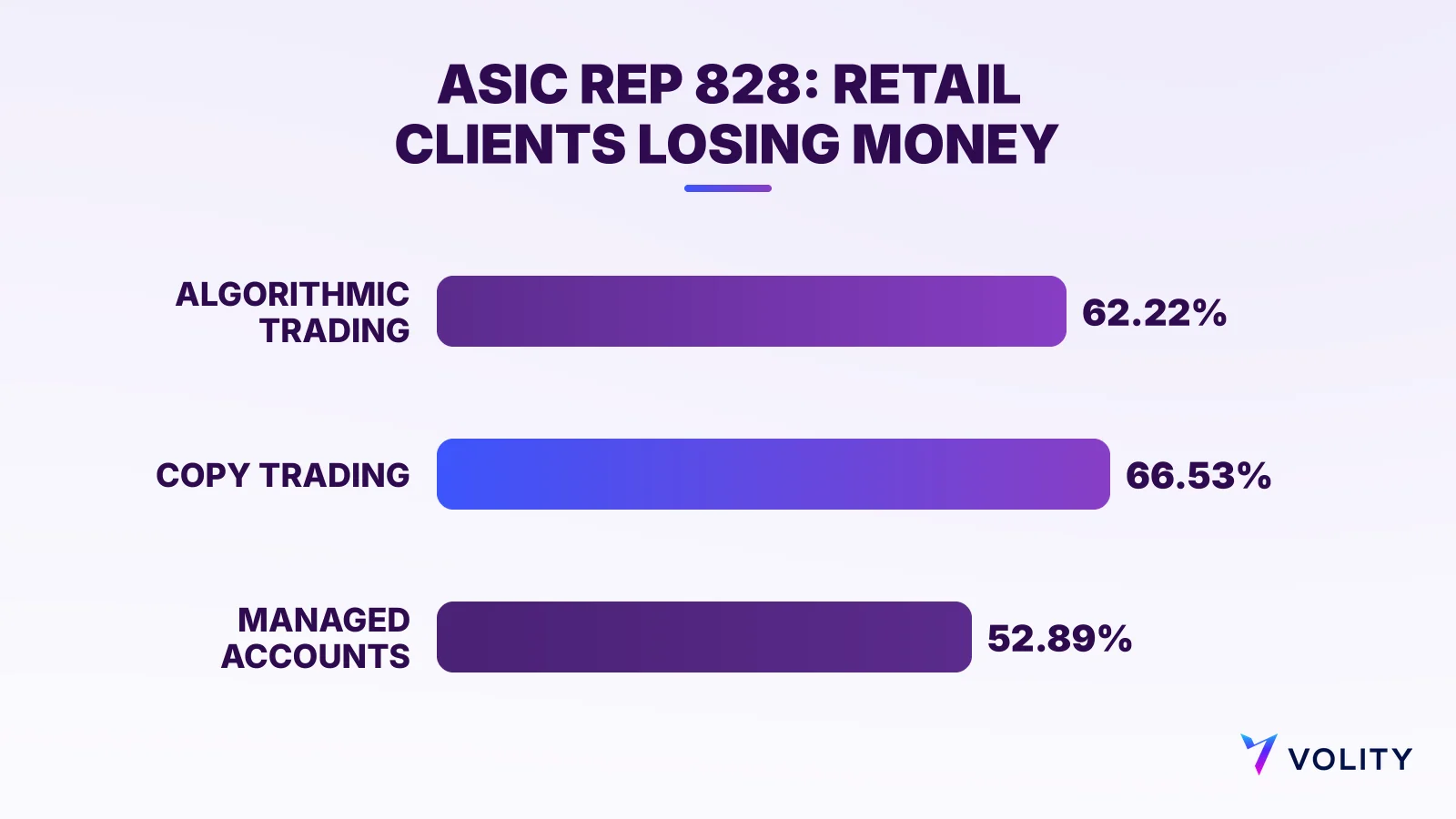
We found no regulator data on people who follow signals by hand. The closest data comes from Australia. In ASIC Report 828 (January 2026, data for FY2023-24), Table 11 shows the share of retail CFD clients who made a loss, by how they traded:
| Method | Clients | Share loss-making |
|---|---|---|
| Algorithmic trading | 8,873 | 62.22% |
| Copy trading | 26,243 | 66.53% |
| Managed accounts | 121 | 52.89% |
Across all retail clients in the report, 68% lost money. The managed-account group is very small. Still, handing the decision to someone else’s system did not turn most clients into winners.
What a verified track record proves
Some sellers show a “verified” record on Myfxbook. Its help page explains the two badges. Track Record verification “indicates to users that the account’s trading history shown on Myfxbook matches the account’s trading history provided by the broker on the trading platform”. Trading Privileges verification “confirms that the individual who added the trading account possesses the master password”.
In our reading, that confirms the history matches the broker’s records. It does not show that the seller is authorised, that subscribers get the same prices, or what happens next. MQL5 says the same about its own listings: “Historical statistics cannot guarantee any profitability in the future.” Look at these points before the headline return:
- How many months and trades the record covers.
- The drawdown, the largest fall from a peak in the balance.
- The average win and the average loss.
- Whether the account shown is the one the signals come from. Ask the seller, since the badge does not say.
Your fills can differ too. A signal sent to many people can fill at a worse price than quoted, a gap called slippage.
Why a 90% win rate can still lose money
A win rate counts how often a trade wins. It says nothing about how much each win and each loss is worth. Expectancy, the average result per trade, joins the two:
Expectancy = (win rate x average win) minus (loss rate x average loss)
Here are three hypothetical plans. A unit is a fixed sum, say EUR 10. The break-even win rate is risk / (risk + reward).
| Plan | Win rate | Average win | Average loss | Expectancy | Break-even win rate |
|---|---|---|---|---|---|
| A | 40% | 3 units | 1 unit | +0.6 units | 25% |
| B | 70% | 1 unit | 1 unit | +0.4 units | 50% |
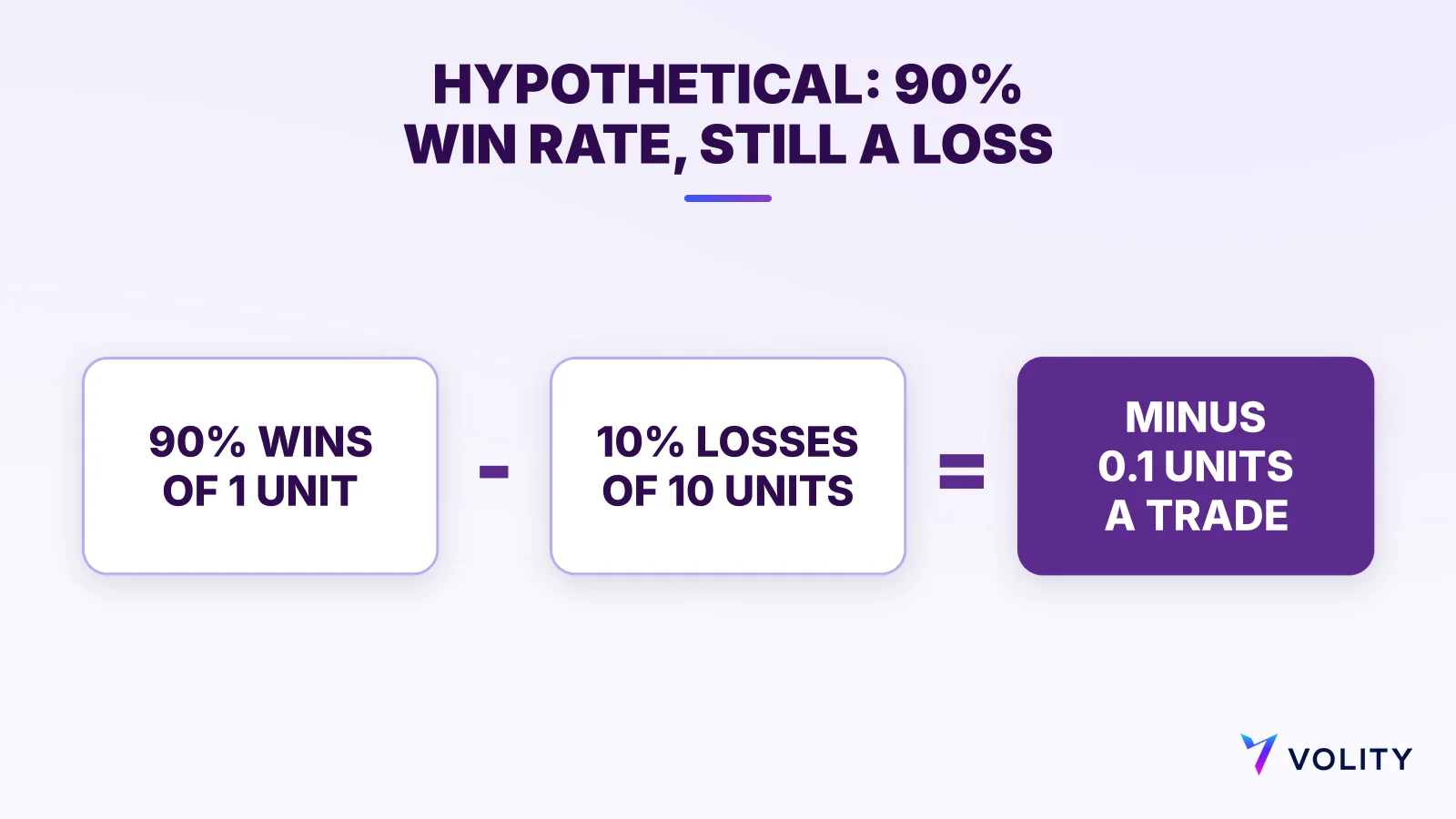
| C | 90% | 1 unit | 10 units | -0.1 units | 90.9% |
Plan A wins less than half the time and earns the most: 0.4 x 3 minus 0.6 x 1 = +0.6 units per trade. Plan C wins 90% of the time and loses: 0.9 x 1 = 0.9 units in, 0.1 x 10 = 1.0 units out, so minus 0.1 units per trade. Over 100 trades, that is 90 small wins worth 90 units against 10 large losses worth 100 units, a net loss of 10 units, or EUR 100.
Plan C needs 90.9% winners just to break even, so a “90% win rate” can be a losing record. A seller who quotes only the win rate is leaving out half of the sum. Our guide to the risk-reward ratio shows how target and stop set the break-even rate; a 1:2 plan needs 33.3%. Spreads and overnight charges raise every break-even figure in the table.
The sales patterns regulators warn about
The FCA’s October 2025 warning on CFDs describes this market plainly: “Some of these finfluencers promise consumers unrealistic returns if they copy trades, invest in managed accounts or pay for daily trading tips. Over 90,000 people have lost around £75m over a 4-year period in this way at just one firm.”
IOSCO’s final report on finfluencers (FR/08/2025, May 2025) names signals directly. Most regulators it surveyed pointed to fraudulent products such as “trading tools (algorithms, robots and trading signals)”, and said such promoters “would typically request significant advance payments”. Describing a UK case, IOSCO mentions “unregistered ‘FX educators’ and ‘signals providers’ (these signals may constitute regulated advice and thus breach FCA’s rules)”.
Automated tools draw the same warning. In media release 26-063MR, ASIC lists this tactic: “Scammers claiming their trading bots use AI to generate passive income and unachievable returns. It is very unlikely that these trading bots exist.”
IOSCO’s report and its tips for investors point to these warning signs:
- Promises of exceptional performance or steady returns with low risk.
- Pressure to act now. IOSCO says: “Be wary of finfluencers who push emotional buttons”.
- Large followings and five-star ratings, because “credibility, expertise and ratings can be faked”.
- A request for a large payment before you see any signal.
- General tips sold as if they fit your situation.
The FCA’s guidance on social media promotions (FG24/1, March 2024) says they must be “fair, clear and not misleading”, with risks shown next to benefits.
Check the seller and the firm in five minutes
Run these steps before any money moves. Each uses a free public source.
- Write down the exact names: the person, the company, the website and any channel handle.
- Search the FCA Financial Services Register for the firm and see which activities it is authorised to carry out.
- Search the FCA Warning List, linked from the FCA’s guide to protecting yourself from scams. In June 2025 the FCA said: “Consumers should check the FCA’s Warning List before making any decision about how to invest their money.”
- Check your own regulator’s list too, for example the CySEC warnings to investors. In Australia, Moneysmart tells readers to check that the provider holds an AFS licence.
- Ask whether the seller itself is authorised to give advice. A broker the seller names may be regulated while the seller is not.
- Ask how the seller is paid. IOSCO’s due-diligence tip asks investors to look for conflicts of interest.
- If any step fails, stop and report the seller to your regulator.
The FCA’s June 2025 action shows why the list check comes first. In one week it made 3 arrests and issued 50 warning alerts, which it said would result in over 650 take down requests on social media platforms.
How the seller earns and what you pay
A signal seller can earn from subscriptions, courses, paid “VIP” groups or a payment linked to the trades you open. Ask which applies. A group that sends many alerts a day can push you into more trades than your plan allows; our guide on how to avoid overtrading sets daily limits.
Your own trading costs come on top of any subscription. On Volity, the Markets account is commission-free and spreads start from 0.6 pip. Every charge is listed on the Volity charges and fees page, and the execution policy sets out how orders are filled.
Test a provider’s signals on a demo first
A demo account uses virtual money at live prices, so you can test a seller’s claims without risk. Follow every signal the seller sends for at least a month. For each one, note the time it arrived, the price you got, the stop, the target and the result.
Then work out your own win rate, average win, average loss and expectancy, and compare them with the seller’s record. If your expectancy is negative, or far below the seller’s, you have your answer before real money is at risk. A free demo is available on every Volity account tier.
Signals and copy trading on Volity
Copy trading and curated trading signals are available on Volity. The same rules apply as with any outside seller: a signal is an idea, you size the trade from its stop, and you judge results by expectancy. Forex on Volity trades with leverage up to 1:500. Leverage magnifies losses as well as gains. Volity operates under CySEC licence 186/12 via UBK Markets.
Fact check: Expectancy and break-even figures are our own arithmetic on hypothetical numbers (11 November 2026). Regulator sources: FCA press releases of June 2025, October 2025 and April 2026, FCA FG24/1 (March 2024), IOSCO FR/06/2025 and FR/08/2025 (May 2025), ESMA35-42-1428 (March 2023), ASIC REP 828 (January 2026), ASIC 26-063MR and ASIC Moneysmart. Platform statements from Myfxbook and MQL5. Volity details from volity.io. Sources checked 10-11 November 2026.
Frequently asked questions
Are forex signal providers legal?
Selling trade ideas can be lawful, but the rules depend on the country and the service. IOSCO’s 2025 report notes that, in a UK case, signals from unregistered sellers may constitute regulated advice. Check the seller on a regulator’s register.
Can a signal provider guarantee profits?
No signal can guarantee a profit. Moneysmart tells readers to be wary of signal services that claim to predict currency moves accurately. MQL5 states that past statistics cannot guarantee future profit.
What does a verified Myfxbook track record prove?
According to Myfxbook, it shows that the trading history on the site matches the history held by the broker. It does not show that the seller is authorised, that you will get the same prices, or that past results will repeat.
Are Telegram signal channels regulated?
A channel is only a way to deliver messages. What matters is whether the person or firm behind it is authorised for the service it sells. The FCA asks consumers to check its Warning List first.
Are trading signals the same as copy trading?
Regulators separate them. With a signal, you receive the trade idea and decide whether to place it. With automatic copy trading, the platform places the trade for you. ESMA’s briefing says a firm that places copied trades without your confirmation would be providing portfolio management.
How long should I test a signal provider on a demo?
Test for at least a month and log every signal: entry, stop, target, the price you got and the result. Then compare your own expectancy with the seller’s record before you use real money.