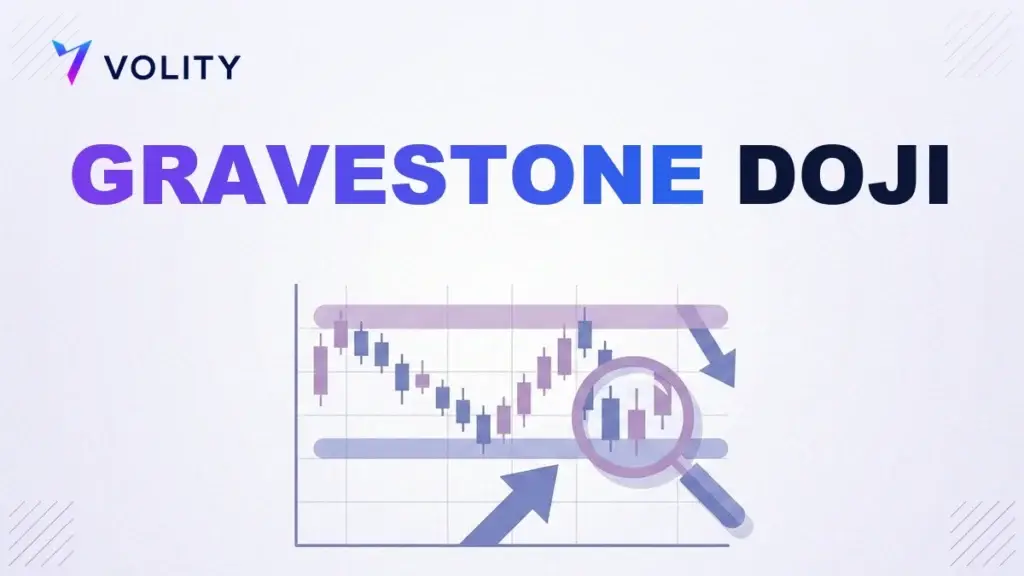
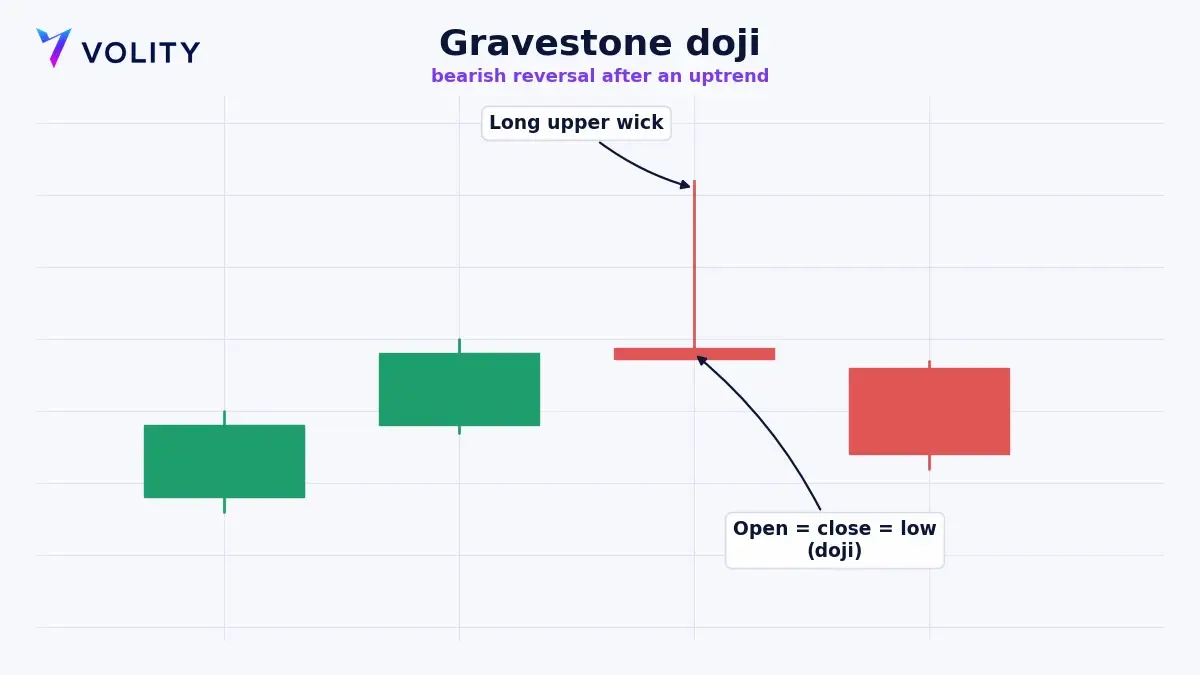
A gravestone doji is a bearish reversal candle. It opens, closes and bottoms at almost the same low price, while a long upper wick shows that buyers pushed higher during the session and were then rejected. When one appears at the top of an uptrend or at resistance, it warns that momentum is turning and that sellers have taken control.
What is a gravestone doji?
A doji is any candle where the open and close finish at virtually the same price, so the real body is a thin line. The gravestone doji is the version with a long upper shadow and little or no lower shadow. Price opens near the low, rallies hard through the session, then falls all the way back to close where it started. The result looks like an upside-down T, or a gravestone, which is where the name comes from.
The message inside the gravestone doji candlestick is rejection. Buyers held the session in their hands and could not keep the gains, and every bit of the advance was handed back by the close. One candle on its own proves little. At the right location it is one of the cleaner single-bar warnings that an uptrend is running out of fuel.
Is the gravestone doji bullish or bearish?
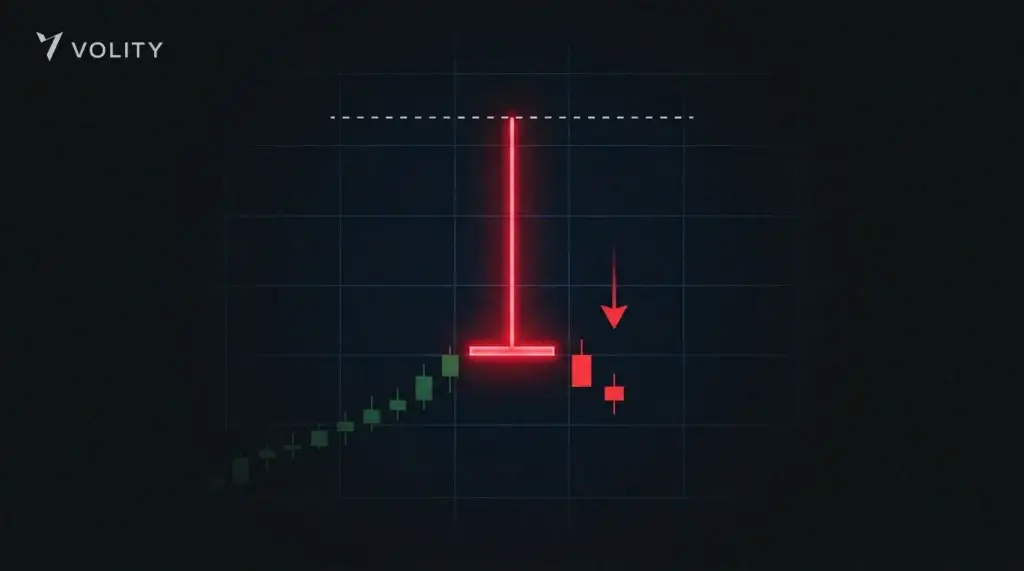
The gravestone doji is a bearish signal, though only when it prints in the right place. Context does most of the work with candlesticks. A gravestone doji at the top of an extended uptrend, or right at a known resistance level, is a genuine reversal warning, because the failed rally shows demand drying up exactly where you would expect sellers to defend.
The same shape in the middle of a choppy range means very little. And a gravestone doji at the bottom of a downtrend is ambiguous, often better left alone. Location is what turns the candle from a curiosity into a tradable idea, so always read where it prints before you act on the doji gravestone shape itself.
Gravestone doji vs dragonfly doji: what is the difference?
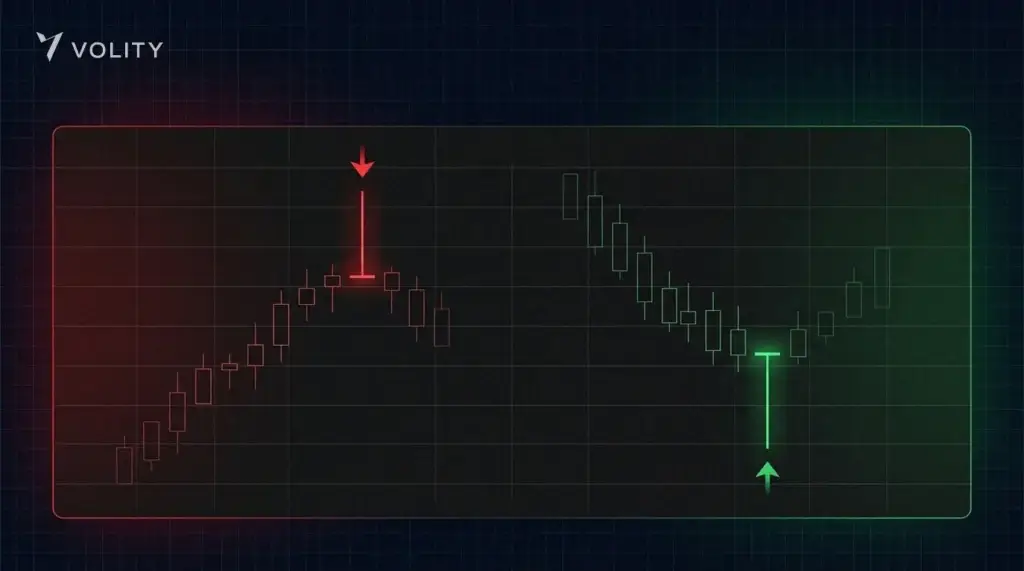
The gravestone doji has a mirror image called the dragonfly doji. They are the same idea flipped upside down, and traders tend to learn them as a pair, since together they cover both ends of a trend.
| Feature | Gravestone doji | Dragonfly doji |
| Long shadow | Upper | Lower |
| Open, close and extreme cluster at | The low | The high |
| Shape | Upside-down T | Upright T |
| Best location | Top of uptrend / resistance | Bottom of downtrend / support |
| Signal | Bearish reversal | Bullish reversal |
The dragonfly doji candlestick tells the opposite story. Price opens near the high, sells off hard, then buyers drag it all the way back to close near the top. That failed sell-off at support hints at a bullish turn. Learn to read one and you can read the other. The gravestone caps rallies; the dragonfly lifts declines.
How do you trade a gravestone doji?
A gravestone doji is where you start paying attention. It rarely pays to sell the instant one prints, because a doji reflects indecision, so most traders wait for the next candle to show which way the market breaks before committing.
- Check the location first. The candle should sit at the top of an uptrend or at established resistance, not in mid-range noise.
- Wait for the next candle to close below the doji’s body. That close is your evidence that sellers have followed through.
- Enter short as the confirming candle closes, or on a shallow pullback into the level that just broke.
- Put the stop above the top of the upper wick. That high is the natural invalidation point, and if price reclaims it the reversal has failed.
- Aim the target at prior support, such as the last swing low or a nearby structure level, and trail the stop if a wider downtrend takes hold.
Volume and timeframe both add weight. A gravestone doji on the daily or four-hour chart carries far more meaning than one on a one-minute chart, and heavier volume on the rejection strengthens the case. The higher the timeframe, the more traders saw the same rejection, and the more reliable the signal tends to be.
What are the limits of the gravestone doji?
No single candle is a complete system. The gravestone doji throws up false signals too, especially on low timeframes or in thin, illiquid conditions where one large order can distort the wick. A perfect gravestone, where open and close match to the tick, is also rare, so in practice you will take candles with a tiny real body and a dominant upper shadow.
Treat the pattern as one input among several, the way a chartered market technician would. Combine it with the trend and a clear resistance level, wait for a confirming close, and it becomes a high-quality piece of evidence. Trade it alone in the middle of a range and it is just noise. The candlestick gravestone doji earns its reputation only when the context around it agrees.
Trading reversals on Volity
Spotting a reversal is only half the job. You also need a platform that lets you act on it in either direction. On Volity you can short a topping market as readily as you go long, trading forex, indices, gold and crypto as CFDs from one account. The Volity platform renders clean candlesticks across every timeframe, so a gravestone doji on the daily is easy to spot and act on, and there is plenty to learn about reading candlestick charts before you rely on one live. Execution runs on Volity MT, regulated by CySEC under UBK Markets, licence 186/12.
Getting started is deliberately low-friction. Opening an account costs nothing, you can practise on a free demo, invest from as little as $1, and begin trading from $1. Define your stop above the wick, size the position to that risk, and use up to 1:500 leverage (product-dependent) with discipline rather than reaching for the maximum. Full trading costs are set out on the charges and fees page.
CFDs are leveraged products, so a position moves further on the same price change than an unleveraged one would, in both directions. A gravestone doji can sharpen your timing and help define your risk. It cannot remove it.
Related patterns
Frequently asked questions
Is a gravestone doji always bearish?
It is bearish when it forms at the top of an uptrend or at resistance, where the failed rally signals exhaustion. The same candle in mid-range, or at the bottom of a downtrend, carries little meaning, so location decides the signal.
What is the difference between a gravestone doji and a shooting star?
Both have a long upper shadow and appear at tops, but a shooting star keeps a small real body, while a gravestone doji has almost no body at all, with the open and close pinned at the same low. The gravestone is the more extreme, purer rejection of the two.
Do I need to wait for confirmation after a gravestone doji?
In most cases, yes. A doji reflects indecision, so waiting for the next candle to close below its body confirms that sellers have followed through and filters out many false reversals before you enter.
What does a dragonfly doji signal?
A dragonfly doji is the bullish mirror of the gravestone. It has a long lower shadow and forms at the bottom of a downtrend or at support, where a failed sell-off hints that buyers are stepping back in and a reversal higher may follow.