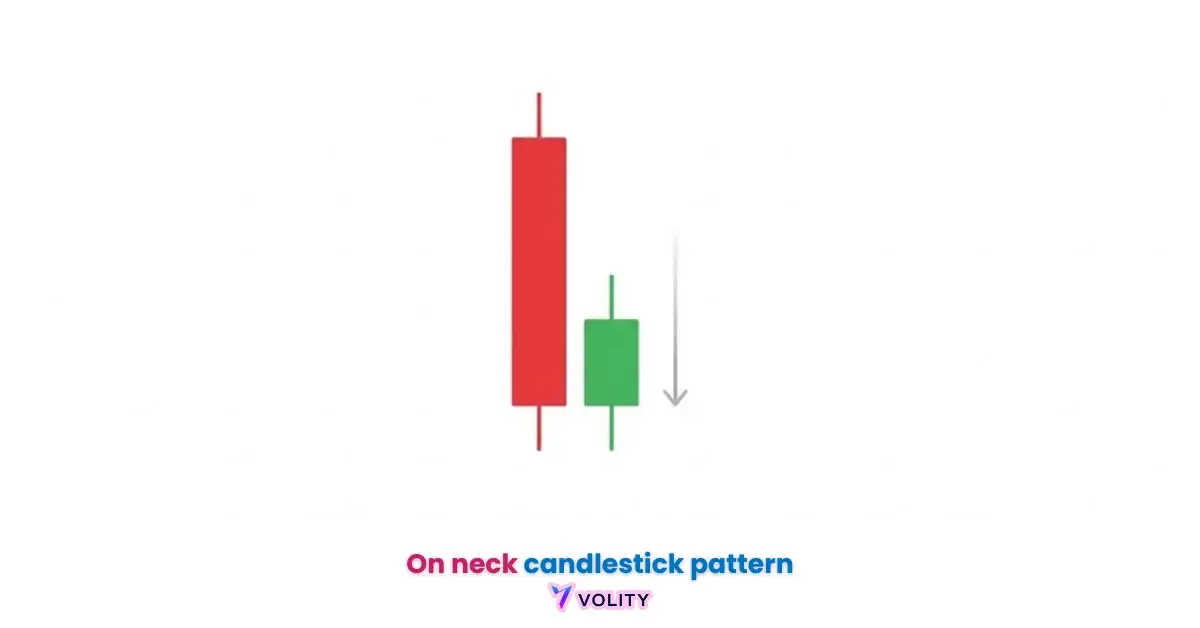
The On-Neck candlestick pattern is a two-candle bearish continuation signal that appears during an existing downtrend, indicating that selling pressure is likely to resume. This guide covers how to identify its unique formation, implement effective trading strategies with precise entry and stop-loss rules, and use advanced filters for higher probability trades. Learn to integrate this pattern into your trading arsenal for better decision-making.
While understanding On Neck Candlestick Pattern is important, applying that knowledge is where the real growth happens. Create Your Free Forex Trading Account to practice with a free demo account and put your strategy to the test.
What is an On Neck candlestick pattern?
The On-Neck candlestick pattern is a two-candle bearish continuation signal that appears during an existing downtrend. Despite a temporary pause, the market’s selling pressure is likely to resume, pushing prices further down. This pattern offers traders a distinct visual cue for potential short opportunities, indicating that the existing downward price movement is likely to persist. Its visual appearance on a candlestick chart is crucial for accurate identification and subsequent trading decisions.
What does the On Neck pattern signify? Is the On Neck pattern bullish or bearish?
The On-Neck pattern signifies a temporary pause in a downtrend before the bearish continuation resumes. This pattern is bearish. It suggests that while buyers attempted to push prices higher, they ultimately failed to overcome the prevailing selling pressure. The resulting price action indicates that sellers are still in control, making it a valuable signal for traders looking to capitalize on downward movements within a broader trading strategy.
Ready to Elevate Your Trading?
You have the information. Now, get the platform. Join thousands of successful traders who use Volity for its powerful tools, fast execution, and dedicated support.
Create Your Account in Under 3 MinutesHow to identify an On Neck pattern?
Identifying an On-Neck pattern requires careful observation of two consecutive candlesticks and their specific characteristics within an existing downtrend. The formation provides visual cues about the ongoing struggle between buyers and sellers, ultimately pointing towards continued bearishness. Recognizing these details is fundamental for any trader using technical analysis.
Bearish and Bullish Formation
The On-Neck Candlestick Pattern begins with a long bearish candle, often with a substantial real body, confirming the existing downtrend. This first candle represents strong selling pressure. The second candle is a smaller bullish candle that opens with a gap down, indicating initial bearish momentum. However, buyers step in, pushing the price up, but its closing price remains near the previous low of the first bearish candle. This indicates a temporary bullish push that ultimately faces strong resistance.
A Critical Detail: The Second Candle’s Close
A key characteristic of the On-Neck pattern is the second candlestick’s close near the low of the first bearish candlestick, resembling a ‘neckline’. This specific price action is crucial for pattern validation. The second candle’s close should be at or very close to the low of the first candle. This forms a temporary support level that buyers could not sustain, indicating that the underlying selling pressure is still dominant, and the downtrend is likely to continue.
What is the difference between On Neck and In Neck patterns?
The distinction between the On-Neck and In-Neck patterns is subtle but critical for accurate interpretation in technical analysis. Both are two-candle bearish continuation patterns that occur within a downtrend, but the closing price of the second candle differentiates their implications. Understanding these nuances is essential for avoiding misidentification and making informed trading decisions.
Key Differences in Formation and Implication
The primary difference between the On-Neck Candlestick Pattern and the In-Neck Candlestick Pattern lies in the second candlestick’s close. For an On-Neck pattern, the small bullish candle closes at or very near the low of the preceding long bearish candle. This indicates a failed attempt by buyers to push prices significantly higher, confirming the bearish continuation. In contrast, for an In-Neck pattern, the second bullish candle closes within the real body of the first bearish candle, but still below its midpoint. While both are bearish continuation patterns, the In-Neck suggests a slightly stronger bullish attempt, though still ultimately failing to reverse the trend. The On-Neck’s close at the prior low signals a more decisive rejection of higher prices.
| Pattern | First Candle | Second Candle Close | Implication | Strength |
| On-Neck | Long Bearish | At/Near Prior Low | Bearish Continuation | Moderate |
| In-Neck | Long Bearish | Within Prior Body | Bearish Continuation | Moderate |
How to Trade the On-Neck Pattern
Effective trading strategies for the On-Neck pattern involve precise entry and exit points, combined with robust risk management and confirmation from other technical analysis indicators. Traders must adapt their approach based on the chosen timeframe and prevailing market conditions to maximize potential profits and minimize losses.
Optimal Entry Points After On-Neck Formation
Optimal entry points after an On-Neck pattern formation typically occur when the price breaks below the low of the second candlestick. This confirms that the selling pressure has resumed following the temporary pause. Traders often wait for a subsequent candle to close below the pattern’s low to validate the entry. Implementing confirmation from other indicators, such as a surge in volume during the breakout, can further increase the probability of a successful trade. An increase in volume suggests strong conviction behind the price move.
Stop Loss and Profit Targets
When trading the On-Neck pattern, strategic stop-loss placement is crucial for risk management. Lack of proper risk management, especially effective stop-loss placement, is a primary reason for failure in trading continuation patterns. A common practice is to place the stop loss just above the high of the second candlestick or the high of the entire pattern. This placement protects capital if the pattern fails and reverses. For profit targets, traders can use a measured move approach, projecting the distance of the initial downtrend prior to the pattern, or targeting the next significant support level. A positive risk-reward ratio, such as 1:2 or 1:3, is essential for long-term profitability within any exit strategy.
Timeframes for Trading On-Neck Patterns
The effectiveness of the On-Neck pattern can vary significantly across different timeframes. For swing trading, daily or 4-hour charts are often preferred, as these longer timeframes tend to produce more reliable signals with less noise. The pattern’s implications carry more weight on these charts, aligning with broader market conditions. For day trading, the pattern can be used on shorter timeframes like 15-minute or 30-minute charts, but it requires faster decision-making and tighter risk management. Regardless of the timeframe, always consider the overall market context and use additional confirmation tools to improve the trading strategy.
How reliable is the On Neck pattern?
The reliability of the On-Neck pattern is a key concern for traders, as no single technical analysis tool is foolproof. While it serves as a valuable bearish continuation signal, its effectiveness is significantly improved when confirmed by other indicators and understood within the context of prevailing market conditions. Recognizing its inherent limitations is also crucial for successful application.
Understanding the On-Neck Pattern’s Success Rate
The On-Neck Candlestick Pattern has a moderate success rate, around 55-60%, as a continuation pattern when confirmed by other indicators like volume or RSI. This means that while it offers a statistically relevant edge, it is not 100% reliable. Traders should always seek confirmation from additional technical analysis tools, such as moving averages, trendlines, or momentum oscillators, to improve the probability of a successful trade.
Limitations and False Signals
The On-Neck pattern, like all candlestick patterns, is subject to limitations and false signals. One common limitation is its appearance in range-bound or low-volatility market conditions, where its predictive power diminishes. In such environments, the temporary support level formed by the ‘neckline’ might hold, leading to a reversal rather than continuation. False signals can also occur if the selling pressure is not strong enough to push the price below the second candlestick’s low, leading to a bounce. Traders should avoid trading the pattern in isolation and always consider the broader price action and market context.
Backtesting On-Neck Strategies
Understanding the quantified performance of the On-Neck pattern through backtesting results is vital for developing robust trading strategies. Unlike anecdotal evidence, backtesting provides data-driven insights into a pattern’s historical efficacy across various asset classes and timeframes. This section explores why backtesting is crucial and how to interpret its findings for the On-Neck pattern.
Why Backtesting is Crucial for On-Neck Traders
Backtesting is crucial for On-Neck traders because it allows them to validate a trading strategy against historical performance data before risking real capital. It provides objective backtesting results on how the pattern has performed in different market conditions. By simulating trades based on the pattern’s rules, traders can assess its win rate, average profit per trade, and drawdown. Common backtesting parameters for candlestick patterns include entry and exit rules, stop-loss placement, and the use of confirmation indicators. This process helps to build confidence and refine the strategy.
Interpreting Historical Performance Data
Interpreting historical performance data for the On-Neck pattern reveals that its effectiveness is not uniform. Backtesting data from 2000-2023 shows the On-Neck pattern’s performance can vary significantly across different asset classes and timeframes, highlighting the need for context-specific analysis. This variability means there isn’t a single “realistic win rate” that applies universally. Instead, traders should expect backtesting results to differ based on the specific market conditions, timeframe, and asset being traded. For instance, the pattern might perform better in highly liquid markets or during strong downtrends.
Psychology and Advanced Filters for On-Neck Trading
Mastering the On-Neck pattern extends beyond mere identification and strategy; it requires psychological discipline and the use of advanced filters to navigate complex market conditions. Many traders find their On-Neck trades reversing prematurely due to overlooked psychological traps or insufficient filtering. Addressing these common pitfalls is essential for improving trading success.
The Psychology of Trading Continuation Patterns
The psychology of trading continuation patterns like the On-Neck significantly impacts a trader’s success. Emotional biases often lead traders to ignore critical confirmation signals for candlestick patterns like the On-Neck. Psychological biases such as fear of missing out (FOMO), overconfidence, or revenge trading can cloud judgment, leading to premature entries or delayed exits. For instance, impatience might cause a trader to enter before proper confirmation, or overconfidence might lead to neglecting stop-loss orders. Effective risk management is not just about technical rules but also about emotional discipline and adhering to a predefined trading strategy.
Advanced Filters for Higher Probability Trades
Beyond basic indicators, employing advanced filters can lead to higher probability trades with the On-Neck pattern. Traders often ask if they should always trade the On-Neck pattern, or if there are specific market conditions where it’s best avoided. Incorporating market sentiment indicators, such as put/call ratios or sentiment indices, can provide additional context. For example, extreme bearish sentiment might signal an impending bounce, making an On-Neck pattern less reliable. Filtering out false signals also involves analyzing broader market structure, volatility levels, or economic news releases. Integrating these elements into technical analysis helps refine entry decisions.
Turn Knowledge into Profit
You've done the reading, now it's time to act. The best way to learn is by doing. Open a free, no-risk demo account and practice your strategy with virtual funds today.
Open a Free Demo AccountIntegrating the On-Neck Pattern into Your Trading Arsenal
The On-Neck candlestick pattern is a powerful bearish continuation signal that, when properly identified and traded, can offer significant opportunities in a downtrend. Its unique formation, characterized by a small bullish candle closing near the previous low of a long bearish candle, provides a clear visual cue of dominant selling pressure. Integrating it into a trading strategy demands a deep understanding of its mechanics, a commitment to risk management, the use of confirmation indicators, and psychological discipline to overcome common biases. By leveraging backtesting results and employing advanced filters, traders can improve the pattern’s reliability and make more informed decisions, ultimately improving their overall trading performance.
Key Takeaways
- The On-Neck pattern is a two-candle bearish continuation signal appearing in a downtrend.
- It is identified by a long bearish candle followed by a smaller bullish candle closing at or very near the first candle’s low.
- Trading strategies include entering below the second candle’s low, placing a stop loss above its high, and setting profit targets at the next support level.
- The pattern has a moderate success rate (55-60%) and requires confirmation from other technical indicators to reduce false signals.
- Backtesting is essential to validate On-Neck strategies across different timeframes and asset classes.
- Psychological discipline and advanced filters like market sentiment indicators are crucial for improving trade probability and avoiding common pitfalls.