Investing in financial products involves risk. Losses may exceed the value of your original investment.
Bitcoin solana ai is a core topic for traders in 2026. The complete guide follows.
Crypto markets surge amid AI hype and tokenization push
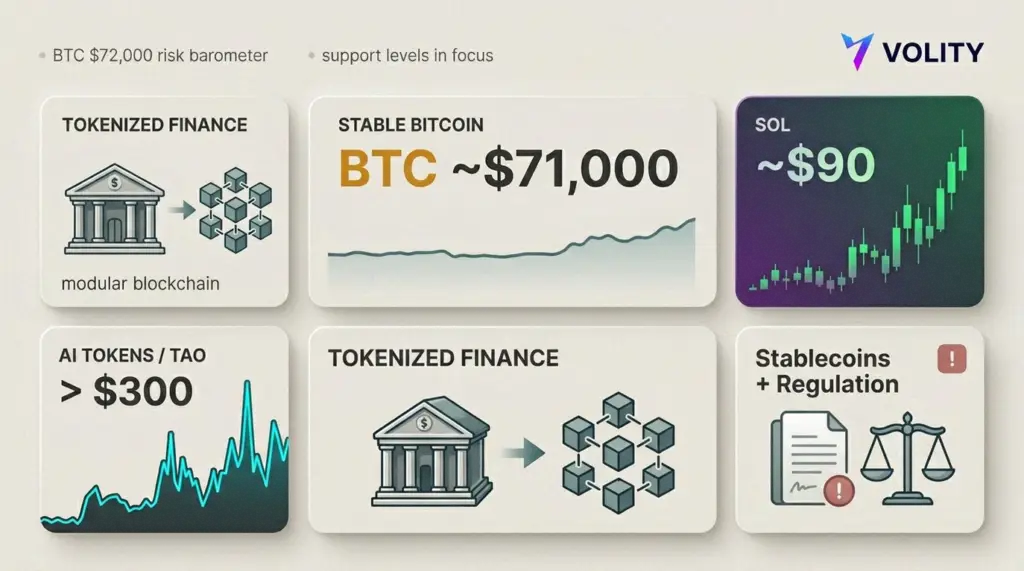
Crypto caught a bid on Tuesday, as traders chased two familiar stories with a new sheen: AI tokens and tokenised finance. Meanwhile, a flare of US-Iran tension jolted oil and risk assets, therefore pushing intraday correlations into a blender. Bitcoin held near $71,000 as altcoins did the sprinting, and Solana reclaimed $90 on upgrade chatter and thick volumes.
However, the rally had a slightly nervous gait. Flows stayed mixed, stablecoin politics turned sharper in Washington, and several eye-catching moves looked more like positioning than conviction. Even so, the tape rewarded momentum, and the market treated “tokenisation” as the polite, suit-friendly cousin of the last cycle’s DeFi buzz.
Solana leads the altcoin charge
Solana’s SOL traded back above $90, with buyers leaning on the Alpenglow upgrade narrative and a return of speculative volume. Technicians watched $92.34 as the next resistance, while $86.66 sat beneath as the line that could turn a breakout into a fast fade. If $92.34 gives way, traders will talk about $98.65, because round numbers still matter in crypto, even when they pretend not to.
Meanwhile, the Solana Foundation pushed the “real ramps” story, flagging a developer platform that links with household finance brands. That mattered because it turned today’s price move into something investors can repeat in conversation without mentioning memes.
AI tokens steal the show again
AI-linked tokens resumed their habit of ignoring the rest of the market. FET traded around $0.25 to $0.26 after a double-digit intraday move, despite a weak weekly look. Traders cited roadmap excitement around the Artificial Superintelligence Alliance, although the price action also looked like a simple risk-on squeeze.
Elsewhere, Bittensor’s TAO pushed above $300, a four-month high, as traders circled a halving catalyst. Leverage looked contained, which helped the move read as demand rather than desperation. At the frothier end, Siren ripped about 125% to $2.34 before cooling. That kind of spike tends to leave footprints in perp funding for days.
- XLM rose about 7% as traders rotated into payment and “utility” narratives.
- ZEC traded above $235 on renewed privacy interest and a $25m ZODL funding headline.
- BNB bounced from trendline support as futures activity picked up.
Bitcoin steadies at $71,000 as flows pull both ways
Bitcoin hovered around $71,000, which in this market counts as calm. However, the surrounding headlines were anything but. Bhutan’s state-linked wallet activity drew attention, while South Korean venues reportedly saw large outflows and thinner profits. Traders kept one eye on ETF flow chatter, because it has become the market’s daily weather report, even when it explains less than people claim.
Meanwhile, Ethereum sat in its familiar $2,150 to $2,400 fog, with occasional bullish signals failing to turn into a clean trend. In the background, larger traders continued to treat ETH as collateral and optionality, not a statement of faith.
Tokenisation and stablecoins heat up, then politics bites
Tokenisation kept marching into boardroom decks. Australia’s policymakers talked up potential gains of about AU$24bn from market tokenisation efforts. Morgan Stanley outlined plans to offer tokenised stocks on its own venue by 2026, while BMO’s tokenised cash pilot linked into CME’s always-on rails.
Meanwhile, DeFi tried to industrialise itself. Aave V4 promised to automatically shift idle stablecoins towards yield, and staking continued to get dressed for institutions.
However, stablecoins ran into the part of the story that always arrives: regulation. Circle’s stock dropped about 22% after a US bill targeted stablecoin rewards, while a report of multiple USDC wallet freezes reignited the centralisation argument. Tether also moved to calm nerves by hiring a Big Four firm for a full USDT audit, which traders will treat as meaningful only when the paperwork lands.
Global and regulatory ripples
Europe pressed ahead with digital money rules, with the ECB aiming to set a summer timetable before a pilot phase. Elsewhere, Ripple continued testing RLUSD in Singapore within a programme dubbed BLOOM. In India, CoinDCX founders secured bail in a probe tied to an alleged fake platform, while Irish police highlighted a drug-linked bitcoin wallet seizure.
Meanwhile, Robinhood flagged a $1.5bn buyback even with HOOD down about 39% year to date, and Pump.fun tightened controls on fee wallet edits as revenues slipped. Those are very different stories, although both point to a market that still rewards scale and punishes sloppy plumbing.
Risks and trader watchlist
Volatility stayed in the room. Pi Coin faced supply overhang fears, one HYPE-linked whale reportedly sold about $22.9m near recent highs, and Hyperliquid’s HIP-3 open interest hit records. Therefore, “quant” and systematic strategies found fresh fans as a kind of pragmatic shelter, not because they are risk-free, but because they at least respect the maths.
Watch Bitcoin at $72,000 for broad risk appetite, and keep a close eye on whether SOL can defend $80 if the mood turns. If it cannot, today’s breakout talk will vanish quickly. If it can, AI, payments and tokenisation may keep the speculative bid alive for another session.
By the numbers
- BTC near $71,000 as altcoins outperformed
- SOL back above $90, with $92.34 as a near-term resistance level
- TAO above $300, a four-month high
- Circle shares down about 22% on stablecoin bill concerns
- Robinhood buyback authorisation: $1.5bn
Key takeaways
- Momentum remains strongest in AI-linked tokens, but reversals can be violent after vertical moves.
- Solana’s rally has clear technical levels, which invites both breakout traders and short-term fades.
- Stablecoin politics now moves prices, not just headlines, therefore watch Washington like a macro release.
- Tokenisation stories keep pulling TradFi names into the crypto orbit, which can boost sentiment on dull days.
- Geopolitical shocks can flip correlations quickly, so size positions for gaps, not for narratives.
For more on this topic see our deep-dives on QQQ Momentum and Tech: How Gold and Bitcoin Shape Risk Sentiment, Bitcoin After a Fed Rate Cut: Altcoins, ETFs, and Market Impact, and Bitcoin Drops as Tether Mints USDT and Liquidations Hit Crypto Markets.
For more on this topic see our deep-dives on XRP ETF Inflows Surge as Bitcoin and Ethereum ETFs Bleed Cash, Binance Stablecoin Flows and FOMC: Reading the Crypto Setup, and Bitcoin Rewards, Ethereum at $4,000 and the Trends Driving Crypto.
Alexander Bennett notes: Three filters separate a tradable narrative rotation from a chart shape that looks like one. Cross-narrative breadth (a rotation that touches AI tokens, layer-one upgrade beneficiaries, and tokenisation infrastructure simultaneously is the structural read; a single-narrative spike is the noise variant).
Funding-rate trajectory across the three narrative buckets (when funding rates compress on the AI tokens during an SOL upgrade rally, the rotation is internal rather than fresh-money-driven, which is the more durable variant). Bitcoin range stability (a steady BTC tape during the rotation signals that the marginal speculative dollar is staying inside the asset class rather than rotating toward Bitcoin as a safe-haven inside crypto, which is the configuration that supports a multi-week alt leg).
When the three align, the narrative-rotation thesis carries weight beyond the daily candle. When they diverge, the rotation is the signal to take profits in the leading narrative rather than to chase the lagging one.
Frequently asked questions
Why does the Solana Alpenglow upgrade matter beyond the SOL price reaction?
Because the upgrade narrative connects the technical performance argument to the developer-platform tokenisation pitch that institutional allocators evaluate for multi-year exposure. A consensus-layer upgrade that delivers measurable throughput and finality improvements removes one of the structural performance objections that has defined the institutional caution on layer-one alternatives, which feeds the broader tokenisation narrative that converts the suit-friendly developer-platform pitch into a defensible thesis rather than a speculative bet. The price reaction is the short-term consequence; the institutional positioning consequence runs over the next several quarters as the tokenised-finance pilots either prove out the throughput thesis or do not. The CoinDesk SOL ecosystem coverage documents the upgrade roadmap and integration partner activity.
What does the AI-token rotation reveal about the speculative dollar profile?
The rotation reveals that the speculative dollar inside crypto has matured beyond the single-narrative cycle that defined the 2021 frame; the current speculative pool rotates between AI, privacy, layer-one upgrade beneficiaries, and tokenisation plays on a roughly two-week cadence rather than concentrating in a single sector for an extended window. The structural consequence is that single-narrative speculative bets carry a shorter half-life than the prior cycle (median rally duration before mean-reversion has compressed from approximately six weeks to approximately two weeks), which raises the importance of position sizing and exit discipline relative to entry conviction. The traders who size for the new half-life capture the rotation; the traders who size for the prior half-life feed the rotation. The Investopedia reference on narrative economics covers the underlying behavioural framework.
How does the tokenisation narrative differ structurally from the prior DeFi cycle?
The tokenisation narrative anchors on regulated-asset wrappers (treasury bills, money-market fund shares, listed equity, real estate funds) issued by traditional finance counterparties on permissioned or hybrid blockchain rails, while the prior DeFi cycle anchored on open-protocol primitives that explicitly competed with traditional finance. The structural consequence is that the tokenisation buyer base extends from family offices, treasurers, and institutional allocators rather than from the retail-leverage cohort that drove the DeFi cycle, which produces a slower, more durable inflow trajectory with a different drawdown profile. The two narratives can coexist without competing because they address different buyer cohorts and different use cases, which is the configuration that supports a multi-year structural thesis rather than a single-cycle bet. The BIS report on tokenisation and the unified ledger documents the international policy framework.
Should retail traders chase the highest-momentum token in each narrative bucket?
Chasing the highest-momentum token in each bucket optimises for the wrong objective. The highest-momentum token in any rotation typically carries the lowest expected-value distribution because the entry price already reflects the consensus thesis, which means the trade depends on a continued acceleration that historically resolves through mean-reversion within one to three weeks.
The structurally better expression is the second-tier token in the same bucket that has not yet repriced to the consensus thesis, which captures the same narrative beta with a lower entry price and a wider stop band. The disciplined practice is to enter the narrative through the second-tier expression, then to size the position for the rotation half-life rather than for the consensus thesis duration.
Position sizing dominates entry timing in narrative rotations.
Related guides
- Bitcoin explained
- Cryptocurrency trading
- Crypto trading platforms
- Best crypto investments
- Best AI stocks to invest in
Volity operates a trading platform and also publishes educational and analytical content about trading. The content on this page is for educational purposes only and should not be considered financial advice. Volity may benefit commercially when readers open trading accounts through links on this site.
Our content is produced and reviewed under documented editorial standards; comparison and review methodology is published here.