AI fever, microcap sparks and the market’s twitchy tape
Artificial intelligence still sounds like an early-cycle story. The trading tape, however, often behaves like a late-cycle one.
Storage stocks have gone vertical. AI chip names swing hard after earnings. Meanwhile, microcaps can double before lunch on a single filing. For active traders, the opportunity set looks rich, but the margin for sloppy entries has narrowed.
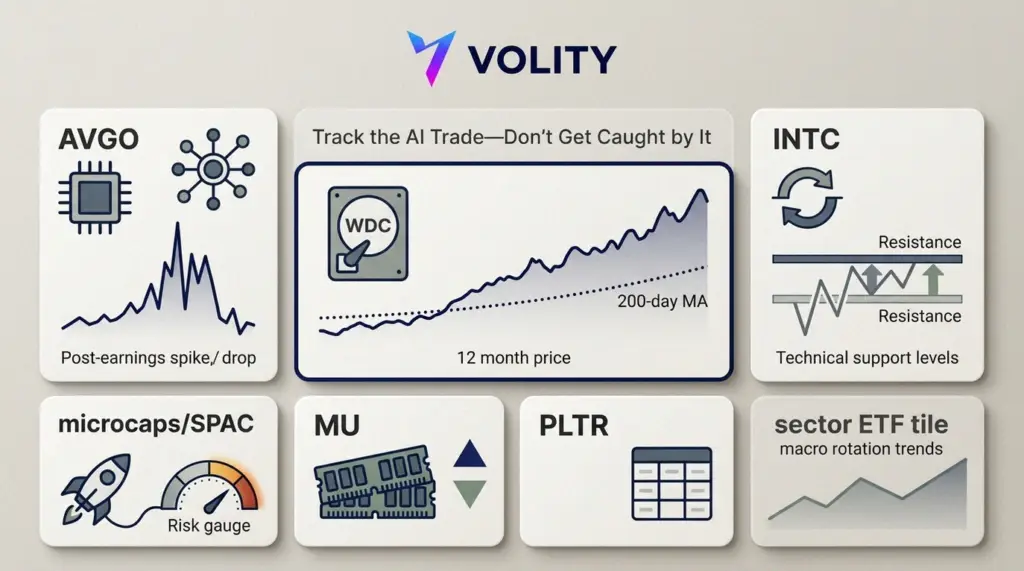
The busiest corner remains the AI hardware chain. Western Digital (WDC) has become a pure expression of data-centre storage demand, with investors chasing capacity, pricing and memory-cycle leverage. The stock has already posted a spectacular one-year run, and it trades far above its 200-day moving average.
That strength matters. However, it also changes the risk profile. Momentum indicators have pushed towards stretched levels, while recent pullbacks show how quickly late buyers can get tested. WDC still belongs on a momentum watchlist, but traders should treat fresh breakouts differently from early-cycle bases.
Broadcom (AVGO), meanwhile, sits at the centre of the custom AI-chip story. The company sells networking silicon, ASICs and infrastructure pieces that large cloud customers need. Traders have treated each AI revenue comment as more than routine guidance.
Still, AVGO has become a high-expectation stock. Even strong numbers can disappoint if management fails to raise the AI bar enough. Post-earnings moves have shown how valuation risk and forecast risk can land at the same time. For short-term accounts, AVGO is tradable, but it is not sleepy.
Intel (INTC) offers a different semiconductor setup. It is not the market’s cleanest AI earnings story, and traders know that. Instead, the stock moves on analyst changes, foundry hopes, government support, sector rotation and resistance levels. When capital leaves the high-beta AI leaders, INTC can catch a bid. When enthusiasm fades, it can quickly feel heavy again.
SanDisk correction
The clean-up starts with SanDisk. Traders should not rely on stale corporate maps or old ticker assumptions. SanDisk was bought by Western Digital years ago, but the market structure later changed again as Western Digital separated its flash business.
As a result, clients should verify the current venue, ticker and corporate status before trading any SanDisk-linked idea. The practical comparison is not a loose “SanDisk versus Micron” slogan. It is a clearer memory-and-storage basket: WDC, Micron (MU) and the current SanDisk vehicle, if available on the client’s platform.
Micron, meanwhile, remains one of the cleaner AI memory beneficiaries. Tight supply, high-bandwidth memory demand and stronger pricing have supported the bull case. However, MU has also carried overbought signals after a forceful climb. That makes relative strength useful, but chasing extended candles less attractive.
In plain English, traders should separate business quality from entry quality. A great AI cycle can still produce ugly two-day reversals.
Software and sovereign AI
Palantir (PLTR) remains the classic headline stock in AI software. Government work, sovereign AI language and links to Nvidia (NVDA) infrastructure can all light up the tape. The valuation debate rarely settles anything intraday. Instead, volume often follows contract headlines, defence spending chatter and management commentary.
That makes PLTR a momentum name rather than a quiet compounder for active traders. Position sizing matters more than opinion strength. The stock can reward conviction, then punish the same conviction before the next coffee.
At the other end of the liquidity spectrum sits SharonAI. The name lacks a widely recognised US ticker in mainstream trading databases, which makes it hard to use in a public client watchlist. Reports of a large investor lifting a stake to about 20 per cent fit the classic low-float ownership-change spike.
However, without a precise symbol, venue and float data, the trade becomes more rumour than setup. If included at all, it needs an extreme-risk label. Otherwise, most active clients are better served by liquid names with clean quotes and borrow visibility.
Biotech and SPAC heat
Small-cap biotech has also re-entered the active-trader screen. SELLAS Life Sciences (SLS) shows the familiar post-breakout pattern: fast upside, a sharp pullback and traders waiting for support to define itself. The appeal lies in volatility. The danger lies in the same place.
Nuvectis Pharma (NVCT) belongs in a more violent category. Microcap biotech moves often begin before the opening bell and depend on very specific trial, regulatory or financing headlines. Intraday reversals can be brutal. Traders should avoid treating a pre-market spike as proof of lasting demand.
Event-driven desks are also watching Churchill Capital Corp XI (CCIX), tied to its proposed merger with Agility Robotics. SPAC trades often move on deal structure, redemption risk, regulatory timing and retail enthusiasm. Robotics adds a fashionable wrapper, but the usual SPAC mechanics still matter.
Meanwhile, Unusual Machines (UMAC) has benefited from sympathy interest around AeroVironment (AVAV) and the broader drone-and-defence theme. The defence tape has rewarded companies with credible exposure to unmanned systems. However, smaller peers can overshoot when traders use them as quick proxies.
Banks, industrials and defensives
JPMorgan Chase (JPM) sits in a calmer part of the market, though not an irrelevant one. The bank remains close to record territory, with stress-test results, buybacks, dividends and capital ratios shaping sentiment. It is less a hot-money trade than a financial-sector barometer.
MSC Industrial Direct (MSM), meanwhile, offers a more old-fashioned earnings setup. Investors care about revenue trends, gross margins, manufacturing demand and the dividend. With a yield around the mid-single-digit area, the stock gives value traders a cushion, but not immunity.
Healthcare and telecom names have also appeared on defensive and quality screens. IBM, Verizon (VZ), Corning (GLW) and Vertex Pharmaceuticals (VRTX) offer different flavours of steadier exposure. Media attention can boost interest for a session. Still, each name needs its own catalyst beyond the television mention.
Overbought screens have also flagged names such as DFTX, NRIX and GALT. These are not automatic shorts. Rather, they are mean-reversion candidates where traders watch RSI, volume fade and failed breakouts. In thin healthcare names, a crowded pullback trade can become crowded very quickly.
Pharma and oil pressure
Big pharma faces a less friendly tape. Merck (MRK) and AbbVie (ABBV) have drawn attention around political and regulatory scrutiny. For traders, that creates headline risk rather than a clean earnings thesis. A fresh letter, hearing or agency update can move the group before fundamentals change.
Energy adds another macro layer. Recent crude commentary has focused on fading geopolitical risk premia as tanker traffic through the Strait of Hormuz normalises faster than feared. Oil-linked instruments such as USO, BNO and XLE remain vehicles for crude softness and energy-stock rotation.
At the index level, the market still looks like a rotation mosaic. AI-adjacent technology leads. Rate-sensitive real estate lags. Housing data remain firm in places, yet real estate equities still wrestle with financing costs. Traders can express those shifts through SPY, QQQ, DIA, XLK and XLRE without forcing every view into a single stock.
By the numbers
- WDC: trades far above its 200-day moving average after a powerful one-year advance.
- SharonAI: reported stake increase near 20 per cent, but ticker clarity remains essential.
- MU: benefits from AI memory pricing, though momentum has looked stretched.
- CCIX: trades around a proposed Agility Robotics merger, creating SPAC-style volatility.
- JPM: remains a capital-return bellwether for large US banks.
Key takeaways
- AI hardware: WDC, MU and AVGO still lead, but late entries carry pullback risk.
- Semiconductors: INTC is more sentiment-and-rotation driven than pure AI momentum.
- Microcaps: demand exact tickers, venues, float data and strict position limits.
- Biotech: treat pre-market spikes as news trades, not confirmation of trend.
- Macro: use sector ETFs when the theme matters more than the single stock.
The active tape rewards clarity. Know the instrument, know the catalyst and know the risk bucket before the order goes in.
Related coverage on Volity
- What Is a P/E Ratio and How to Use It
- Fundamental Analysis in Stock Trading: A Working Definition
- Growth Investing vs Value Investing: Which Style Fits You?
- Fractional Shares Explained: How to Start Investing With $50
- How to Start Stock Trading: A 2026 Beginner Guide
- Dividend Investing for Beginners: How to Start