Wall Street’s October watchlist: Real catalysts, rumours and the price of patience
The market offered no clean signal in its latest session. The Dow Jones Industrial Average edged higher, while the S&P 500 and Nasdaq-100 slipped.
Gold rose as investors sought ballast. That split tape matters because selectivity, rather than broad market direction, now drives many trades.
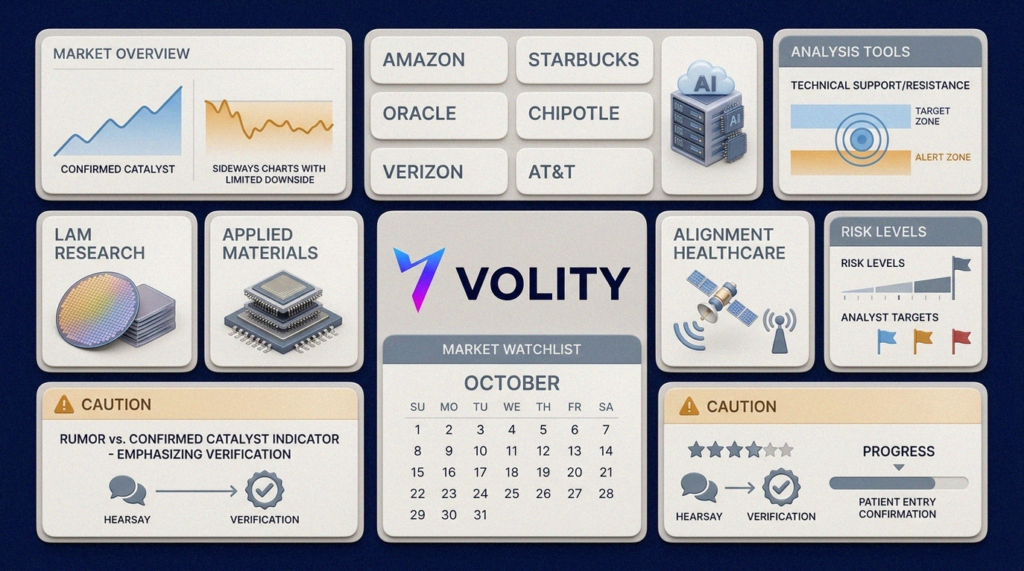
Technology, healthcare, restaurants and telecom each offer tempting setups. Yet only some carry a dated catalyst and a usable trading framework.
A watchlist should never become a shopping list. Traders need an entry condition, a catalyst window and a level that proves them wrong.
Cloud stories still need price discipline
Amazon remains a credible long-term candidate. AWS demand, artificial intelligence infrastructure spending and potential margin gains support the underlying business case.
Still, a strong company does not automatically offer a strong entry. Earnings guidance and price behaviour must validate the thesis.
A breakout on convincing volume would matter more than a slow climb on optimistic commentary. Investors should also compare the share price with current valuation assumptions.
Oracle deserves similar attention, although older technical levels require a reset. A previously cited $120 support level looks stale near a reported $144.74 share price.
The company’s cloud infrastructure growth remains the central attraction. Recent reporting pointed to 121% growth, while one model placed fair value near $214.93.
Those figures describe potential, not certainty. Oracle needs a current support zone, a reclaim level and a clear invalidation point.
Lam Research and Applied Materials offer a cleaner relative-strength contest. Both depend on memory demand, foundry investment and the wider technology tape.
Rather than choose the apparently cheaper stock, traders can let leadership decide. The better performer should hold up during semiconductor pullbacks and lead on recoveries.
Targets without names are not trade ideas
Humana and Cboe may merit attention after reported upgrades. However, an analyst target means little without the firm, date and current share price.
The same standard applies to CrowdStrike’s cited 18% upside. An unnamed target should not anchor a published trade plan.
Pacira Biosciences presents a more defensible caution case after a downgrade and lower price target. Still, traders need the revised target and date.
Precision is not a cosmetic concern. It separates a thesis from a rumour and prevents stale research from becoming fresh advice.
Bearish signals need follow-through
Alignment Healthcare has a defined negative catalyst. The company lost a four-star Medicare Advantage rating, which could affect enrolment and future guidance.
That rating change does not prove an immediate earnings collapse. Management commentary, membership trends and the next results will show the financial impact.
CHT, IDT and Angi have appeared on overbought screens with RSI readings above 70. Yet an overbought reading is a warning light, not a sell signal.
Strong shares can stay stretched while earnings expectations improve. A better short setup needs a failed breakout, reversal confirmation or a decisive support break.
Intel remains a speculative value proposition within semiconductors. It needs a trigger, such as improving margins, a product milestone or resistance reclaimed.
Until then, Intel belongs on a monitor rather than in a forced position. Cheapness alone rarely creates momentum.
Starbucks and Chipotle turn rumour into volatility
The session’s liveliest story involved Starbucks and Chipotle Mexican Grill. Reports said Starbucks had explored a possible acquisition with advisers.
Chipotle shares jumped, while Starbucks weakened. Neither company confirmed a formal offer, and Starbucks said it does not comment on speculation.
Investors questioned the strategic fit almost immediately. Coffee and fast-casual Mexican food share customers, but obvious revenue synergies remain limited.
Possible savings in corporate functions and technology could exist. Still, a multibillion-dollar deal might distract Starbucks from its “Back to Starbucks” turnaround.
The setup is event-driven, not merger arbitrage. Chipotle can retain a rumour premium until the companies clarify their intentions.
Meanwhile, Starbucks could stay under pressure if shareholders fear debt, dilution or management distraction. A formal bid would change the calculation quickly.
SpaceX raises the stakes for wireless carriers
SpaceX’s planned acquisition of low-band spectrum created a more concrete risk for Verizon, AT&T and T-Mobile. The portfolio includes up to 14 megahertz of paired 800 MHz spectrum.
The transaction still requires Federal Communications Commission approval. Low-band airwaves travel farther and penetrate buildings better than higher-frequency spectrum.
That makes the assets valuable for Starlink’s direct-to-device ambitions. SpaceX has said the purchase could help Starlink Mobile become a major US carrier.
Shares in established operators fell as investors reassessed the competitive landscape. Still, incumbents retain deep advantages in networks, distribution, capacity and customer relationships.
The threat concerns future expectations more than an instant earnings shock. Regulatory timing, deployment and customer adoption will determine the real commercial impact.
What belongs on the list
- Alignment Healthcare: Monitor enrolment and guidance after the Medicare Advantage rating loss.
- Starbucks and Chipotle: Treat price moves as rumour-driven until a formal statement changes the facts.
- Verizon, AT&T and T-Mobile: Watch regulatory progress and satellite-service developments.
- Lam Research and Applied Materials: Follow relative strength rather than headline valuation.
- Amazon and Oracle: Wait for current technical levels and earnings confirmation.
The October watchlist rewards patience over prediction. Each position needs evidence before capital, especially when narratives move faster than verified information.
Related coverage on Volity
- What Is a P/E Ratio and How to Use It
- Fundamental Analysis in Stock Trading: A Working Definition
- Growth Investing vs Value Investing: Which Style Fits You?
- Fractional Shares Explained: How to Start Investing With $50
- How to Start Stock Trading: A 2026 Beginner Guide
- Dividend Investing for Beginners: How to Start