Crypto markets, policy drama and grain onchain: Thursday’s trading brief
Crypto markets have settled into an awkward calm. Prices sit near important levels, yet momentum has weakened beneath the surface.
Meanwhile, Washington has returned to digital-asset legislation. In India, grain collateral is moving onto Avalanche infrastructure.
Those stories appear unrelated. However, each touches the same question: where will crypto’s next durable value come from?
Bitcoin and ethereum face narrow technical tests
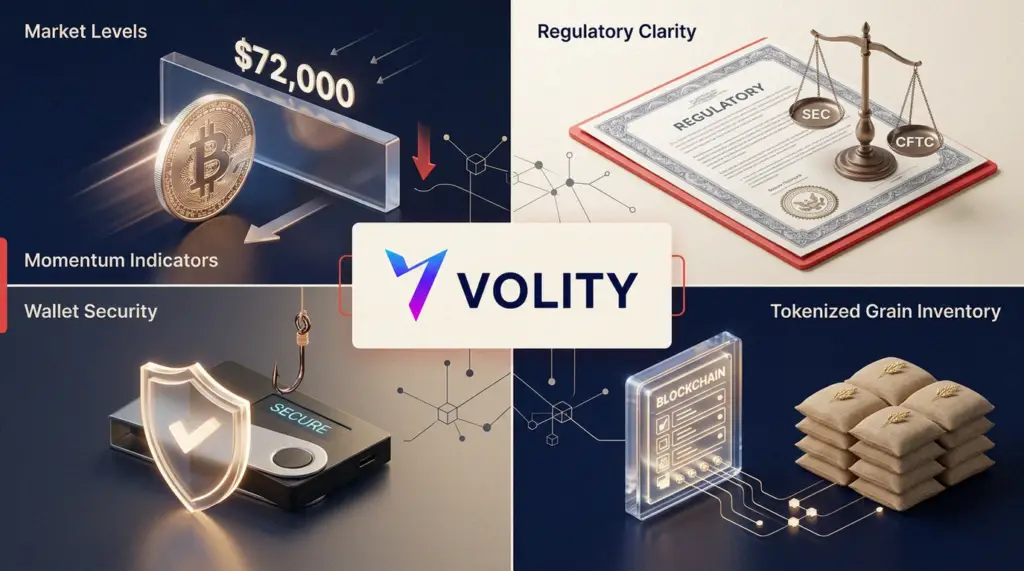
Bitcoin is trading beneath a psychological ceiling, with $72,000 still drawing bullish attention. However, higher-time-frame momentum signals have turned less friendly.
A bearish MACD crossover suggests the latest advance may be losing force. That does not guarantee a sell-off, but it raises the cost of chasing strength.
- $72,000 to the mid-$70,000s marks the main overhead resistance area.
- The high-$60,000s offers the first major downside zone if support breaks.
Leveraged longs looked comfortable nearer $78,000. Yet they would face a faster reckoning if Bitcoin loses its current range.
Ethereum has a tighter and more immediate chart. ETH recently traded around $2,468, after touching roughly $2,455.
It remains close to its lower four-hour Bollinger Band, near $2,460. Meanwhile, the middle band sits around $2,484 and the upper band near $2,508.
That arrangement leaves short-term sellers in control. However, it also creates a clean set of levels for traders.
- A sustained move below $2,460 could expose the recent $2,445 intraday low.
- A recovery above $2,484 would bring $2,500 to $2,508 back into view.
Options and perpetuals traders should expect sharp reversals around those markers. Thin conviction often produces expensive whipsaws.
Washington puts the clarity act back on the board
Market charts are not the only source of risk. Policy uncertainty continues to shape valuations, listings and institutional investment decisions.
Treasury Secretary Scott Bessent has renewed his call for Senate action on the CLARITY Act. The bill would set market-structure rules for digital assets.
Its central task is deceptively simple. It would establish when a token falls under securities law or commodities law.
That distinction determines whether the Securities and Exchange Commission or Commodity Futures Trading Commission takes the lead. Exchanges and token issuers have therefore treated the bill as commercially important.
Still, a Senate vote would not settle every regulatory fight. Enforcement priorities, court cases and agency rulemaking would remain important.
Expectations of passage this year have also slipped. A mid-September procedural vote may instead reveal how much Senate support actually exists.
For markets, delay carries its own price. Firms may defer US product launches while rivals build in friendlier jurisdictions.
Conversely, progress could support listed exchanges, custodians and institutional crypto products. It would not, however, erase compliance costs overnight.
India puts $2 billion of grain inventory on avalanche
The day’s more consequential crypto story may involve warehouses rather than trading screens. Arya.ag has begun recording crop inventory on an Avalanche-based blockchain.
The Indian warehousing and lending company manages about $2 billion of stored agricultural goods. It also supports roughly $1.3 billion of annual agricultural credit.
The system records grain deposits, electronic warehouse receipts and loan status. Three major banks are participating, although their names remain undisclosed.
Each tokenised receipt represents a claim on specific goods in storage. A lender can therefore check ownership, outstanding debt and previous pledges through a shared record.
- Collateral visibility: banks can identify whether grain has already secured another loan.
- Fraud control: shared records may reduce duplicate receipts and disputed ownership.
- Credit efficiency: cleaner collateral data could lower underwriting costs over time.
This is not a tokenised fund with a polished investor deck. Instead, it concerns sacks of grain, warehouse ledgers and loans to farmers.
That makes the project more interesting. Commodity collateral remains fragmented, paper-heavy and vulnerable to poor recordkeeping.
Yet the migration brings operational risk. Banks must trust the data entering the ledger, not merely the blockchain beneath it.
Avalanche benefits if the network scales. However, investors should resist treating a corporate deployment as immediate demand for AVAX.
The key metric remains undisclosed: how much of Arya.ag’s existing collateral has actually moved onto the system. Until that figure appears, the project deserves attention rather than exaggeration.
Hardware-wallet phishing returns
Security threats have also returned to the foreground. Trezor and BitBox users have faced phishing emails posing as urgent security or firmware notices.
The messages direct holders towards imitation websites. There, victims are asked for seed phrases or private keys.
That request is always fraudulent. Legitimate wallet providers do not need a recovery phrase to provide support or process an update.
- Enter a recovery phrase only on the hardware wallet itself, when recovery genuinely requires it.
- Open firmware updates through the official wallet application, not an email link.
- Check website addresses carefully before connecting a wallet or approving a transaction.
Markets can recover from a sharp candle. Stolen self-custodied assets, however, rarely return.
What matters into the next session
Bitcoin’s $72,000 area and Ethereum’s $2,460 level offer the clearest near-term signals. However, policy headlines could quickly overwhelm technical setups.
Meanwhile, Arya.ag’s grain network shows where blockchain adoption may prove more durable. The useful applications often look boring before they look obvious.
Traders should keep risk tight around current ranges. Investors, meanwhile, should follow the less glamorous plumbing: custody, regulation, collateral and settlement.
Related coverage on Volity
- How to Avoid Crypto Scams: A Beginner Safety Checklist
- How to Choose a Trading Platform: A 10-Point Checklist
- Demo vs Live Trading Account: A 7-Step Checklist Before You Go Live
- How to Size a Trade: Position Sizing and Risk Per Trade for Beginners
- Risk-Reward Ratio Explained: How to Set It and Why It Matters
- ETF vs Index Fund: The Difference and Which to Pick