Crypto market digest: bitcoin holds the line as etfs, hackers and lawmakers set the tone
Crypto begins the day with a steady price and a restless news tape.
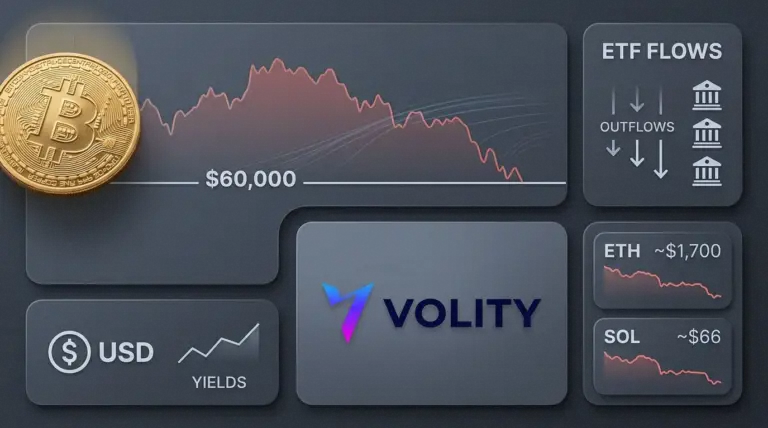
Bitcoin is still hovering around the mid-$60,000s, which looks calm at first glance. However, the quiet chart hides a busier story. ETF inflows remain strong, Washington has delayed a key bill, and security incidents keep testing the market’s plumbing.
For traders, this is not a clean momentum market. Instead, it is a market waiting for someone to blink. That could be lawmakers, ETF buyers, miners, hackers, or long-term holders sitting on profits.
Market pulse
Bitcoin closed Week 32 at $66,627, up 0.8% for the week. That was its smallest weekly absolute move since January 2026. Meanwhile, another market snapshot put BTC near $64,991, up 1.0% on the day.
Total crypto market value also edged higher. However, trading volume fell sharply, suggesting caution rather than euphoria. The tape looks active, but not excited.
That matters because price stability can cut both ways. A tight range can show healthy digestion after a rally. Yet it can also show fading conviction before a break lower.
For now, ETF demand is doing useful work. U.S. spot Bitcoin ETFs have attracted $853.5 million across a five-day inflow streak. Separately, Morgan Stanley’s ETF reportedly bought $15 million worth of bitcoin during the dip.
That is not a huge amount in bitcoin terms. Still, the signal is more important than the size. Institutions continue to buy weakness, even when retail momentum looks muted.
By the numbers
- $66,627: Bitcoin’s Week 32 close.
- 0.8%: Bitcoin’s weekly gain, its smallest absolute weekly move since January 2026.
- $853.5 million: Five-day inflows into U.S. spot Bitcoin ETFs.
- $15 million: Reported bitcoin dip-buying by Morgan Stanley’s ETF.
- $1.5 billion: Size of the Lazarus-linked Bybit hack at the centre of a lawsuit.
Regulation: the slow clock in washington
The main policy story remains the CLARITY Act. The bill has been pushed to a September vote after filing in the Senate. That delay does not kill the legislation. However, it stretches out the uncertainty.
Coinbase chief executive Brian Armstrong said the delay would not slow crypto adoption. That may be true in practice. Still, markets prefer rules to pep talks, especially when capital is moving into regulated products.
The bill matters because investors want a cleaner line between securities, commodities and payment tokens. Without that line, exchanges, issuers and asset managers must keep pricing in legal risk.
Europe, meanwhile, is not standing still. The European Union is expected to revise MiCA in 2027. Stablecoins sit near the centre of that next fight, partly because U.S. payment-token policy keeps pressing into global markets.
Stripe-owned Bridge has already joined the EU MiCA register as the 42nd authorised stablecoin issuer. The stablecoin race is no longer just a Silicon Valley matter. It is becoming a licensing race across jurisdictions.
Security: the pipes still leak
Security remains crypto’s most persistent weakness. The prices may look mature, but parts of the infrastructure still behave like wet cement.
The Aztec bridge exploiter reportedly moved 300 ETH to Tornado Cash. Meanwhile, BTCPay Server warned of an active exploit that could drain funds. Neither item moved the broader market much. However, both reminded traders that technical risk never sleeps.
Retail users face a different version of the same threat. A Trezor user said their life savings were stolen through a Google phishing ad. That points to an uncomfortable truth. Hardware wallets reduce custody risk, but they do not remove human risk.
The biggest case remains Bybit’s lawsuit against North Korea over the $1.5 billion Lazarus hack. That turns another crypto loss into a geopolitical file. It also shows how far the industry has moved from exchange mishap to state-linked cybercrime.
Altcoins: xrp and ethereum stay in focus
XRP remains one of the more policy-sensitive large tokens. XRP Ledger privacy voting is targeting a $530 million real-world asset market. Separately, XRP Ledger 3.3.0 is bringing privacy and batch upgrades.
Those developments matter because tokenisation is now a serious institutional pitch. However, privacy features can make regulators tense. That leaves XRP exposed to both adoption hopes and policy suspicion.
Ethereum also had a constructive session. ETH cleared key averages and pushed towards $2,000. Still, its market story is not only technical.
SharpLink reportedly opposed an Ethereum plan to cut staking yield to zero. That shows the continuing tension inside Ethereum’s economy. Validators, builders, investors and users do not always want the same thing.
For traders, that governance angle matters. Ethereum’s value case depends on settlement activity, staking incentives and credible neutrality. Any fight over rewards can therefore spill into valuation.
Industry shake-out
Beyond the majors, crypto companies continue to reorganise for a harsher operating world.
BitMEX reportedly spent two years looking for a buyer before shutdown. CleanSpark posted a quarterly loss after revenue fell. MARA’s bitcoin holdings also dropped sharply alongside a large second-quarter loss.
Meanwhile, former Bitcoin miner Firmus raised $2 billion with backing from Blackstone and Nvidia for an AI push. That is an important signpost. Some mining-linked companies now see better economics in artificial intelligence infrastructure than pure crypto exposure.
This pivot is not surprising. Miners face volatile coins, rising energy scrutiny and fierce hardware competition. AI infrastructure, by contrast, offers a story that public markets still reward.
Key takeaways
- Bitcoin: Stability near the mid-$60,000s is constructive, but not yet a breakout signal.
- ETFs: Inflows remain the strongest support under the market.
- Policy: The September CLARITY vote is now a key risk event.
- Security: Exploits and phishing still deserve a risk discount.
- Miners: Weak results and AI pivots show pressure beneath the surface.
What matters next
The day’s crypto story is not one dramatic move. Instead, several forces are tightening at once.
Institutional buyers are still adding exposure through ETFs. However, lawmakers are delaying a clearer rulebook. At the same time, hackers and phishing campaigns keep raising the cost of participation.
Macro is also leaning on the tape. One labour-market report showed U.S. payrolls falling by 23,000. That helped support bitcoin above $65,000, as traders revived the rate-cut argument.
That pattern remains familiar. Softer jobs data can help risk assets if it lowers expected interest rates. However, weak data can also become a growth scare if it worsens.
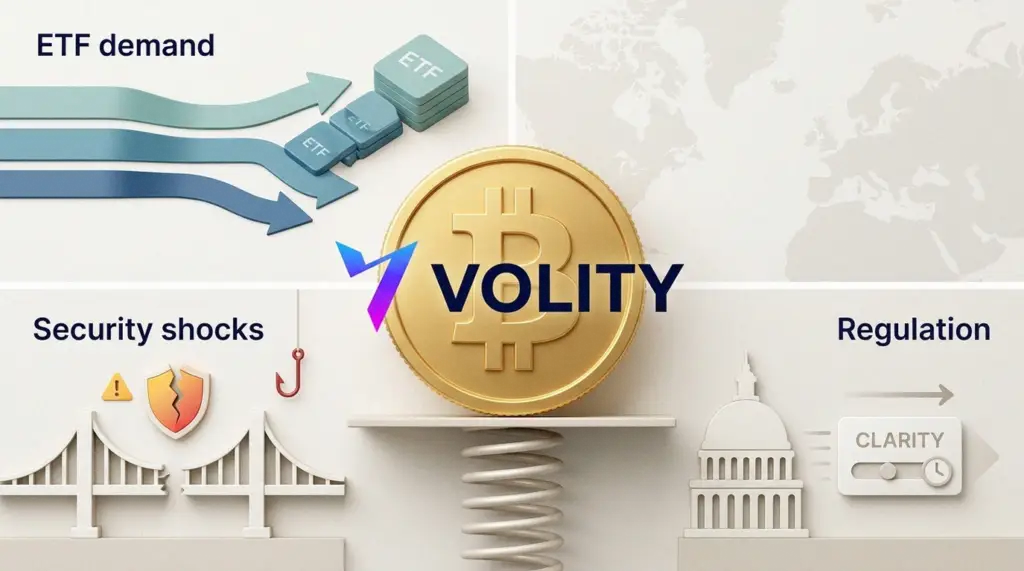
So the market sits in a narrow corridor. ETF flows argue for patience. Security risks argue for caution. Regulation argues for a September calendar alert. Bitcoin, meanwhile, is holding the line and making everyone wait.
Related coverage on Volity
- How to Avoid Crypto Scams: A Beginner Safety Checklist
- How to Choose a Trading Platform: A 10-Point Checklist
- Demo vs Live Trading Account: A 7-Step Checklist Before You Go Live
- How to Size a Trade: Position Sizing and Risk Per Trade for Beginners
- Risk-Reward Ratio Explained: How to Set It and Why It Matters
- ETF vs Index Fund: The Difference and Which to Pick