Crypto’s hot autumn: bitcoin steadies as leverage, hacks and regulation reshape the market
November 11, 2026 – Bitcoin held close to $74,000 after another bruising session, but the calm looked fragile.
October’s hotter-than-expected US inflation report jolted risk assets early. Meanwhile, slowing ETF withdrawals gave battered crypto buyers a modest reason to stay involved.
Inflation redraws the rate map
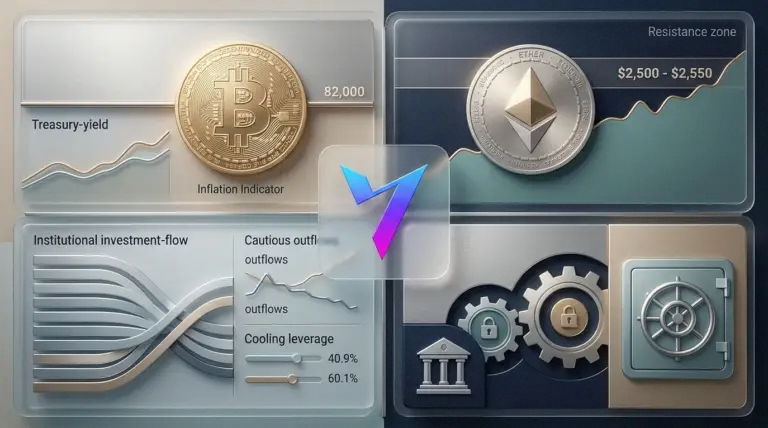
US consumer prices rose 0.4% in October, above economists’ 0.3% forecast. Core prices also increased 0.3%, exceeding expectations.
The figures revived bets on another Federal Reserve rate increase. Markets now place the odds of a quarter-point rise near 90%.
Bitcoin initially slid to about $72,700 before recovering into a $73,800 to $74,700 band. Ether changed hands near $2,060 and fell more sharply.
Higher yields offer investors a real alternative to speculative assets. That shift matters most when crypto traders already carry heavy borrowed positions.
Liquidations reached more than $723 million during the past 24 hours. Long positions accounted for almost four-fifths of the forced closures.
Ether traders absorbed roughly $259 million of those losses. Bitcoin positions added another $204 million.
The pattern suggests traders had leaned too heavily into a rebound. When inflation surprised, exchanges closed crowded long bets at speed.
Perpetual-futures open interest remains high, while funding rates still favour long positions. That leaves the market exposed if Bitcoin revisits last week’s lows.
ETF selling eases, without turning positive
US spot Bitcoin ETFs recorded about $95 million of net outflows on Tuesday. It was the fourth straight day of withdrawals.
Yet the pace slowed from $201 million on Monday. Redemptions had also been substantially larger late last week.
That improvement does not signal fresh institutional demand. Still, it reduces an immediate source of selling pressure.
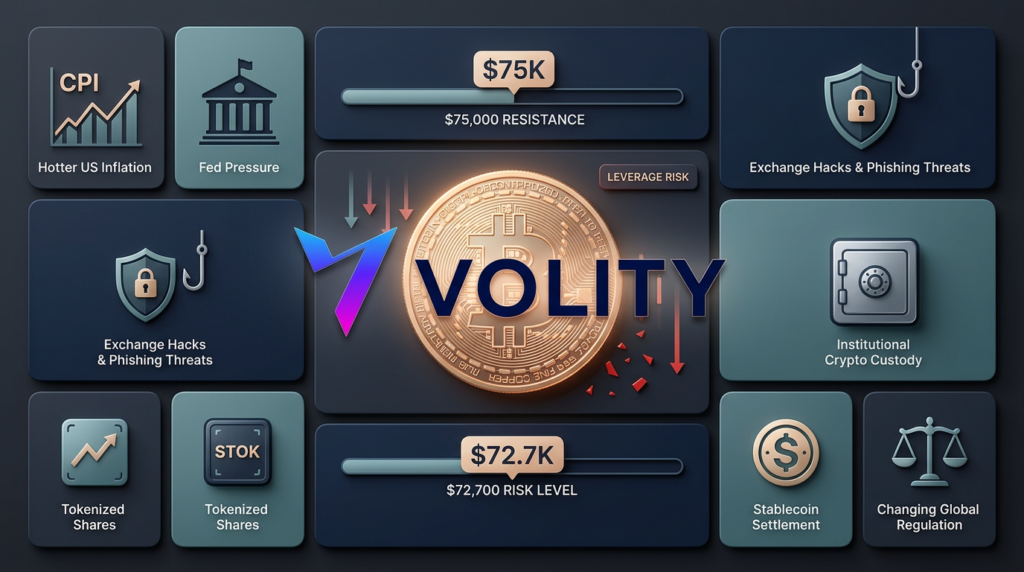
Traders now want to see Bitcoin regain $75,000 without a fresh liquidation cascade. A clean break above that level could squeeze short sellers.
Conversely, another move below $72,700 may uncover more leveraged longs. The result could be a sharp fall even without major spot selling.
Hacks put operational risks back in focus
Security worries added a second layer of anxiety. Investigators linked October’s Binance breach to a North Korean hacking group.
The reported theft totalled $6.3 billion, which would make it crypto’s largest recorded heist. The episode centred attention on employee access and internal controls.
Attackers reportedly compromised a limited number of staff before moving through exchange infrastructure. Technical safeguards mean little if criminals capture the people operating them.
Crypto thefts since 2021 have exceeded $22.3 billion. That bill now includes cloud credentials, phishing pages and compromised staff devices.
Initia confirmed its second breach in less than three weeks. A compromised Google Cloud key exposed its environment and developer credentials.
The attacker then triggered fraudulent withdrawals across five rollups. Estimated losses reached $3.27 million before the network halted activity.
Across Protocol suffered a different failure when attackers hijacked its website domain. Visitors were directed to a phishing page rather than the legitimate service.
Smart contracts were not blamed for that breach. Even so, losses across six blockchains reportedly reached about $350,000.
Investors increasingly need to assess the whole operating chain. Audited code cannot protect a user who signs a transaction on a fake website.
Wall Street keeps building through the sell-off
Price weakness has not stopped institutions from expanding crypto infrastructure. Deutsche Bank has launched custody services for Bitcoin, Ether and stablecoins.
The service could help regulated clients hold digital assets within familiar administrative systems. That is less dramatic than a token rally, but it matters.
Kraken parent Payward is also bringing more than 200 UK and European shares onto its platform in tokenised form. The offering includes stocks linked to the FTSE and DAX.
Meanwhile, the Depository Trust & Clearing Corporation is testing tokenised shares as usable collateral. Tradable collateral could shorten settlement cycles and release trapped capital.
Visa has added Monad to its stablecoin settlement network. Its stablecoin settlement run rate now exceeds $25 billion.
Goldman Sachs and Citi are backing a $270 million stablecoin venture. Banks increasingly see digital dollars as payment plumbing rather than a crypto side bet.
Regulators choose different routes
Russia plans to permit crypto exchange trading from November 22 under central-bank rules. In Washington, policy remains less settled.
Former adviser Patrick Witt said President Donald Trump still supports a strategic Bitcoin reserve. Its funding mechanism and legal structure remain unclear.
House Republican Tom Emmer has become the party’s No. 2 representative after the midterm losses. His elevation gives the crypto industry a prominent ally.
Democrats are expected to push harder on consumer protections and market oversight. The debate now turns on enforcement as much as innovation.
SEC enforcement activity has fallen to a 35-year low under Chair Paul Atkins. Penalties have also declined.
A lighter enforcement environment may attract new businesses. It may also test whether deterrence has weakened when markets become volatile.
What traders are watching
- $75,000: Bitcoin needs to reclaim this level to weaken the immediate bearish case.
- $72,700: A break below the recent low could trigger another long-liquidation wave.
- ETF flows: Smaller outflows help, but sustained inflows would offer a stronger demand signal.
- Funding rates: Persistently positive funding shows traders still pay to hold leveraged longs.
- Security disclosures: Exchange access failures and domain attacks can damage tokens without any smart-contract flaw.
Bitcoin’s next move may depend less on a fresh story than on market mechanics. Buyers must return before leverage finds another reason to unwind.
Related coverage on Volity
- How to Avoid Crypto Scams: A Beginner Safety Checklist
- How to Choose a Trading Platform: A 10-Point Checklist
- Demo vs Live Trading Account: A 7-Step Checklist Before You Go Live
- How to Size a Trade: Position Sizing and Risk Per Trade for Beginners
- Risk-Reward Ratio Explained: How to Set It and Why It Matters
- ETF vs Index Fund: The Difference and Which to Pick