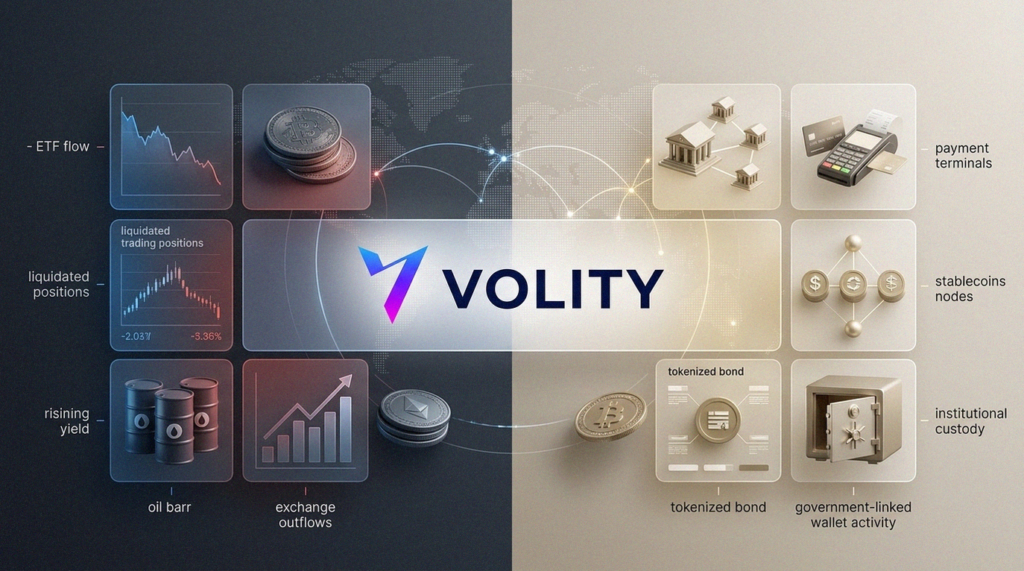
Crypto’s risk map gets redrawn as markets wobble and real-world adoption accelerates
October 7, 2026 – Crypto markets fell back into their old habit: prices weakened while the industry kept laying fresh tracks.
Bitcoin traded near $84,286, down 1.5% in 24 hours. Yet banks, payment firms and governments continued pushing digital-asset projects forward.
The divide matters for traders. Adoption can grow steadily while liquidity-driven markets punish every crowded bullish bet.
Macro pressure hits leveraged positions
Total crypto market value fell 1.8% to $2.95 trillion. Ether changed hands near $2,619, while Solana traded around $118.80.
XRP slipped towards $1.47. Dogecoin fell 4.5% to about $0.0906, placing it among the weaker large-cap tokens.
Oil prices climbed above $101 a barrel after attacks on tankers unsettled Middle Eastern supply routes. That shift lifted Treasury yields and the dollar.
Risk assets rarely welcome that combination. Crypto, still highly dependent on global liquidity, felt the pressure quickly.
Leverage then turned an orderly retreat into a sharper move. More than $403 million of long positions vanished within one hour.
Longs accounted for 97% of that liquidation burst. Over 24 hours, traders lost roughly $555 million, including $487 million in bullish wagers.
Bitcoin now faces a busy technical range between $83,300 and $84,600. Large volumes previously changed hands across that zone.
A sustained break below $83,300 would damage the recent recovery attempt. By contrast, a hold could show that forced sellers have largely cleared.
There was one quieter constructive detail. Roughly 24,073 Bitcoin left exchanges in one day, the largest withdrawal since March 1.
Exchange balances fell to about 6.5% of circulating supply. Those transfers do not guarantee a rally, but they reduce immediately available supply.
ETF buyers remain selective
Spot Bitcoin ETFs offered no broad vote of confidence. Recent net outflows reached $89.8 million across the group.
ARKB lost $85.2 million, while FBTC shed $74.5 million. IBIT, however, attracted $69.9 million in new money.
That split tells a more useful story than the headline outflow. Institutions are rotating between products rather than abandoning the asset class outright.
Regulated fund demand can also diverge from spot-market demand. ETF buying does not always create the urgent exchange purchasing seen during breakouts.
XRP showed the same disconnect. United States spot XRP ETFs added $3.14 million on October 6, yet the token still fell 4.3%.
Traders are defending $1.40. A recovery above $1.4850 would improve the near-term chart and ease pressure on recent buyers.
XRP futures remain large enough to amplify each move. Open interest stood near $3.38 billion, with daily futures volume around $3.67 billion.
Evernorth also delayed the expected Nasdaq debut of XRPN shares until October 12. That date now sits on traders’ calendars.
A government wallet adds supply fears
A United States government-linked wallet sent 833.6 Bitcoin, worth about $71.56 million, to Coinbase Prime.
The wallet also transferred 40,285 BNB valued near $31.63 million. Neither move proves an immediate sale.
Governments shift seized assets for custody, settlement and administrative reasons. Still, a transfer to an institutional trading venue catches attention.
Markets often trade the possibility before they receive the explanation. In fragile conditions, prospective supply can weigh on sentiment.
Traders will watch for follow-on transfers to exchange-linked addresses. An official statement could also quickly change the market’s reading.
Stablecoins enter the payments machinery
While token prices slid, stablecoin issuers kept moving deeper into corporate finance. Circle is bringing USDC and EURC payment tools to SAP.
The partnership targets treasury and settlement workflows inside large enterprises. It seeks to make digital cash less of a specialist trading product.
Tether, meanwhile, is working with Kazakhstan on a pilot for a tenge-linked stablecoin. The project reflects growing interest in digital local currencies.
The appeal is straightforward: round-the-clock transfers, faster cross-border settlement and programmable payment terms. The difficult question concerns genuine commercial use.
Investors need to separate merchant payments and payroll from exchange turnover, arbitrage and internal wallet transfers. Those activities carry very different economic meanings.
Institutions build through the volatility
Russia approved its first crypto exchanges and custodians under new rules. South Africa’s FNB began offering digital assets through a partnership with VALR.
Customers can begin with as little as 10 rand. Such small entry points matter because they normalise crypto access inside familiar banking channels.
In Britain, six banks will lead the first digital gilt issuance, expected early in 2027. South Korea also recorded fresh tokenisation activity.
Ripple expanded work with Meritz Securities, while Securitize partnered with LG CNS on tokenised assets. These projects focus on financial plumbing, not meme-token excitement.
Robinhood added $25 million in Bitcoin to its balance sheet. The purchase is modest, though it signals growing corporate comfort with direct exposure.
Platforms now face a delicate trade-off. Bitcoin can support strategic ambitions, but falling prices can also affect earnings, customer activity and risk controls.
Control and custody become investment questions
Ledger is introducing Bitcoin-backed borrowing through Morpho. Eligible users can pledge cbBTC or wBTC for USDC and USDT loans.
Borrowing avoids an immediate sale, but collateral can be liquidated during a rapid decline. Investors should treat that risk as central, not incidental.
Cardano also raised a different issue with issuer controls. Certain token creators may freeze or seize assets under specified terms.
That may help regulated issuers meet legal obligations. Yet it changes the practical meaning of ownership for token holders.
Europol has also warned that quantum computing may eventually threaten existing wallet cryptography. The danger is gradual rather than imminent.
Networks and custodians need time to adopt stronger signature systems. Still, investors should ask whether projects have credible migration plans.
What traders are watching
- Bitcoin: $83,300 to $84,600 remains the immediate battleground after heavy long liquidations.
- XRP: Support sits near $1.40, while $1.4850 is the level needed for a cleaner recovery.
- ETF flows: Product-level rotation matters more than one day’s sector-wide headline figure.
- Stablecoins: Enterprise integrations may matter more long term than daily token volatility.
- Risk: Government transfers, derivatives positioning and oil shocks can overwhelm fundamentals in hours.
Crypto’s loudest signals still flash on liquidation screens. Its more durable changes are occurring in payment systems, custody arrangements and financial-market infrastructure.
Related coverage on Volity
- How to Avoid Crypto Scams: A Beginner Safety Checklist
- How to Choose a Trading Platform: A 10-Point Checklist
- Demo vs Live Trading Account: A 7-Step Checklist Before You Go Live
- How to Size a Trade: Position Sizing and Risk Per Trade for Beginners
- Risk-Reward Ratio Explained: How to Set It and Why It Matters
- ETF vs Index Fund: The Difference and Which to Pick