Market reset or real reversal
Wall Street has a familiar problem today: fear looks cheap, until it gets cheaper.
Intuitive Surgical, Takeda, semiconductors and crude oil are pulling traders in different directions. Together, they frame the session’s real question. Is this a reset, or has the market started pricing a reversal?
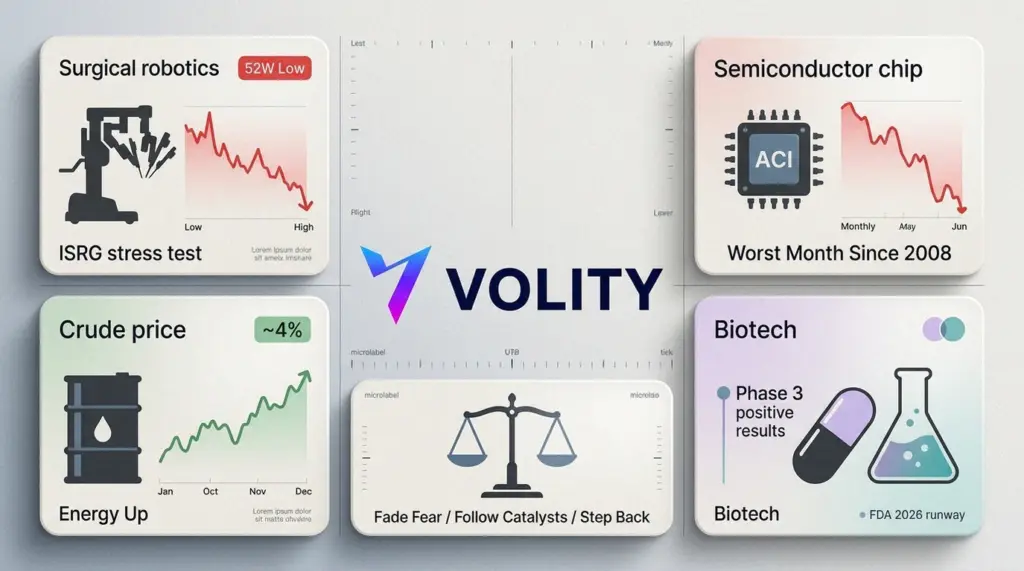
Intuitive Surgical is the cleanest stress test. The surgical robotics leader has slipped to fresh 52-week lows after a wave of price-target cuts. However, most analysts have kept Buy ratings in place. That gap matters.
When targets fall before ratings break, the market often moves faster than the analyst community. Traders now see two competing setups in ISRG. One is an oversold bounce in a high-quality med-tech name. The other is a momentum breakdown that keeps feeding on itself.
If the new lows hold, short-covering could appear quickly. However, another failed bounce would shift the story. Investors may stop calling it discounted quality and start calling it an orderly de-rating.
Takeda sits at the opposite end of the tape. Its oral TYK2 drug, zasocitinib, also known as TAK-279, delivered strong Phase 3 plaque psoriasis data. The trial hit PASI 75 and PASI 90/100 measures with efficacy that looked close to biologic territory.
More than half of treated patients achieved clear or almost clear skin at week 16. Roughly one-third reached complete clearance. Meanwhile, the safety profile looked clean enough to support the next leg of the trade.
Takeda plans an FDA filing in fiscal 2026 and is aiming for a launch around 2027. That gives TAK a visible regulatory calendar, a large addressable market and a clean catalyst path. In biopharma, that combination still gets attention.
Jasper Therapeutics has added more heat to the biotech tape. The company closed its Kira Pharma deal and raised about $132 million. As a result, Jasper extended its cash runway into 2028 and the stock jumped more than 20%.
Still, traders should treat that move with care. Post-deal biotech rallies often burn brightly, then confront valuation and dilution reality. For now, Jasper is a high-beta momentum name, not a quiet compounder.
By the numbers
- ISRG: fresh 52-week lows after multiple price-target cuts.
- TAK: FDA filing planned in fiscal 2026 for zasocitinib.
- Jasper: roughly $132 million raised, runway extended into 2028.
- Crude: oil up about 4%, helping energy gauges rise near 1.4%.
- Semis: sector suffering its worst month since 2008.
Oil has supplied the day’s sturdier momentum. Crude’s roughly 4% rise has pulled the energy complex higher, with sector measures up about 1.4%. USO, XLE and OXY are back on trend-following screens.
If crude holds recent levels, traders may chase continuation rather than mean reversion. Occidental Petroleum also keeps its longer-term appeal. Over five years, OXY has significantly outperformed many energy peers, reinforcing its role as a structural oil-beta name.
Financials have joined the rotation conversation. Travelers delivered better-than-expected second-quarter numbers, creating a follow-through setup in insurers. U.S. Bancorp also beat in the quarter, while a recent target increase towards the mid-$70s has fed interest in USB.
However, banks still need friendly rates and calm credit signals. If those worries stay contained, money can rotate back into regionals and large lenders. If not, earnings beats may get sold into strength.
Longer-term investors are getting a quieter reminder from growth indexes. The Schwab U.S. Large-Cap Growth ETF, ticker SCHG, has compounded at a mid-teens annual rate over 15 years. That record makes it more than a simple momentum wrapper.
Instead, SCHG remains a broad route into large winners without forcing stock-picking heroics. Microsoft and Meta tell the same story through single names. Both have delivered long-run annual returns in the high-teens range.
Yet their appeal now depends on more than old charts. Microsoft still anchors cloud and enterprise AI spending. Meanwhile, Meta controls a powerful digital advertising machine and keeps spending aggressively on AI infrastructure.
The contrarian corner looks less comfortable. Netflix is trading near its 52-week lows, despite continuing arguments for streaming, advertising and global scale. That leaves NFLX at a clean technical battleground.
If support holds, the stock could trap late shorts. However, a decisive break would confirm a deeper downtrend. For traders, this is not a gentle valuation debate. It is support versus breakdown, with little room for poetry.
Semiconductors carry the bigger market signal. SOXX and SMH have been hit hard, while Nvidia, AMD and Broadcom have endured heavy selling. The group is suffering its worst month since 2008.
Even so, major desks still describe the move as a summer reset, not a broken AI-chip cycle. That distinction matters. A reset invites selective buying after stabilisation. A reversal demands lower multiples and lower expectations.
Taiwan Semiconductor stands out inside the damage. TSM reported roughly 34% year-on-year second-quarter revenue growth. At least one major analyst also raised the target while staying bullish, despite the sector selloff.
TSM has become the relative-strength name to watch. If chips find a floor, traders often look first to firms still delivering numbers. Balance-sheet strength and demand visibility matter more than dramatic dip-buying.
Industrials are offering a sturdier counterweight. GE Aerospace posted a record quarter and raised guidance. Management stressed execution rather than celebration, which usually plays well with institutional money.
That makes GE a post-earnings continuation candidate, especially for portfolios crowded with high-beta tech risk. Kratos Defense & Security fits the same durability theme from another angle. Its defence and space exposure keeps KTOS on breakout and dip-buying lists.
Applied Digital is the noisier side of the AI build-out. The stock fell more than 6% despite enthusiasm around data-centre infrastructure. Persistent net losses and growth-tech risk-off have kept pressure on APLD.
So, the trade remains high-volatility and fragile. Bulls can argue infrastructure demand. Bears can point to losses, funding needs and a market suddenly less patient with AI adjacency stories.
Space-linked private-market vehicles add another speculative wrinkle. Funds such as SPCX remain sensitive to short interest and questions about private valuations. Importantly, SpaceX itself remains private, so conventional IPO-price talk misses the point.
Here, the setup is sentiment-led. Bearish positioning can create sharp squeezes. However, high valuations can also punish late buyers with little warning.
Small-cap scanners are busy as well. Southland Holdings has leapt more than 50% on headlines. Sadot Group has risen more than 40%. Meanwhile, Laser Photonics and Regenxbio have dropped around 20% and 15%, respectively.
Those moves sit outside normal fundamental rhythms. Liquidity, position size and stops matter more than polished narratives. Lulu’s Fashion adds an event-driven layer, after its review of strategic alternatives opened the door to sale or restructuring headlines.
Key takeaways
- ISRG: watch whether fresh lows hold after target cuts.
- TAK: late-stage psoriasis data create a clear pipeline catalyst.
- SOXX and SMH: stabilisation matters before high-quality dip-buying works.
- USO, XLE, OXY: crude strength keeps trend-followers engaged.
- NFLX: 52-week support is the line between bounce and breakdown.
The med-tech tape circles back to Intuitive Surgical. Weakness in equipment names could still become a sector-wide oversold bounce. However, it could also turn into a broader de-rating if guidance fails to reassure.
That is today’s trade in miniature. Fade panic in quality, ride catalysts in biotech and energy, or wait. Sometimes the best trade is refusing to catch falling knives with both hands.
Related coverage on Volity
- What Is a P/E Ratio and How to Use It
- Fundamental Analysis in Stock Trading: A Working Definition
- Growth Investing vs Value Investing: Which Style Fits You?
- Fractional Shares Explained: How to Start Investing With $50
- How to Start Stock Trading: A 2026 Beginner Guide
- Dividend Investing for Beginners: How to Start