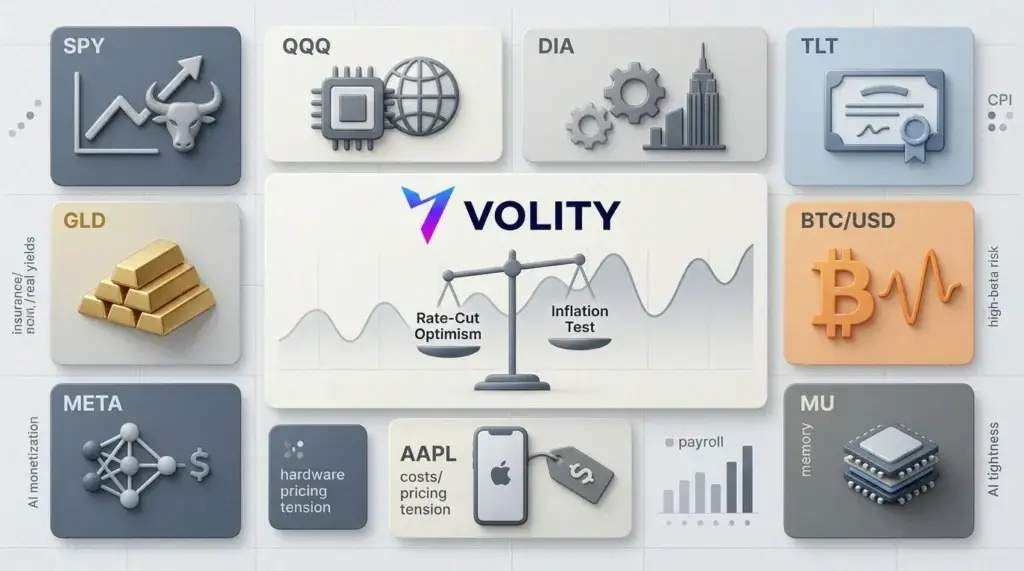
Markets enter a headline tape
Markets are moving into a skittish stretch, where a soft data print can outrun a three-month earnings model.
Cooling labour indicators have sharpened the Fed-cut debate. Equities, Treasuries and gold are trading from the same macro script. If inflation behaves, weaker jobs data can lift rate-cut odds. However, one stubborn price reading could quickly spoil that comfort.
That makes SPY, DIA and QQQ useful market thermometers today. They are less clean directional bets than gauges of Fed trust, growth fear and AI appetite. Meanwhile, TLT sits at the centre of the rates trade. Falling yields support the bond ETF, but Fed speakers can still knock it around.
Gold has found a place in the same conversation. GLD benefits when real yields fall and investors want insurance against slower growth. Bitcoin, by contrast, remains the noisy cousin at the table. BTC/USD still trades more like high-beta risk than a tidy macro hedge.
Ai winners face a sharper test
Meta is one of the cleaner single-stock stories on the board. The market is no longer treating its AI push as only a spending problem. Instead, investors are starting to price a path toward paid AI features, subscriptions and agent tools.
Some estimates now point to more than $20 billion in annual AI-related revenue by 2030. That number is not in the share price by magic. However, it gives traders a framework beyond “more servers, more costs”. Meta has the advertising engine to fund the buildout. It also has the user base to test paid products at scale.
As a result, META looks like both a momentum stock and a structure stock. The distinction matters. Momentum needs excitement; structure needs a credible revenue bridge. Meta now has both, though execution still matters.
Apple sits on the other side of the AI hardware trade. Tim Cook has pointed to higher memory and storage costs. Apple has already raised prices on selected iPads, MacBooks, HomePod devices and Apple TV models.
That creates a more delicate setup for AAPL. Higher prices can defend margins. However, they can also test consumer patience. Traders will listen closely for demand signals, gross margin pressure and any hint of volume damage.
Meanwhile, Micron offers the cleaner hardware read-through. If AI data-centre demand keeps memory tight, DRAM and storage makers keep pricing power. MU remains a levered play on the part of the AI boom that buyers cannot easily postpone.
Software momentum is more uneven
The software trade is less tidy. Adobe is a continuation candidate if investors keep rewarding AI-adjacent software. Yet the stock still needs proof that generative tools can protect pricing, not merely defend the franchise.
Palantir is more theatrical. It trades with the force of an AI and defence-data story, not a conventional valuation debate. PLTR remains powerful in a risk-on tape and vulnerable when investors ask harder questions.
Both stocks deserve a place on watchlists. However, neither has the same clean line as Meta’s monetisation story or Micron’s memory cycle.
Google offers a different pattern: bad headlines, sturdy stock. Legal pressure remains visible, but GOOG and GOOGL have continued to find buyers when the broader megacap tape cooperates. That usually signals focus on cash flow, scale and franchise durability.
For traders, the setup is simple enough. If Google keeps absorbing legal news without breaking support, dips may attract fresh demand. However, a broad tech wobble could quickly turn that resilience into another crowded exit.
Cloud infrastructure gets crowded
The AI infrastructure trade is becoming more complicated by the week. CoreWeave remains a volatile route into compute demand. Bullish analyst commentary has kept the rebound case alive, especially for investors chasing scarce GPU capacity.
Still, competition risk has become harder to ignore. Meta has explored ways to sell excess AI compute capacity in a cloud-like model. If that market expands, neocloud providers could face tougher pricing and supply questions.
That does not sink CRWV. It does, however, make the stock more headline-sensitive. Peers such as NBIS should be treated the same way. The upside remains real, but structural risk now travels with it.
Defensives and laggards split the tape
Defensive pockets are producing their own stories. Verizon has a flow problem after its Dow exit. Index selling can pressure the name, although income investors may step in if the move overshoots.
The yield still matters. VZ can draw value buyers in a softer market. Yet it may need time for forced selling to clear.
Chevron is less about analyst chatter and more about the old energy trio: oil, discipline and dividends. If crude steadies, CVX can regain attention from income and value accounts. If oil slips, the dividend support may only cushion the fall.
Elsewhere, Nokia has a cleaner technical map. Traders are watching whether NOK can reclaim and hold $15. A durable move above that level would restore some bullish momentum. Failure would leave it as just another false start.
Several downgraded names look more fragile. SkyWest, TCOM, AGNT and DAN all need proof before buyers get aggressive. Until then, failed rallies matter more than optimistic stories.
In cybersecurity, PANW, ATEN and QLYS look extended rather than broken. That distinction matters. Extended stocks do not need bad news to pull back; they only need tired buyers.
Small caps need selectivity
IWM remains the macro side note with real consequences. The Russell 2000 still contains plenty of weak balance sheets and unprofitable companies. Small-cap enthusiasm should be selective, not automatic.
Rate cuts would help the group. However, cheaper money does not fix every business model. Quality screens matter more here than broad exposure.
Redwire keeps its momentum profile in defence and space. Still, liquidity matters more in small caps than in megacaps. A thin order book can turn a good headline into a difficult exit.
Franklin Covey is a patience trade after its guidance cut. Falling knives sometimes bounce, but rarely on a trader’s preferred timetable.
By the numbers
- $20 billion-plus – potential annual Meta AI revenue estimate by 2030.
- $15 – key reclaim level traders are watching in Nokia.
- 3 – main macro assets in focus: equities, Treasuries and gold.
- 4 – downgraded or fragile names to watch: SkyWest, TCOM, AGNT and DAN.
- 1 – central market question: do rate-cut expectations survive the next inflation test?
Earnings names need transcript work
A few earnings setups round out the session. EQBK is a standard pre-report watch, where estimate revisions may matter more than the headline result. Positioning can drive the first move before fundamentals get a voice.
PXED has already seen a pre-report run-up. The company may need a convincing beat to justify the move. A merely decent print may not be enough.
Constellation Brands looks more balanced. STZ delivered solid results and reaffirmed guidance, but analyst caution has not disappeared. That keeps the stock from becoming a simple victory lap.
FactSet is the transcript name. With FDS, the release gives the first answer, but the call gives the trade. Margins, bookings and guidance tone will matter most.
Key takeaways
- META has the clearest AI monetisation story among the megacaps.
- AAPL hinges on whether price increases protect margins without hurting demand.
- MU remains a direct play on AI-driven memory tightness.
- TLT depends on rate-cut expectations surviving Fed commentary and inflation data.
- NOK needs a sustained move above $15 to regain technical credibility.
Related coverage on Volity
- What Is a P/E Ratio and How to Use It
- Fundamental Analysis in Stock Trading: A Working Definition
- Growth Investing vs Value Investing: Which Style Fits You?
- Fractional Shares Explained: How to Start Investing With $50
- How to Start Stock Trading: A 2026 Beginner Guide
- Dividend Investing for Beginners: How to Start