Monday markets balance AI appetite against earnings risk
Markets began Monday in their customary late-summer posture: uneasy, but far from panicked.
Nasdaq and S&P 500 futures edged higher before the opening bell. Meanwhile, Dow futures slipped as technology again outpaced defensive shares.
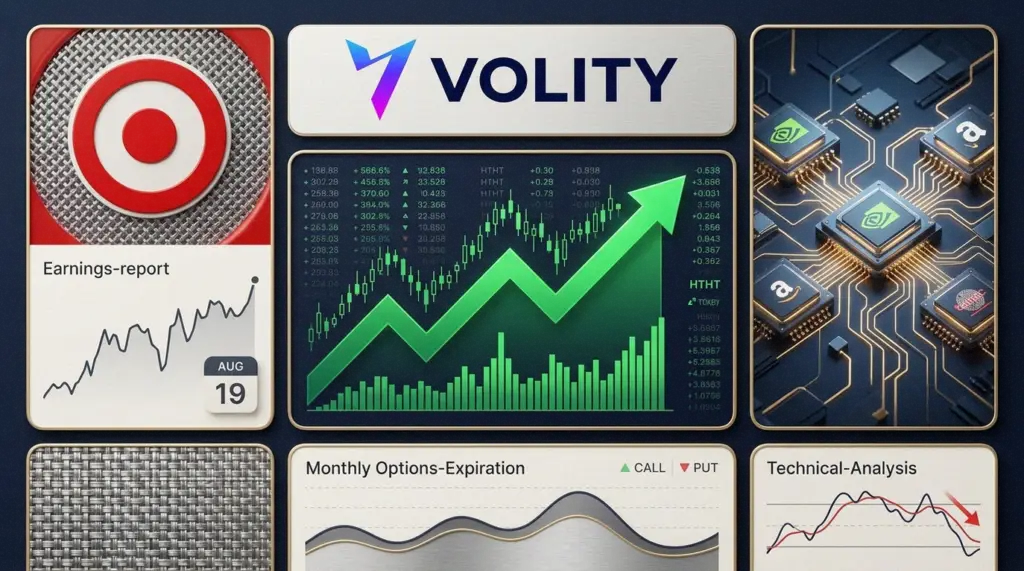
That split matters during monthly options-expiration week. Traders should expect sharp moves in SPY, QQQ and the largest technology names.
Fresh AI optimism has kept buyers near the market’s growth leaders. However, the broader tape still lacks the conviction of a clean risk-on rally.
Instead, money appears likely to chase company-specific catalysts. H World Group’s results and Target’s approaching earnings report offer two very different tests.
H world turns earnings into a gap higher
H World Group, which trades in New York as HTHT, delivered the morning’s clearest earnings surprise.
Revenue rose 10.8% from a year earlier to RMB7.1 billion. Meanwhile, adjusted EBITDA increased 20% to RMB2.7 billion.
Adjusted net income climbed nearly 27% to RMB1.7 billion. Net income attributable to shareholders reached RMB1.6 billion, or roughly $232 million.
The figures gave investors evidence of stronger operating leverage across its Chinese hotel estate. The company also continued to emphasise asset-light expansion and cash generation.
HTHT indicated a gain of nearly 9% before the market opened. That creates a proper post-earnings gap, rather than a modest relief bounce.
For short-term traders, the opening range will matter more than the headline percentage move. If buyers defend the gap on sustained turnover, momentum could extend.
However, a retreat into the pre-results range would alter that calculation quickly. A gap fill often signals that early buyers were covering shorts, not building positions.
Longer-term holders have a firmer argument. Margins improved faster than revenue, while profits rose at an even quicker pace.
- HTHT revenue: RMB7.1 billion, up 10.8% year on year.
- Adjusted EBITDA: RMB2.7 billion, up 20%.
- Adjusted net income: RMB1.7 billion, up nearly 27%.
- Pre-market indication: roughly 9% higher.
Target faces a harder examination
Target has not yet earned its market verdict. The retailer reports fiscal second-quarter 2026 results before Wednesday’s opening bell, on August 19.
Wall Street expects earnings near $2.26 to $2.32 a share. Revenue estimates cluster around $26.1 billion.
Those figures imply low single-digit sales growth. Yet investors will focus on the quality of that growth, including traffic, discretionary demand and inventory discipline.
Target shares carry a turnaround narrative after a difficult stretch. Merely matching estimates may not satisfy investors who already expect operational progress.
A result above $2.32 a share could support the bull case. Still, management must also provide steady or improved guidance.
In that outcome, TGT could attract post-earnings buyers seeking a retailer with an indicated dividend yield near 3%.
However, weaker guidance would probably matter more than a narrow earnings beat. Consumers have remained selective, especially in categories where Target needs stronger demand.
Options traders expect a meaningful move either way. That makes unhedged positions uncomfortable before the release, even for investors with a favourable long-term view.
- Bullish outcome: Earnings exceed $2.32, sales hold up and guidance improves.
- Neutral outcome: Target meets estimates, but offers little evidence of accelerating demand.
- Bearish outcome: Earnings or guidance disappoint, opening the door to a sharp gap lower.
AI giants remain the market’s centre of gravity
Elsewhere, the market’s AI dependence remains plain. Technology futures led early trading as investors weighed stronger AI revenue expectations and a gentler rate outlook.
Large investors continue to favour semiconductor and cloud beneficiaries, including Nvidia, Taiwan Semiconductor and Amazon. Those shares remain central to index direction.
Rotations within mega-cap technology deserve a cooler reading. Sales of Alphabet, for example, do not automatically represent a rejection of digital advertising or AI investment.
Instead, portfolio managers often shift exposure between expensive winners. Valuation, concentration limits and risk budgets can drive those trades.
For active traders, though, the distinction offers limited comfort this week. Options positioning can move AAPL, MSFT, NVDA, GOOGL, META and TSLA independently of news.
Market makers hedge customer options positions as prices change. As a result, intraday rallies can feed on themselves, while reversals can become suddenly violent.
Defined-risk spreads fit that environment better than naked leverage. Smaller positions also leave room for the tape to misbehave without damaging an account.
Overbought stocks need a second look
Some less celebrated names also deserve attention. NewMarket, New Pacific Metals and Avient have recently shown RSI readings from the mid-70s into the low-80s.
An RSI above 70 signals a stretched market by conventional measures. Above 80, meanwhile, traders often begin searching for mean-reversion opportunities.
That does not mean investors should mechanically short each new high. Strong trends can remain overbought much longer than sceptics expect.
Instead, traders should wait for observable weakness. A break beneath intraday support, fading volume, or a failed push to fresh highs offers better evidence.
Existing holders face a different decision. Trimming a portion of gains or tightening stops can protect profits without abandoning the trend.
What traders are watching
- HTHT: Whether heavy volume keeps the earnings gap intact after the open.
- TGT: Earnings, traffic trends and guidance before Wednesday’s session.
- NVDA and peers: AI enthusiasm versus options-driven reversals into expiration.
- NEU, NEWP and AVNT: Signs that stretched momentum has begun to fade.
Monday’s market offers little room for complacency. Tech remains supported, yet earnings and options flows could rearrange leadership before the week is over.
Related coverage on Volity
- What Is a P/E Ratio and How to Use It
- Fundamental Analysis in Stock Trading: A Working Definition
- Growth Investing vs Value Investing: Which Style Fits You?
- Fractional Shares Explained: How to Start Investing With $50
- How to Start Stock Trading: A 2026 Beginner Guide
- Dividend Investing for Beginners: How to Start