Confirmation matters more than the headline
The better trade today is not the cleanest story. It is the story that survives the open.
That distinction matters across a tape crowded with earnings reactions, AI positioning chatter, crypto beta and retail sentiment names. A stock can gap higher on a strong report, then spend the first hour leaking below VWAP. Meanwhile, a supposedly weak print can flush at 9:30 a.m., find buyers, and close near the high.
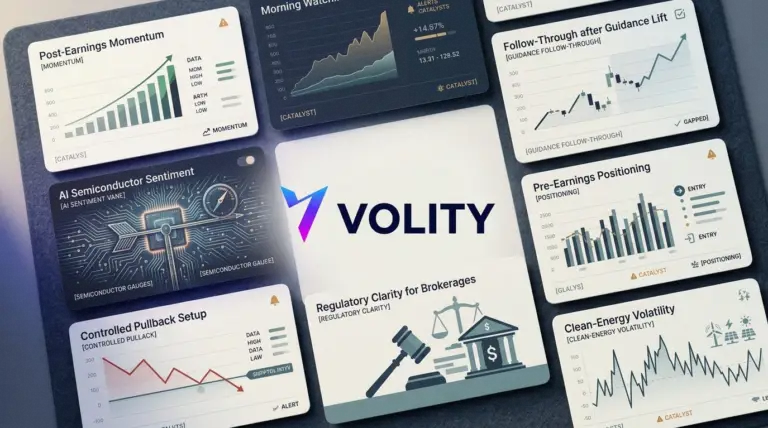
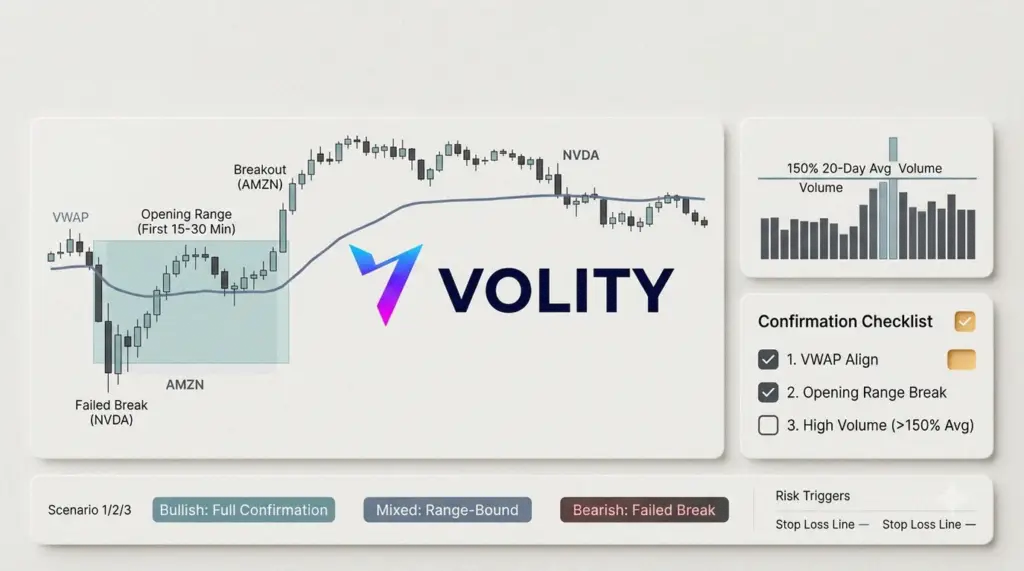
So the working rule is simple: catalyst first, confirmation second, position size always. For short-term traders, the signal improves when price holds above a post-event high, volume runs above average, and the opening range becomes support rather than resistance.
In other words, do not trade the headline alone. Trade the market’s reaction to it.
Bullish setups need volume
Amazon, Starbucks, Monolithic Power, LPL Financial, Ryan Specialty and Bloom Energy sit in the momentum bucket. However, they need more than a favourable narrative.
For AMZN, the AWS story remains the centre of gravity. Traders want to see whether buyers defend the post-earnings high after the first burst of orders. A sustained move above that level, with volume running at least 150% of the 20-day average, would give the breakout better credentials.
However, a weak-volume push matters less. If AMZN clears resistance before 10 a.m. and then slips back under VWAP, the move becomes suspect. That pattern often traps late buyers.
SBUX also needs proof. A better margin or traffic story can help sentiment, but the stock still needs to hold the opening range. If sellers absorb the first bounce, the trade shifts from recovery to fade.
MPWR remains tied to power-management demand and the broader semiconductor tape. The cleanest long case needs participation from the chip complex. Watch NVDA, AMD and SOXX alongside it.
LPLA and RYAN are less noisy, but that can be useful. Financial-platform and insurance-brokerage names often trend better when volume expands slowly through the session. A green open with no follow-through is not enough.
BE is the livelier name. It can move sharply on clean-energy headlines and risk appetite. Still, the same rule applies: price must hold after the first squeeze.
Mixed names need patience
Lucid is the clearest high-beta watch. The ticker, LCID, can rally hard on optimism, then reverse when liquidity thins. Support matters more than the story.
If LCID holds the prior session’s low and reclaims VWAP, traders can treat the rebound seriously. If it loses both in the first hour, the setup becomes a liquidity warning, not a dip-buying invitation.
Mastercard, Marriott and Stryker belong in the reaction bucket. Good companies can trade badly after good reports. Expectations, not quality, guide the first move.
For MA, the market will judge spending trends, cross-border volumes and margins. However, traders should watch whether selling gets absorbed near the opening range low.
MAR has a similar issue. Hotel demand can look solid while the stock struggles if guidance sounds merely adequate. A reclaim of VWAP would matter more than the first headline.
SYK often trades with institutional rhythm. If it opens lower, then climbs back through the first 30-minute range, the sell-the-news move may be temporary. If it cannot reclaim that range, sellers keep control.
Bearish watches are not automatic shorts
Apple should be treated as a margin-pressure watch, not a broken-company call. Rising input costs can compress expectations over time. Yet they rarely destroy a franchise overnight.
For AAPL, premarket weakness matters only if it continues after the open. A break below the first 15-minute low, with rising sell volume, would confirm pressure. A fast reclaim of VWAP would argue against chasing downside.
Coinbase is different. COIN trades as crypto beta first and an earnings stock second. Bitcoin and ether direction can overwhelm company-specific news.
If BTC loses a key intraday level while COIN opens weak, downside follow-through becomes more credible. However, if crypto steadies and COIN reclaims VWAP, short sellers may face a fast squeeze.
Novo Nordisk has a trial-setback problem, not necessarily a franchise problem. For NVO, analysts will decide whether the news dents incremental upside or challenges the base business. That distinction matters.
A weak open followed by heavy institutional selling would show concern has broadened. Conversely, a flat close after an early drop would suggest buyers still trust the long-term obesity and diabetes story.
Ai shorts create tension, not verdicts
Michael Burry’s reported scepticism towards AI-linked trades adds spice to an already crowded debate. Still, one manager’s book is not a market verdict.
NVDA remains the benchmark for institutional AI demand. If the stock keeps holding rising short-term moving averages, bearish commentary may do little more than produce intraday dips.
However, stretched positioning can make the stock sensitive to disappointment. A failed breakout on fading volume would matter. So would a close below the prior week’s low.
Micron is more complicated. MU can benefit from improving DRAM pricing, AI server demand and memory-cycle momentum. Meanwhile, hedge-fund positioning can increase volatility in both directions.
That makes MU a two-sided trade. A high-volume break above recent highs supports bulls. A gap up that fades below VWAP supports the caution camp.
Lululemon and DraftKings work better as reflexive rebound ideas than clean fundamental longs. For LULU and DKNG, traders should demand proof that buyers defend early weakness.
Sentiment names need fast hands
Cramer mentions can move tickers, but usually not for long. They are sentiment sparks, not investment theses.
Howmet Aerospace, Coherent and AMC Entertainment fit that category. HWM and COHR have stronger institutional links, especially through aerospace and optical demand. AMC remains more speculative.
The trade plan should be shorter. Watch the first flush, the first reclaim of VWAP, and whether volume stays elevated after 10:30 a.m. If volume dies, so often does the move.
Overbought does not mean finished
Several tech leaders look extended by common momentum gauges. However, overbought is not a sell signal by itself. Strong stocks can stay overbought for weeks.
The warning grows louder when three things arrive together: fading volume, a failed breakout and a close below the prior day’s low. Until then, strength is still strength.
This matters for AI, semiconductors and cloud names. The crowd may be full, but crowded trades can still rise when institutions keep adding exposure.
By the numbers
- 9:30 a.m. – the first liquidity test for gaps, flushes and squeezes.
- 15 minutes – useful opening-range window for fast momentum setups.
- 30 minutes – cleaner confirmation window for larger-cap earnings reactions.
- 150% – practical volume threshold for a stronger breakout signal.
- VWAP – the line separating controlled strength from fading enthusiasm.
Key takeaways
- Bullish means catalyst, price hold and volume confirmation.
- Bearish means a negative catalyst plus downside follow-through.
- Mixed means the story is not enough without market confirmation.
- AI leaders need price evidence before sentiment shorts matter.
- High-beta names require smaller size and faster risk control.
The tape is full of tempting stories. Still, the best trades will likely come from waiting. Let the open shake out the uninformed orders, then see who owns VWAP. Today, confirmation is the edge.
Related coverage on Volity
- What Is a P/E Ratio and How to Use It
- Fundamental Analysis in Stock Trading: A Working Definition
- Growth Investing vs Value Investing: Which Style Fits You?
- Fractional Shares Explained: How to Start Investing With $50
- How to Start Stock Trading: A 2026 Beginner Guide
- Dividend Investing for Beginners: How to Start