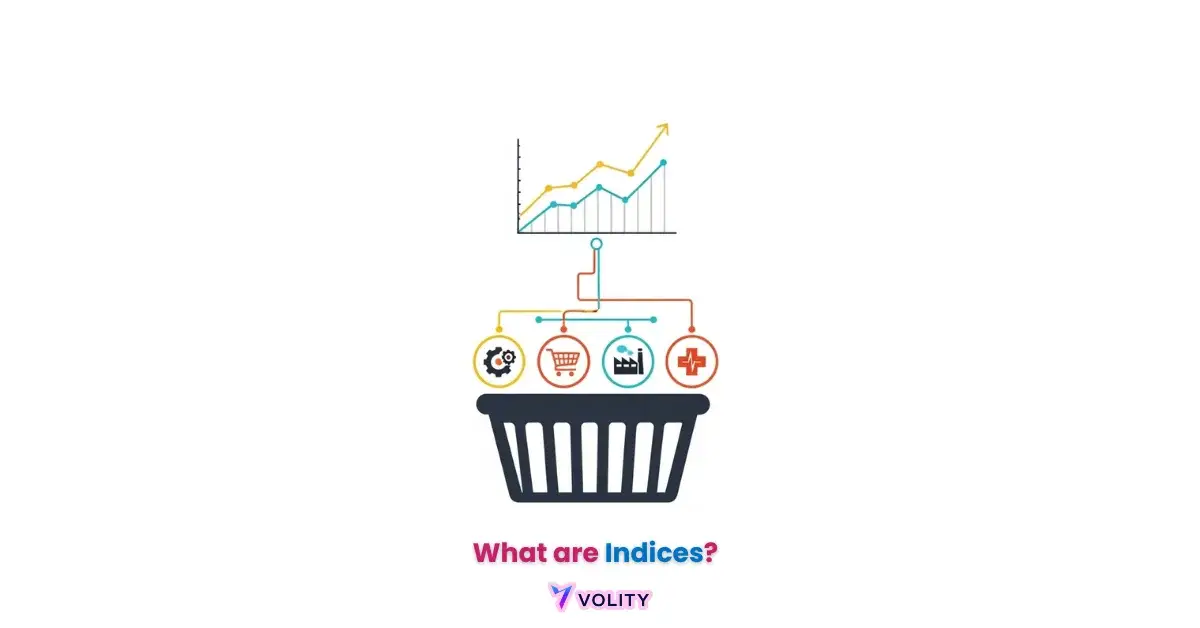
Indices are financial benchmarks measuring the performance of a specific group of stocks, offering a snapshot of market health. They allow traders to speculate on entire industries rather than individual companies, providing diversification. This guide covers how indices are calculated, major global examples, and how to start trading them effectively.
While understanding What Are Indices is important, applying that knowledge is where the real growth happens. Create Your Free Forex Trading Account to practice with a free demo account and put your strategy to the test.
Key Points
- Index traders speculate on future price changes using financial instruments such as CFDs. To do this, they need to understand how a market or industry is performing.
- A skilled index trader will cite the diverse nature of indices as compared to buying stock in a small number of isolated companies.
- Indices can be leveraged so that you can hold much larger positions with an initial small stake than you otherwise would be able to.
Important Global Indices
Each index is a quantitative description of how a particular market, sector, or industry is performing from an economic and financial point of view. Many major economies around the world have indices that every seasoned trader will be highly familiar with:
S&P 500
Tracks the performance of the 500 largest U.S. companies based on their current share price. It is widely considered a barometer for the overall health of the American stock market.
NASDAQ 100
A more specialised index that tracks the 100 largest non-financial companies listed on the NASDAQ Stock Market, heavily weighted toward technology and growth stocks.
FTSE 100
Represents the 100 most highly capitalised companies currently trading on the London Stock Exchange.
DAX
Measures how Germany’s 40 largest publicly listed companies are currently performing.
Nikkei 225
Provides data describing how the Tokyo Stock Exchange is currently performing.
A skilled index trader will trade a variety of indices over multiple timeframes, allowing them to diversify their portfolio and reduce risk across their positions. They may also take up positions in specific companies within each index if they feel there is an additional opportunity to profit. This is known as equity trading.
Ready to Elevate Your Trading?
You have the information. Now, get the platform. Join thousands of successful traders who use Volity for its powerful tools, fast execution, and dedicated support.
Create Your Account in Under 3 MinutesHow Are Indices Calculated?
Each index is calculated differently depending on how it was originally defined. For example, the Nikkei 225 is a weighted average of the Tokyo Stock Exchange’s 225 best-performing companies. The composition of this index is reassessed twice a year to ensure it remains economically relevant. Other indices are simple averages of the share prices of the companies that make up a specific market sector.
Understanding how an index is calculated matters because it determines how much influence individual stocks have on the overall value. In a price-weighted index, higher-priced stocks carry more weight. In a market-cap-weighted index like the S&P 500, large-cap stocks have a greater impact on the index’s direction. Traders need to know these mechanics to properly interpret market changes.
The Power of Indices
Indices allow traders and financial analysts to see how a market is performing at a glance and to profit if they can predict its future behaviour. A detailed understanding of how an index is likely to perform gives traders the ability to take out contracts — speculating on whether its value will rise or fall over a set timeframe.
This is particularly useful during periods of market volatility, when individual stock picking carries heightened risk. By trading an index, you are effectively spreading your exposure across dozens or even hundreds of companies, which can serve as a natural hedge against isolated downturns.
Turn Knowledge into Profit
You've done the reading, now it's time to act. The best way to learn is by doing. Open a free, no-risk demo account and practice your strategy with virtual funds today.
Open a Free Demo AccountHow to Trade Indices
Reading our comprehensive guide on how to trade indices is the next step. It will introduce you to the mechanics of taking up new positions and making trades, as well as the key strategies that every index trader needs to know about.
You may also want to explore the best index trading strategies to understand which approaches suit your risk appetite and trading style. And if you’re just getting started in the markets, our stocks investing for beginners guide is a great place to build your foundation.
Bottom Line
Indices serve as powerful tools for traders and analysts, offering a consolidated view of market performance and economic health. They provide a means to diversify portfolios and manage risk, especially in volatile conditions, by allowing speculation on broad market movements rather than individual company fortunes. Mastering index trading involves understanding their diverse calculation methods and employing strategic approaches to capitalize on global market trends.
Key Takeaways
- Indices are financial benchmarks that track the performance of a group of stocks, providing a broad market overview.
- They offer diversification and allow traders to speculate on entire sectors, reducing risk compared to individual stock picking.
- Understanding how indices are calculated (e.g., price-weighted vs. market-cap-weighted) is crucial for interpreting market movements.
- Effective index trading involves learning specific strategies and risk management techniques for diverse global benchmarks.