A forex compound calculator projects how a trading account grows when you reinvest your gains instead of withdrawing them. You give it a starting balance, an expected return per period and a number of periods, and it hands back the ending balance and the shape of the growth path. It is good at showing the pull of compounding, and it is just as good at exposing what happens when you assume a return you cannot actually repeat.
Investing in financial products involves risk. Losses may exceed the value of your original investment.
What is compounding in forex trading?
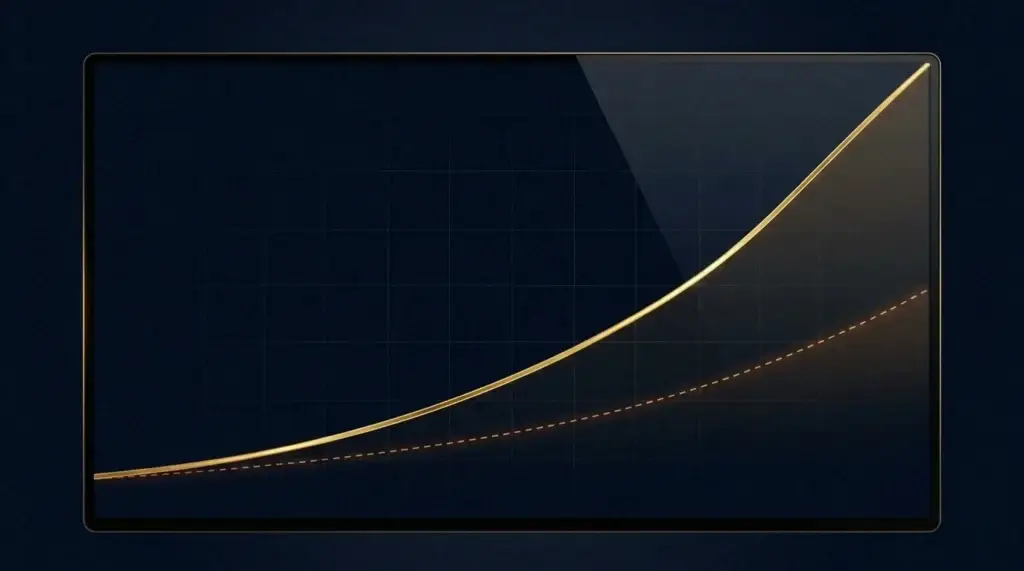
Compounding means each period’s gains are folded back into the balance, so the next period earns on a bigger base. Grow a 1,000 account by 5% in a month and leave the profit in, and month two works on 1,050 rather than 1,000. Let it run and the balance stops climbing in a straight line and starts to curve upward. That curve is the whole reason a compound calculator forex traders keep bookmarked is worth having.
The honest catch is that a forex compound calculator assumes you hit the same return every single period. Real forex trading refuses to cooperate. Losing months arrive, and one deep drawdown resets the base that everything after it compounds from. Read the projection as a best-case shape you are aiming at, not a forecast you are owed.
The forex compound formula
The core calculation fits on one line:
Ending balance = Starting balance x (1 + return per period) raised to the number of periods.
Add money along the way and a forex calculator compound model bolts an annuity term onto that: every deposit you make compounds only across the periods left after it lands, so an annuity schedule is doing the extra work. Most tools handle it for you once you type in a periodic deposit. It is the same engine that drives ordinary compound interest. The one difference that matters is that interest is paid to you and fixed, while a trading return has to be earned and is never guaranteed.
Worked example: 1,000 at 5% a month for a year
Start with 1,000, assume a steady 5% monthly gain, and reinvest all of it.
| Month | Balance (reinvested) |
| Start | 1,000 |
| 3 | 1,158 |
| 6 | 1,340 |
| 9 | 1,551 |
| 12 | 1,796 |
The finish, 1,796, is a 79.6% gain out of twelve 5% steps, comfortably ahead of the 60% that plain, non-reinvested returns would deliver. Those extra 19.6 points are the compounding effect, the same force behind any compound annual growth rate. Now the reality check. Holding 5% a month for a year is exceptional, not routine. Drop in two losing months of minus 8% and the year-end figure sinks, because compounding runs in reverse through a drawdown with exactly the force it runs forward through a winning streak.
Use the free forex compound calculator
Set your own numbers below. Turn on the realism switch to plant a few losing periods in the run and watch what they cost, which is the part a best-case projection quietly hides.
Forex compound calculator
Projections assume a constant return. Real trading returns vary, and losing periods compound downward. Past results are not indicative of future performance.
Build the habit on a free Volity demoWhy realistic inputs matter more than the tool
A trading compound calculator will cheerfully turn 1,000 into a small fortune if you feed it 10% a month for five years. That output is arithmetic, not a promise. The discipline lives in the inputs, so three habits keep the projection honest.
- Choose a return you could plausibly repeat after costs. Consistent professionals plan around single-digit monthly figures and accept that plenty of months finish flat or down. The free lessons at the BabyPips School of Pipsology are a sober place to calibrate what is realistic.
- Model the losing periods rather than pretending they will not come. A projection with no red months is fiction, so switch them on and see how much they take back.
- Keep the risk on each trade small enough to survive a bad run, because compounding only helps the traders who are still in the game to enjoy it. A shallow drawdown protects the base far more than any single big win adds to it.
Compound calculator vs compound interest calculator
These two tools overlap, yet they answer different questions. This forex compound calculator is a growth projector, so what you care about is the ending balance and the curve that gets you there. A compound interest calculator forex traders reach for is more of a mechanics tool, focused on the interest formula itself, the compounding frequency and how the rate behaves. If you would rather learn the engine than read the projection, a dedicated forex compound interest calculator drills into the formula, and our wider trading education walks through the underlying maths. Use this page to plan the outcome, and use the mechanics view when you want to understand why the outcome lands where it does. A rough sense-check like the Rule of 72 tells you roughly how long a rate takes to double the balance.
Grow an account on Volity
Compounding on the Volity forex trading platform comes down to a simple choice: leave your gains in the account and let position sizes scale with the balance as it grows. Volity MT shows running balance and equity in real time, and a fixed-percentage risk rule resizes each trade automatically as the account moves. The same discipline runs through our other planning tools, from the lot size calculator and risk-reward calculator to the drawdown calculator that shows what a losing streak does to the curve. Leverage runs up to 1:500 on selected forex products, which speeds the curve in both directions, so the projection only holds while the risk plan holds. Both the FCA and ESMA publish data showing how many retail accounts lose money on leveraged products, which is the strongest argument there is for conservative inputs. Execution runs under CySEC-regulated UBK Markets (licence 186/12), and the wider retail FX context is tracked by the Bank for International Settlements. Test the whole process on a free demo account before you compound real capital. There is no funded or prop desk here; you grow your own balance with your own capital and leverage, which is exactly why the discipline in your inputs is the thing that decides the outcome.
Frequently asked questions
What is a forex compound calculator?
It is a tool that projects how a trading account grows when gains are reinvested rather than withdrawn. You enter a starting balance, a return per period and a number of periods, and it returns the ending balance and the growth curve. Because it shows compounding at its best, you get an honest picture only when you pair it with realistic, drawdown-inclusive inputs.
Is compounding realistic in forex?
Compounding itself is real, but a constant monthly return is not. Trading throws up winning and losing periods, and a compound forex calculator that assumes a fixed gain will overstate the result. Use conservative returns, include the losing periods, and treat the projection as a planning shape rather than an expectation.
How do losing months affect compounding?
They hurt more than the matching winning months help, because a loss shrinks the base that future gains compound from. A minus 20% month needs a plus 25% month simply to get back to level. That asymmetry is why keeping drawdowns shallow protects the compounding curve more than chasing one big win ever could.
What return should I put into a compound calculator?
Use a return you can genuinely repeat after costs, not your best-ever month. Many steady traders plan around low single-digit monthly figures and accept that some months come back negative. A modest, honest input gives you a projection you can actually plan against, while an optimistic one gives you a daydream.