Investing in financial products involves risk. Losses may exceed the value of your original investment.
Bitcoin price crypto is a core topic for traders in 2026. The complete guide follows.
Crypto market clings to $70k amid scams, whale moves and bold price calls
Bitcoin held near $70,000 on Saturday, but it did not feel like a victory lap. Price action stayed stiff, altcoins wobbled, and the backdrop turned louder. Meanwhile, oil pushed above $110 and traders talked again about geopolitical risk premiums. Crypto, which loves to sell its detachment, traded like another jittery risk asset.
However, the day’s real split ran between big money that kept moving quietly and retail punters facing a rising tide of fraud. On one side sat institutions routing billions through non-ETF channels. On the other sat Telegram impersonators, “law enforcement” scam tokens and a retiree reportedly hit three times. The tape looked calm while the plumbing and the public square looked messy.
Bitcoin steadies, yet positioning looks fragile
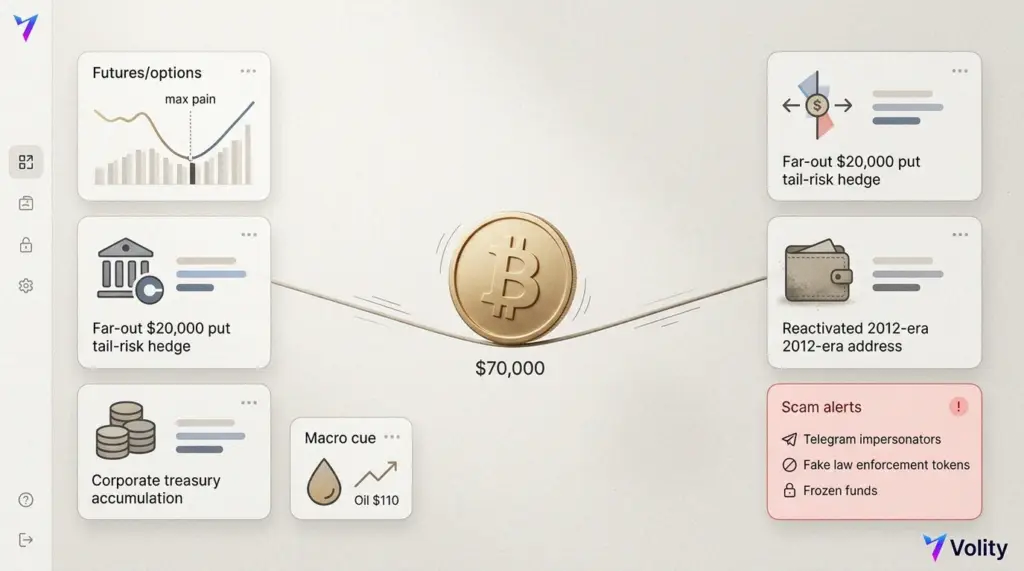
Bitcoin ranged around $69,000 to $70,000, with traders treating that zone as a line in the sand. Meanwhile, open interest and options positioning suggested a market prepared to chop, not sprint. Max pain sat near $75,000, which kept that strike in view as a magnetic level into expiry.
However, there were clear pockets of stress. Reports pointed to roughly $596 million of deep-out-of-the-money $20,000 puts sitting out there like disaster insurance. Even if spot looked composed, some investors still paid for tail risk. Separately, analysts flagged a potential cycle reset signal as mining difficulty was seen heading for a 7.5% drop, following softer hash rate readings.
Big wallets also stirred. BlackRock reportedly shifted about $140 million of Bitcoin and Ether to Coinbase Prime, a reminder that “flows” are not only about ETFs. Meanwhile, an early Bitcoin holder from 2012 moved roughly $147 million in BTC, the sort of on-chain jolt that makes liquidity feel thinner than it looks. Elsewhere, DDC Enterprise added 200 BTC, taking its treasury to 2,383 coins.
Ethereum gets the chartists back, even as forecasts turn theatrical
Ethereum bulls had their own narrative. Tom Lee of Fundstrat suggested ETH may have put in a bottom, with chart watchers pointing to a cup-and-handle setup and a $3,000 breakout target.
Meanwhile, Robert Kiyosaki returned with outsized calls, touting BTC at $750,000 and ETH at $95,000 after a crash. However, markets rarely trade on prophecy.
They trade on liquidity and forced positioning, and both looked twitchy.
Scams and enforcement actions turn retail cautious
Fraud risk didn’t just hover, it shouted. Ripple warned about fake Telegram accounts impersonating company executives. Meanwhile, the FBI flagged Tron-based scam tokens that pose as law enforcement, a particularly ugly twist designed to panic uninformed users into “paying” officials. In a separate action, the FBI and Thai police froze about $580 million tied to a cross-border operation.
Elsewhere, the UK shut Zedxion, citing links to Iranian sanctions issues. South Korea’s tax agency reportedly explored outsourced custody after a security lapse.
Investors also sued Gemini over alleged IPO-related misstatements and strategy changes. However, the most sobering detail was the human one.
A 66-year-old retiree was reportedly caught in three separate crypto frauds, which tells you how persistent and industrial these schemes have become.
Institutions keep buying the pipes, not the hype
While retail worried about impostors, institutions kept building exposure through less visible rails. Roughly $13 billion reportedly flowed into crypto via channels outside the headline ETF trade. Meanwhile, Grayscale was said to be circling the Hyperliquid ETF race, another sign that asset managers are rushing to package whatever the market will digest.
Tokenisation also kept bubbling. The World Gold Council reportedly pushed for tokenised gold standards, while Washington chatter included the CLARITY Act and stablecoin yield mechanics. However, sovereign flows cut the other way. Bhutan reportedly sold more than $110 million of BTC and reduced its stack by about 65%, a reminder that “long-term holders” sometimes need cash, too.
Altcoins drift as narratives fray
Altcoins struggled for attention. XRP’s whale activity reportedly declined, even as traders floated another “$2” pattern.
Kaspa drew interest on a falling wedge setup with talk of a 50% rebound. Zcash pulled back to trendline support, which chart traders often treat as a bounce zone.
Meanwhile, Pi Network’s token drifted around $0.19 ahead of a v21 discussion, though sceptics called it a broken story.
Macro heat rises, and crypto reacts like a passenger
Oil above $110 set the tone. Meanwhile, politics pressed on central banks, with Donald Trump again urging Jerome Powell towards rate cuts. JPMorgan warned the S&P 500 looked vulnerable if Brent stays above $110, and crypto took the same cue. Bitcoin’s $70,000 perch looked more like a balancing act than a beachhead.
By the numbers
- BTC spot: $69,000 to $70,000 range on Saturday.
- Mining difficulty: a potential 7.5% drop flagged on weaker hash rate.
- BlackRock transfer: about $140m in BTC and ETH reportedly moved to Coinbase Prime.
- Whale move: roughly $147m in BTC from a 2012-era wallet.
- Fraud freeze: about $580m in an FBI and Thai police action.
Key takeaways
- Respect $69k to $70k: a clean break lower shifts focus to deeper support levels fast.
- Watch options gravity: with max pain near $75k, price may drift towards it into expiry.
- Treat “official” tokens as toxic: scammers now impersonate regulators, not just influencers.
- Follow non-ETF flows: big allocation often moves off-stage, through prime desks and custody rails.
- Keep alt exposure liquid: when macro risk flares, thin books punish late exits.
For more on this topic see our deep-dives on Bitcoin and Geopolitical Risk: How BTC Reacts to Middle East Tension, Crypto News: $50M USDT Heist, UNI Burn Vote, Bitcoin and Token Unlocks, and Bitcoin Short Squeeze Explained: How ETF Inflows Trigger BTC Rallies.
What our analysts watch: Three on-chain metrics shape our BTC reading. Exchange net-flow (positive flow toward exchanges signals selling intent), whale-cohort balance change (wallets holding 1,000+ BTC), and dormant-supply movement (coins last moved more than 5 years ago). When exchange reserves decline while whale balances rise, the supply-side setup is bullish; when dormant supply spikes onto exchanges, treat any rally as suspect. We also screen scam blacklists from FATF compliance feeds before sizing exposure.
Frequently asked questions
What is whale accumulation and why does it matter?
Whale accumulation refers to wallets holding 1,000 or more BTC growing their balances during a price drawdown. Historically, accumulation periods of 4 to 8 weeks coincide with cycle lows, because whales typically have lower time preference than retail traders. CoinDesk publishes regular whale-flow analyses worth tracking.
How do I spot a Bitcoin scam before falling for it?
Three rules cover most cases. First, any scheme guaranteeing returns is a fraud, full stop.
Second, requests to send BTC to “verify” your address or “double” your funds are universal scam patterns. Third, unsolicited DMs offering trading signals or recovery services are almost always fraud.
The SEC maintains an investor alerts page covering crypto fraud schemes.
Are dormant-coin movements always bearish?
Not always, but they raise the burden of proof on bulls. A dormant wallet waking and depositing to an exchange usually means distribution. The exception is when the coins move to cold storage or staking infrastructure, which is on-chain bullish. Tools like Glassnode and Chainalysis classify these flows; the BIS has published research on on-chain analytics methodology.
Can I trade Bitcoin and altcoins on Volity?
Yes. Volity offers spot BTC, ETH and major altcoin exposure through UBK Markets (CySEC licence 186/12) with our Saint Lucia and Cyprus entities. KYC-verified accounts get negative-balance protection on retail tier and access to FX and equity instruments to hedge crypto positions in the same account.
Related guides
- Bitcoin explained
- Cryptocurrency trading
- Crypto trading platforms
- Best crypto investments
- Risk management
Volity operates a trading platform and also publishes educational and analytical content about trading. The content on this page is for educational purposes only and should not be considered financial advice. Volity may benefit commercially when readers open trading accounts through links on this site.
Our content is produced and reviewed under documented editorial standards; see our comparison and review methodology.