Investing in financial products involves risk. Losses may exceed the value of your original investment.
Quick answer
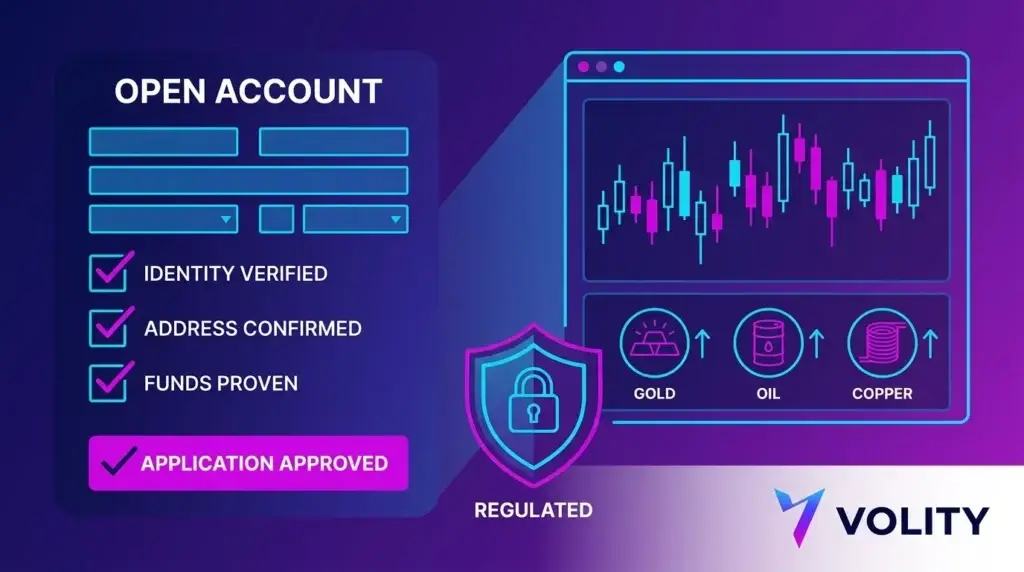
To open a commodity trading account: pick an FCA- or CySEC-regulated broker that offers commodity futures or CFDs, submit KYC documents (photo ID + proof of address), wait 24 to 72 hours for approval, fund with at least $1,000 to $5,000 (futures) or $100 to $500 (CFDs), and start on the demo or paper-trading mode before going live.
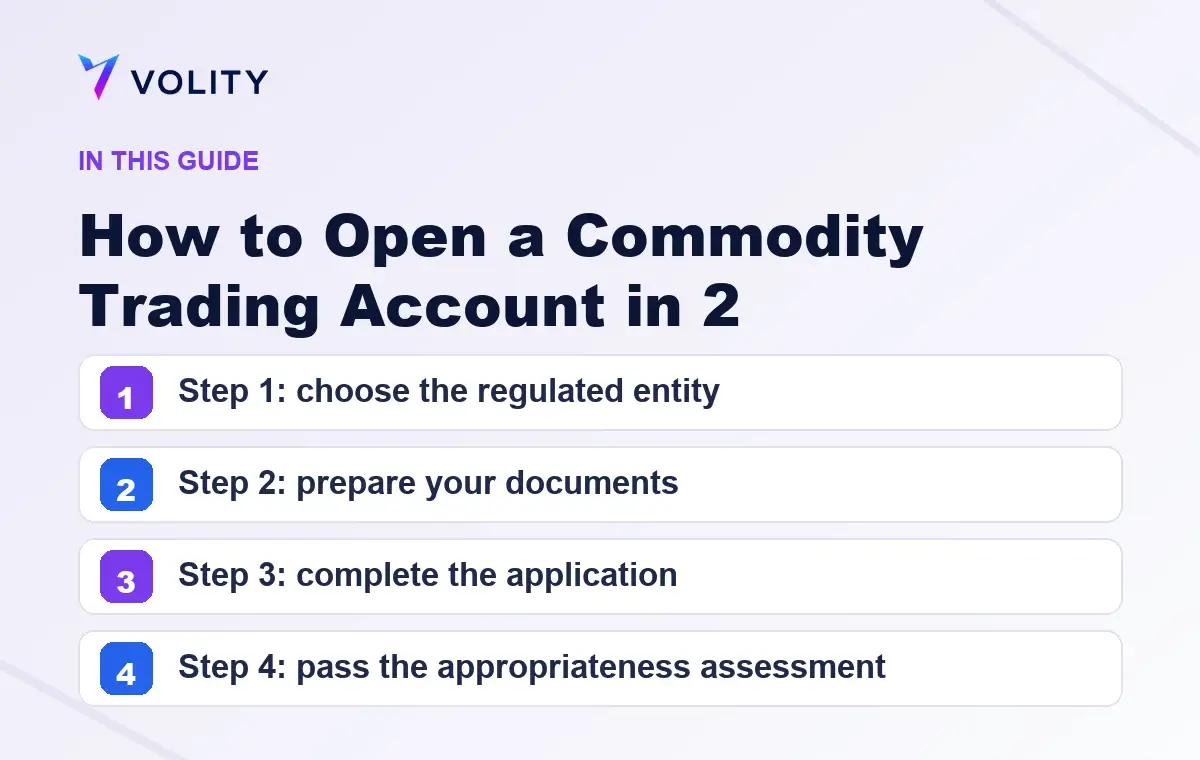
Opening a commodity trading account in 2026 is a one-hour process if you have your documents ready. The friction is regulatory, not technical: KYC, AML screening, and an appropriateness assessment under MiFID II. Here is the seven-step process we walk new clients through, with the checks that matter and the ones that are paperwork.
Step 1: choose the regulated entity
Before anything else, verify the broker’s licence. Three checks:
- Licence number on a public register. CySEC, FCA, ASIC, BaFin, AMF all maintain searchable registers. Volity’s trading is executed by UBK Markets Ltd, CySEC licence 186/12, verifiable on the CySEC public register.
- Investor compensation scheme membership. EU CIF firms participate in their national Investor Compensation Fund. Cyprus ICF covers eligible retail clients up to EUR 20,000 per client per firm in the event of broker insolvency.
- Negative balance protection. Retail clients of EU-regulated brokers are protected from owing more than their account balance, under ESMA product-intervention measures.
If a broker cannot show all three, the account is not worth opening.
Step 2: prepare your documents
Three documents will close 95% of KYC requirements:
- Government-issued photo ID: passport, national ID card, or driver’s licence. Must be valid (not expired).
- Proof of address: utility bill, bank statement, or tax document dated within the last three months. Must show your name and full address.
- Proof of income or source of funds: payslip, bank statement, or accountant letter. Required for higher deposit tiers under AML rules.
Have these as PDFs or clear photos before you start the application. The biggest source of delay is uploading a blurry photo, getting rejected, and waiting 24 hours for a re-review.
Step 3: complete the application
Expect 15-20 minutes for the form itself. The fields fall into four buckets:
- Identity: name, date of birth, nationality, tax residency, tax identification number.
- Contact: email, phone, residential address.
- Financial profile: income, net worth, source of funds, employment status. These are AML questions, not gatekeeping. Answer accurately.
- Trading experience: years of experience, products traded, frequency. This feeds the appropriateness assessment.
Step 4: pass the appropriateness assessment
Under MiFID II, the broker must assess whether complex products (CFDs on commodities are complex products) are appropriate for you. The assessment is a 10-15 question multiple choice on:
- What leverage is
- What a margin call is
- What negative balance protection covers
- How CFD pricing relates to the underlying
- What the typical risk-of-loss is on retail CFD trading
You cannot game this. If you fail, you receive a warning and may still proceed at your own risk, or the broker may decline. Read the broker’s risk disclosure document before you start; it covers everything in the assessment.
Step 5: fund the account
Most regulated brokers support four funding rails:
- SEPA bank transfer (EU): 0-1 business day, no fee.
- SWIFT international transfer: 1-3 business days, $10-30 fee.
- Card (Visa, Mastercard): instant, may carry a 1-2% fee depending on issuer.
- Crypto deposit (BTC, ETH, USDT, USDC where supported): on-chain confirmations, typically 10-60 minutes.
For commodity trading specifically, fund in the currency you intend to trade. If your account is denominated in EUR but you trade USD-quoted commodities (WTI, gold), every trade incurs FX conversion. Most brokers offer multi-currency wallets to avoid this drag.
Step 6: install the platform
For commodities, MT5 is the dominant choice. Native multi-asset support, faster strategy tester, deeper order types. MT4 still works for forex-heavy desks. Both run on Windows, macOS (via WebTerminal), iOS, Android.
After install, three configuration steps:
- Connect to your live server (broker provides credentials).
- Add the symbols you intend to trade to Market Watch (Symbols dialog, organised by category).
- Set up your default chart template: indicators, timeframe, drawing tools.
Step 7: place a small first trade
Your first live trade should be 0.01 lots (the minimum), held for under an hour, with a defined stop. The point is to verify execution: did the order fill at the price you expected, did the stop trigger correctly, did the P&L show up in your account history. Once verified, you can size up to your strategy size.
Commodity accounts at Volity
Volity offers CFD exposure to gold, silver, oil, gas, copper, and agricultural commodities on MT4 and MT5. Trading is executed by UBK Markets Ltd (CySEC 186/12). Retail leverage on commodities is capped at 1:10 under ESMA, 1:20 on gold. Negative balance protection applies. Cyprus ICF covers eligible retail clients up to EUR 20,000 per client per firm. Account opening typically completes within 24 hours of document submission.
Volity operates a trading platform and also publishes educational and analytical content about trading. The content on this page is for educational purposes only and should not be considered financial advice. Volity may benefit commercially when readers open trading accounts through links on this site.
Our content is produced and reviewed under documented editorial standards; see our comparison and review methodology.
Frequently asked questions
What do I need to open a commodity trading account?
Proof of identity, proof of address, and answers to a suitability questionnaire covering your experience and financial situation. Regulated firms are required to collect all three before granting access to leveraged products.
How long does approval take?
Verification is often completed within a business day when documents are clear and legible. Delays usually come from mismatched addresses, expired identification, or a proof of address older than the accepted window.
Should I open a demo account first?
Yes. Commodity contract specifications differ substantially between markets, and a demo lets you confirm tick value and margin behaviour on the specific contract before capital is exposed.