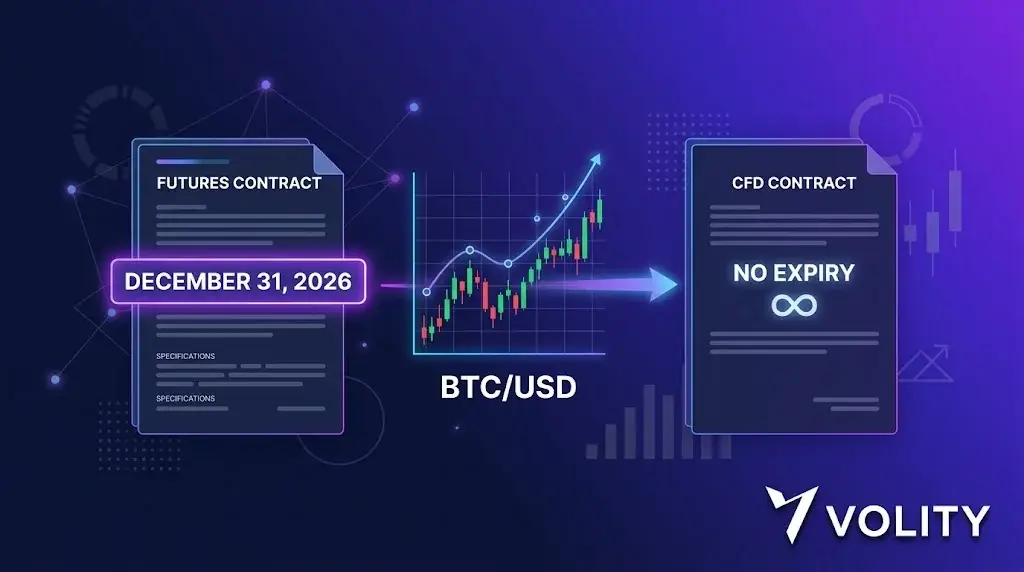
Crypto futures trading uses standardised contracts that derive value from a cryptocurrency, with a defined expiry and cash or coin settlement. Most retail traders prefer CFDs for the same leveraged exposure without expiry roll. Volity offers crypto CFD exposure up to 1:50 leverage on 20+ pairs, with no expiry, no on-chain custody, and CySEC-regulated execution.
The Crypto Trading Starter Kit
A plain-English PDF: what to check before you trade, how orders and risk really work, and the mistakes to skip. Get it free.
What crypto futures trading actually is
A crypto future is a contract to buy or sell a cryptocurrency at a fixed price on a specific future date. The contract is standardised by an exchange (CME for Bitcoin and Ether, various offshore venues for altcoins). On expiry, the contract settles in cash or coin. Before expiry, the contract trades like any other security.
The venue you use shapes what you can verify about your own position, which is set out in our comparison of perp DEX versus centralised exchange.
Three retail futures models exist:
1. Regulated futures (CME-style). Bitcoin and Ether futures on the Chicago Mercantile Exchange. Cash-settled in USD. Monthly contracts. Heavily regulated, with low retail leverage. The institutional standard.
2. Offshore perpetual futures (perps). No expiry. Funded every 8 hours via a funding-rate mechanism that keeps the perp anchored to spot. Up to 1:100 leverage on major venues. Most retail crypto futures volume sits here. Regulation varies by venue.
3. CFD substitutes (Volity). Not technically futures, but mirror the leveraged exposure. No expiry. Swap fee charged at 22:00 GMT on overnight positions. Up to 1:50 leverage on selected products. Regulated under CySEC 186/12.
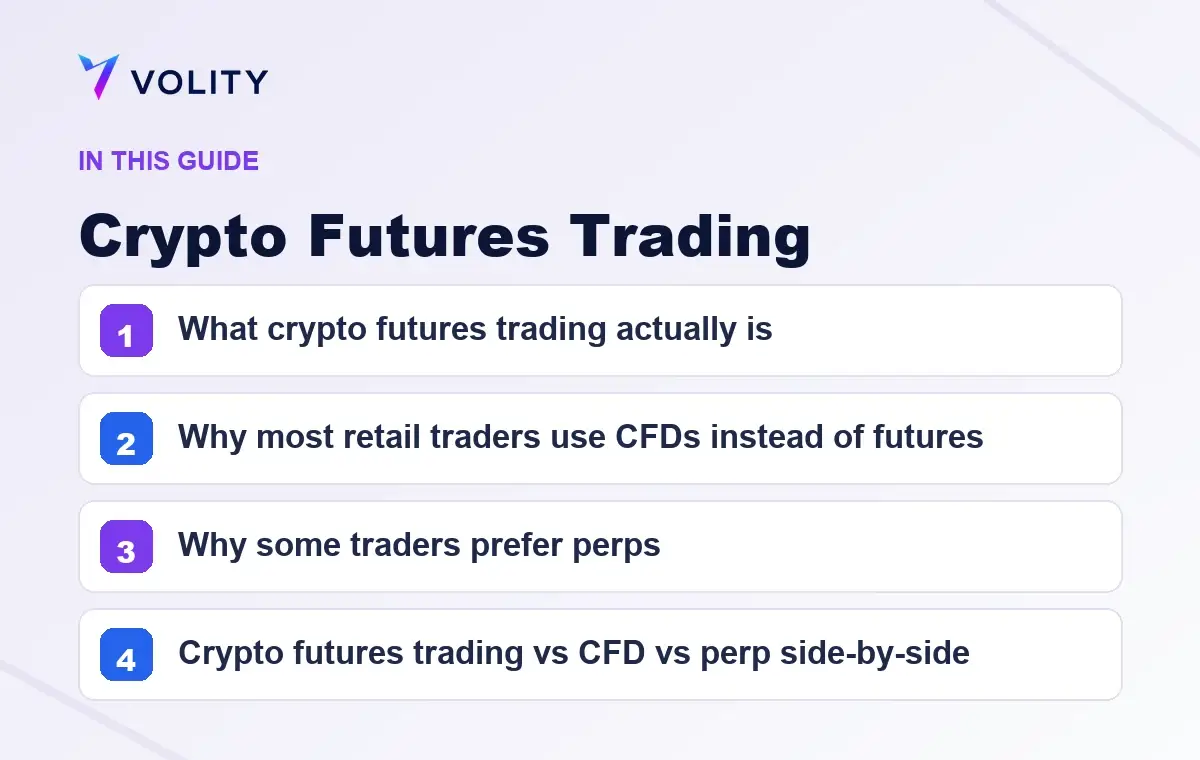
Why most retail traders use CFDs instead of futures
Three practical reasons:
1. No expiry roll. Standard futures expire monthly or quarterly. Holding a position across expiry means rolling into the next contract, which involves closing the expiring position and opening a new one. This is administrative overhead with cost implications (the roll spread). CFDs on Volity have no expiry; hold as long as the trade thesis holds.
2. Smaller contract size. One CME Bitcoin futures contract = 5 BTC. At $70,000 BTC, that is $350,000 notional. Most retail accounts cannot hold a single full contract. CFDs let you scale position size to any multiple of one coin or fraction.
3. Multi-asset margin. CME futures sit in their own margin pool. Volity’s CFD margin sits in the same balance as your forex, indices, commodities, and stocks margin. One account, one risk view.
Why some traders prefer perps
Perpetuals on offshore venues offer:
- No expiry (like CFDs)
- High leverage (1:100 or higher on some venues)
- Funding-rate exposure as a tradable signal
- 24/7 markets that match crypto’s nature
What perps trade off:
- Funding-rate volatility creates a moving carry cost every 8 hours
- Offshore regulation means weaker counterparty protection
- Liquidation cascades on major venues during volatile periods (historical event)
- No segregated client funds on most offshore venues
For traders who want regulatory protection and stable carry costs, CFDs on Volity provide most of the perp upside without the offshore counterparty risk.
Crypto futures trading vs CFD vs perp side-by-side
| Feature | Volity CFD | CME Futures | Offshore Perp |
|---|---|---|---|
| Expiry | None | Monthly | None |
| Settlement | Open-ended (cash) | Cash at expiry | Marked-to-market continuous |
| Carry cost | Swap at 22:00 GMT | Implicit in roll | Funding every 8 hours |
| Leverage | Up to 1:50 | ~1:5 retail | Up to 1:100 (often higher) |
| Contract size | Flexible (fractional) | 5 BTC per contract | Flexible |
| Regulation | CySEC (Volity), various | CFTC | Varies, often offshore |
| Custody risk | Volity segregated | Cleared through CME | Exchange-held |
| Tax treatment | Country-specific | Country-specific | Country-specific |
| Available to retail | Yes (Volity, most countries) | Limited by broker | Restricted in regulated jurisdictions |
For most retail crypto traders globally, CFDs on Volity are the cleanest path to leveraged crypto exposure.
How crypto CFDs trade on Volity
The mechanics:
- Pick a crypto pair (BTCUSD, ETHUSD, USDTUSD, or 17 others)
- Set position size in coin units (e.g., 0.5 BTC = $35,000 notional at $70,000)
- Choose leverage (1:1 to 1:50 product-dependent)
- The platform shows required margin and liquidation price before order entry
- Place order, fills in under one second 99.6% of the time
- Manage with stop-loss, take-profit, trailing stop
- Close when ready, or hold and pay swap each overnight rollover
No expiry to manage. No funding rate to monitor. Just the trade.
Carry costs in plain numbers
Example: $10,000 BTC CFD position at 1:10 leverage held for 7 days.
- Required margin: $1,000 (10% of $10,000)
- Spread paid on entry + exit: indicative $30 combined
- Swap fee: indicative $5-15 per day depending on rate market = $35-105 for the week
- Total cost of round-trip: $65-135
Compare to CME futures roll: – 1 BTC contract = $70,000 notional – Roll spread on monthly expiry: indicative 5-15 bps = $35-100 – Plus brokerage fee per contract – Plus margin requirement of $5,000+ per contract
For a $10,000 position, CFDs cost less in absolute dollars and require less capital.
Risk specific to crypto futures (any flavour)
- Liquidation cascades. When many leveraged positions liquidate simultaneously, prices can gap through orderbooks. Volity’s segregated client model and negative balance protection cap your downside at deposit
- Overnight gaps. Crypto trades 24/7 but you sleep. Adverse moves while you are away can hit stops or liquidation levels
- Funding-rate skew (perps only). Funding flips can produce large overnight costs unpredictably
- Exchange counterparty risk (offshore venues). Volity’s CySEC regulation and segregated funds materially reduce this for Volity users
A futures contract settles against a named index at a stated time, and event contracts apply the same discipline in a shorter document. See how prediction markets resolve for the settlement sources, the timeline from event to payout and the dispute path.
Frequently asked questions
Where a futures contract trades matters as much as the contract itself. Some venues now run the order book inside a blockchain’s consensus instead of a matching engine the operator controls, which changes what is publicly verifiable. See our guide to what Hyperliquid is for how that works in practice.
Sources
Related crypto guides on Volity
More crypto-trading depth on Volity:
- Wash Trading Crypto: What It Is and How to Spot It
- Crypto Trading Liquidity and Volume: How They Affect Your Fills
- Crypto Perpetual Trading: Funding Rates and the CFD Alternative
- Crypto Options Trading Explained: Calls, Puts and Derivatives
- Short-Term Crypto Trading: 1 Hour to 30 Day Strategies
- Is Crypto Trading Legal? A Country-by-Country Snapshot
- Is Crypto Trading Profitable? An Honest Look at the Data
- Crypto Trading Fees on Volity: Spreads, Commissions and Zero Wallet
- Crypto Trading Bot: The Three Styles and How They Work
Frequently asked questions
What is crypto futures trading?
Crypto futures trading uses standardised contracts to take leveraged positions on crypto prices with defined expiry. CME offers regulated Bitcoin and Ether futures. Offshore venues offer perpetual futures with no expiry. Volity offers CFD substitutes that mirror futures-style leverage with no expiry, under CySEC regulation.
Does Volity offer crypto futures?
Volity offers crypto CFDs, not technical futures. CFDs mirror the leveraged exposure of futures with no expiry, no funding rate (swap fee instead), and CySEC-regulated execution. For most retail traders the practical experience is similar to trading futures, with simpler administration.
What is the difference between crypto futures and crypto CFDs?
Futures have defined expiry and require contract roll; CFDs are open-ended. Futures have fixed contract sizes; CFDs let you size flexibly. Futures clear through exchanges; CFDs trade with a broker. CME futures are tightly regulated; CFDs on Volity are regulated under CySEC 186/12. For most retail traders, CFDs are simpler.
Can I trade Bitcoin futures on Volity?
Volity offers Bitcoin CFDs with leverage up to 1:50, which provide the same leveraged exposure as futures without expiry. If you specifically need CME-listed Bitcoin futures contracts for tax or institutional reasons, you need a futures broker. For mainstream retail leveraged BTC exposure, the Volity CFD path is more flexible.
What leverage is available on crypto futures?
CME retail futures: ~1:5. Offshore perpetuals: up to 1:100 or higher on some venues. Volity CFDs: up to 1:50 on selected products. Higher leverage means faster liquidation; most retail strategies work better at 1:5 to 1:10 with strict position sizing.
Are crypto futures profitable?
For disciplined traders with edge, yes; for most retail participants, no. The same logic as crypto trading generally applies. The futures or CFD wrapper does not change the underlying need for strategy, position sizing, and risk management.
What are the tax implications of crypto futures?
Tax treatment depends on where you live. CME futures and crypto CFDs are typically taxed as derivatives by jurisdiction; in the UK, gains generally fall under Capital Gains Tax reported to HMRC, and across the EEA realised CFD P&L is taxed as capital gain or income depending on country. Volity provides annual statements; consult a local tax advisor.