Crypto Week Opens with Bitcoin Bruised and Regulators Wide Awake
Crypto traders enter the week with the market looking less like a rocket ship and more like a weather map.
Bitcoin remains under pressure, miners are cutting power, and regulators are moving from speeches to rules. Meanwhile, the liveliest trade sits in a corner that once looked dull: tokenised stocks.
That mix gives the next few weeks unusual weight. Prices matter, of course. However, flows, legislation and product launches may now drive the bigger moves.
Bitcoin Searches for a Cleaner Catalyst
Bitcoin has lost the easy confidence that surrounded it earlier in the cycle. Traders still talk about a run back towards $70,000, but conviction has thinned.
For now, the market wants evidence. Spot demand must improve. ETF flows must stabilise. Also, Washington must show whether crypto legislation can make real progress.
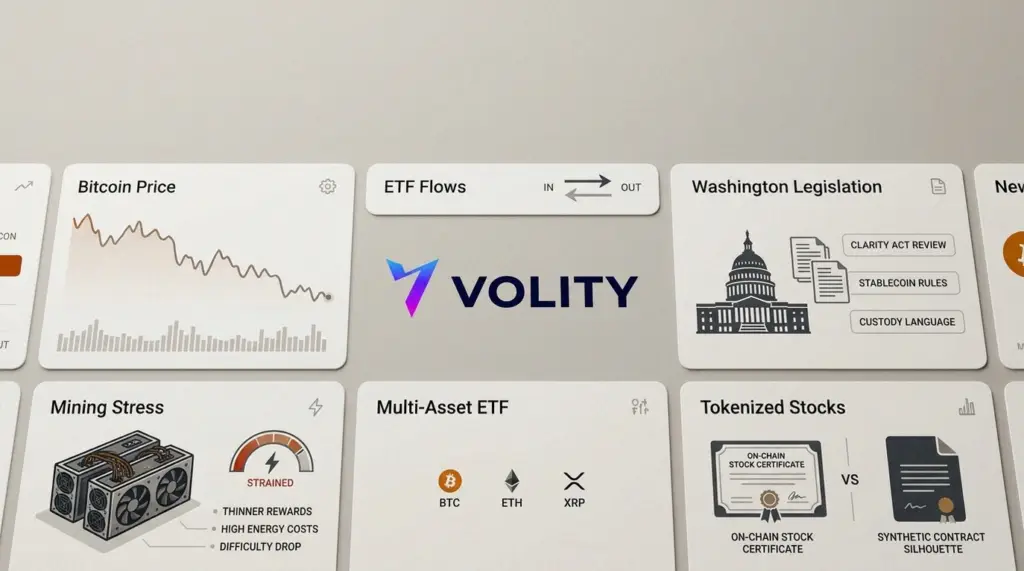
Mid-July’s expected “Crypto Week” has become the next political marker. Investors will watch the CLARITY Act debate closely. They will also track stablecoin rules, market-structure language and custody provisions.
If Congress signals friendlier rules, institutions may add risk again. However, disappointment could leave bitcoin exposed to another test of support.
Geopolitics adds another layer. Hopes for lower Middle East tension have helped risk assets at times. Still, traders have learned not to price peace too early.
Mining Stress Moves Into View
Under the surface, bitcoin miners face a tougher calculation. The halving cut block rewards, while power costs remain stubborn.
Mining difficulty has dropped sharply, signalling that less efficient machines have left the network. Listed mining stocks may trade more like distressed industrial names than simple bitcoin proxies.
Hardware makers continue to chase efficiency gains. Yet that progress cuts both ways. Strong operators can survive, while weaker rivals lose market share faster.
- Block rewards: miners now receive fewer coins after the latest halving.
- Power costs: cheaper energy remains the sector’s main competitive edge.
- Difficulty: sharp drops usually point to hash power leaving the network.
- Equity risk: miners can underperform bitcoin during margin squeezes.
For traders, this is no side issue. Mining stress can affect forced selling, network security debates and funding conditions.
XRP Grabs the ETF Spotlight
The ETF story is no longer just bitcoin and ethereum. Multi-asset crypto products are gaining attention, and XRP sits near the centre of that shift.
Demand for regulated exposure beyond the two largest tokens has surprised some desks. Meanwhile, XRP has defended the $1 area better than many rivals.
That matters because large investors rarely change habits quickly. If they move beyond BTC and ETH, the sector’s liquidity map changes. Market makers, custodians and index providers then follow the money.
Still, traders should avoid treating all ETF headlines as equal. A filing, an approval and sustained inflows are three different events. Prices often blur them together, then correct the mistake.
Ethereum Needs a Fresh Reason
Ethereum remains the hardest major token to summarise neatly. It has deep developer activity, large stablecoin usage and broad DeFi infrastructure.
However, its investment story has become less tidy. Layer-2 networks captured activity. Rival chains sold speed and lower fees. Meanwhile, staking rules still create regulatory uncertainty for some institutions.
ETF outflows have added pressure. When passive demand weakens, ether needs a clear narrative. At present, it has several half-narratives competing for attention.
One longer-term theme deserves watching: quantum-resistant security. Developers are exploring ways to protect accounts before quantum computing becomes a market problem.
That may sound distant. Yet financial markets are poor at pricing slow technical risks. Then, suddenly, they price them all at once.
Tokenised Stocks Become the Hot Corner
The week’s brightest corner is tokenised equities. Retail traders want exposure to private-market stories and high-profile public stocks through crypto rails.
Products linked to SpaceX-style demand have drawn particular attention. Platforms offering tokenised or synthetic stock exposure are reporting heavier volumes. Solana has benefited because many issuers prefer its speed and low fees.
Exodus, Ondo and other platforms are pushing tokenised stocks and funds onto public chains. Securitisation products are also appearing, including tokenised credit funds.
That growth looks important. It also looks messy.
Valuation questions remain sharp. Allocation mechanics can break. Jurisdictional rules differ. Beyond that, buyers may not always understand what they own.
A tokenised stock, a depositary claim and a synthetic contract are not the same instrument. In a calm market, that distinction feels academic. In a sell-off, it becomes the whole trade.
Regulators Close the Gaps
Regulation has moved well beyond the United States. Emerging markets are tightening oversight, often through tax and anti-money-laundering rules.
India has sent tens of thousands of tax notices tied to digital assets. Authorities have also identified more than $100 million in undeclared crypto income.
Meanwhile, the Philippines is increasing scrutiny of crypto service providers. Zimbabwe is bringing digital-asset firms more directly under central-bank oversight.
These moves do not amount to blanket bans. Instead, governments want visibility, licensing and tax collection. The old grey-zone trade is becoming harder to maintain.
For exchanges and market makers, compliance costs will rise. For investors, venue quality will matter more. Thinly regulated platforms may offer convenience, but they carry growing shutdown risk.
AI and Quantum Risk Enter the Trading Conversation
Crypto’s risk map now stretches beyond rates, liquidity and regulation. AI and quantum computing have entered boardroom discussions.
Security teams are asking how blockchains should migrate if quantum machines threaten current cryptography. At the same time, AI-linked tokens face closer scrutiny because many projects sell more ambition than infrastructure.
Ripple and others are pitching settlement layers for machine-to-machine payments. The idea has appeal. AI agents may eventually need cheap, automated payment rails.
However, the market will need proof. Usage, fees and counterparties matter more than slogans. Traders should watch real transaction volume, not just partnership language.
By the Numbers
- $70,000: key upside area traders cite for bitcoin if policy momentum improves.
- $1: important psychological level for XRP during recent volatility.
- $100 million: undeclared crypto income identified by Indian tax authorities.
- 24/7: the trading model spreading from crypto into tokenised commodities and securities.
- Mid-July: expected window for major US crypto legislation debate.
Related coverage on Volity
- Fed Rate Cuts, AI Chip Stocks and Energy Policy: What to Buy Now
- RZLV Buyback, AMD AI Lead: Top Stocks to Watch Today
- RZLV Share Buyback: $300M Plan Sparks Trader Catalyst Trade
- AI Earnings Test: Adobe (ADBE) and Oracle (ORCL) in Focus
- Bitcoin Price Wobbles as Tokenisation Goes Mainstream
Key Takeaways
- Bitcoin needs flows: political optimism alone will not carry the market for long.
- Miners look vulnerable: falling difficulty points to pressure on weaker operators.
- XRP demand matters: ETF interest beyond BTC and ETH could reshape allocations.
- Tokenised stocks need caution: structure and legal claims matter as much as price.
- Regulation is now tradable: rules can move tokens, exchanges and regional liquidity fast.
The crypto market is not waiting for one decisive headline. Instead, it is juggling politics, miners, ETFs, tokenised equities and new security risks.
That makes this week awkward, but useful. The strongest trades may come from watching where real money flows, not where the loudest story points.