Crypto had a split-screen session today: Washington argued over legal definitions, while Wall Street pushed deeper on-chain. Meanwhile, miners chased AI margins, meme traders rediscovered leverage, and enforcement files stacked up from India to Oklahoma.
For traders, this is no longer background noise. It is the market structure behind the candles.
Washington Sets the Risk Premium
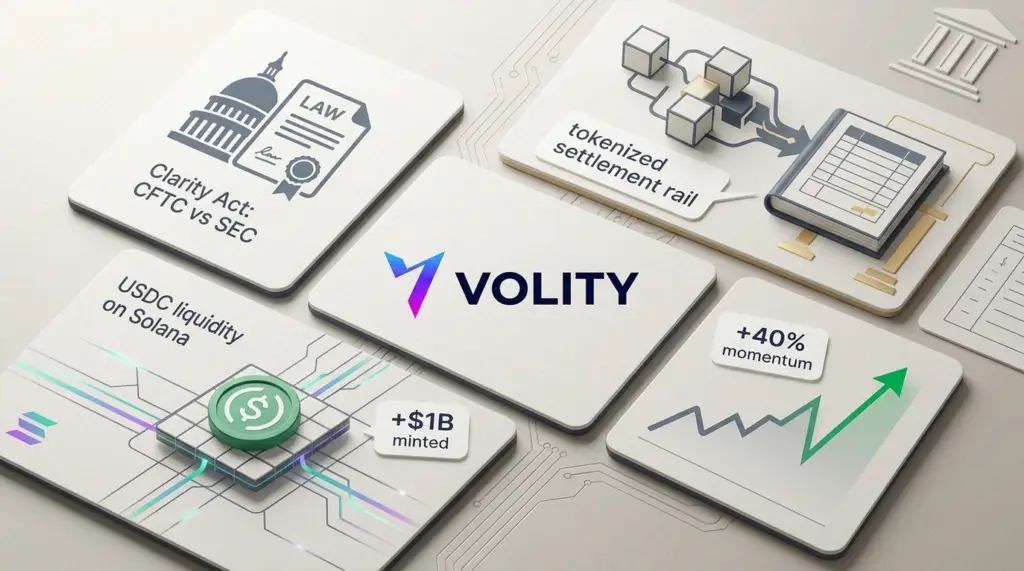
The Clarity Act remains the main regulatory swing factor for U.S. crypto assets. However, markets are not pricing one outcome. They are pricing three.
A clean passage would give many tokens a clearer route toward commodity treatment. That would shift more oversight toward the CFTC, ease listing risk, and help structured products. Mid-cap layer-1 tokens and DeFi names would likely catch the strongest bid.
A watered-down bill would create a two-speed market. Clean assets would command a premium. Meanwhile, tokens stuck in Securities and Exchange Commission uncertainty would keep trading at a discount.
The bearish case is simple. If the bill stalls, enforcement by lawsuit remains the default. Liquidity then keeps drifting offshore, and large U.S. institutions stay cautious.
Solana’s policy arm has already warned senators against weakening the bill. That matters because regulatory language now feeds directly into relative value. If you trade SOL, UNI, AAVE or smaller DeFi names, Capitol Hill has become a macro desk.
Wall Street Moves On-chain
While Congress talks, market plumbing keeps moving. The Depository Trust & Clearing Corporation has picked Stellar for a tokenisation push, giving XLM a rare institutional headline.
The practical message is plain. Wall Street wants faster settlement, programmable records, and products that can move outside old banking hours. However, it also wants compliance, auditability, and familiar counterparties.
That makes Stellar’s low-fee, compliance-friendly pitch useful. More importantly, it gives other institutions a reference point. When the entity sitting near the centre of U.S. securities settlement tests a chain, rivals notice.
For traders, the lesson is not to chase every tokenisation headline. Instead, watch where liquidity can actually settle. Chains attached to payments, funds and treasury products often get second chances.
Solana Shows the Dollar Flow
Solana is sitting near a delicate technical area, with traders watching the mid-$70s zone. However, the on-chain flow looks stronger than the chart.
Circle minted another $1 billion of USDC on Solana, taking weekly issuance across chains to roughly $3.5 billion. That is not social-media froth. It is dollar liquidity choosing rails.
Meanwhile, Solana beta has started moving. Jupiter (JUP) jumped more than 40%, with buyers pressing resistance around $0.20. That move turned a DeFi recovery story into live price action.
Elsewhere, Dogecoin (DOGE) is trying to reclaim $0.10. XRP traders, meanwhile, are watching whale accumulation and inflows for a possible push toward $1.30. The tape is risk-on beneath the surface, even if bitcoin looks steadier.
Bitcoin Fights Over Yield
The bitcoin debate has returned to first principles. Michael Saylor has rejected “Ethereum-style” yield for BTC. No restaking, no native yield layers, no financial engineering costume.
His argument treats bitcoin as pristine collateral, not a yield product. Peter Schiff, predictably, sees the opposite problem. He argues that large corporate bitcoin treasuries carry too much balance-sheet risk through deep cycles.
Still, the more important shift may sit in derivatives. The CFTC is defending a formal path for crypto perpetual futures in the U.S. market. The most important leverage instrument in crypto is edging closer to regulated territory.
That change matters more than another online argument over gold. If perps gain a clearer U.S. framework, basis trades, funding strategies and institutional hedging all change.
Miners Chase Ai Money
The mining trade keeps mutating. IREN is targeting European AI cloud growth through a deal with Nostrum. That pushes part of its business toward high-performance computing, not pure hashpower.
Meanwhile, Nvidia has tapped debt markets for about $20 billion as AI infrastructure demand keeps exploding. The read-through for miners is obvious. Power and data-centre space may earn more from AI workloads than from mining blocks.
As a result, investors should stop treating every miner as a simple bitcoin proxy. Some are becoming AI infrastructure companies with bitcoin exposure. Others remain tied to hashprice, energy contracts and halving pressure.
Stablecoins Draw the Police
Stablecoins are also becoming a geopolitical instrument. The IMF has flagged Nigeria’s stablecoin boom as a challenge to monetary controls. Residents use dollar-pegged tokens to escape inflation, weak currency access and capital limits.
At the same time, enforcement is following the flows. South Korean authorities arrested 23 people linked to an alleged USDT laundering network tied to Cambodian fraud. In India, the Enforcement Directorate filed charges in a $20 million Coinbase spoofing case.
Meanwhile, Oklahoma regulators flagged several suspected crypto fraud operations, including BG Wealth and DSJ. These cases differ in size, but they point to the same issue. Dollar tokens now sit inside scams, remittances, capital flight and real commerce.
That mix creates headline risk for exchanges, issuers and OTC desks. However, it also proves stablecoins are no sideshow. They are the transaction layer everyone now fights over.
They are also the collateral layer. On-chain derivatives venues take a dollar token as margin and settle profit, loss and funding in it, which is set out in our explainer on USDC margin.
Corporate Crypto Gets Practical
The corporate deal flow has also turned less theatrical. Tether signed an MoU with Dubai’s DMCC to push tokenisation and digital-asset education. The UAE keeps building its hub strategy around commodities, payments and crypto capital.
Separately, Nuvei agreed to buy stablecoin-focused payment platform Payoneer for $2.75 billion. The price tells the story. Stablecoin rails are moving from experiment to strategic infrastructure.
In Europe, Capital B is planning a bitcoin-backed credit product for investors. That would use BTC as collateral for more traditional lending. Crypto collateral keeps creeping into mainstream credit.
Retail Platforms Sharpen the Funnel
Robinhood (HOOD) is showing both sides of the retail brokerage trade. The company has rolled out AI-powered trading tools to all users. Investors liked the growth angle, and the stock pushed above $100.
However, the company is also cutting about 290 jobs as it restructures. That keeps the focus on margins, automation and operating discipline.
For crypto traders, the direction is important. AI trade prompts, crypto access and equity accounts are blending into one retail funnel. The question is whether those tools improve decisions, or simply increase turnover.
By the Numbers
- $1 billion – fresh USDC minted by Circle on Solana.
- $3.5 billion – approximate weekly USDC issuance across chains.
- 40% – Jupiter’s reported surge as buyers targeted $0.20.
- 23 – arrests in South Korea’s alleged USDT laundering case.
- $2.75 billion – Nuvei’s agreed deal value for Payoneer.
Related coverage on Volity
- Bitcoin Price Falls as Crypto Week, XRP ETF Buzz and Tokenised Stocks Heat Up
- Fed Rate Cuts, AI Chip Stocks and Energy Policy: What to Buy Now
- RZLV Buyback, AMD AI Lead: Top Stocks to Watch Today
- AI Earnings Test: Adobe (ADBE) and Oracle (ORCL) in Focus
- Bitcoin Price Wobbles as Tokenisation Goes Mainstream
Key Takeaways
- Regulation is now tradable. Treat the Clarity Act as a live input for U.S.-linked altcoins.
- Dollar liquidity matters. USDC growth on Solana supports the chain’s payments and trading role.
- Tokenisation has favourites. DTCC’s Stellar move gives XLM institutional relevance again.
- Miners are splitting. Some remain BTC proxies, while others are becoming AI data-centre plays.
- Stablecoin risk is rising. Enforcement will follow USDT and USDC wherever fraud, sanctions or capital flight appear.
Crypto is no longer one trade. It is law, leverage, payments, AI infrastructure and crime control in the same market. The edge comes from seeing those links before they hit price.