You have $50 and a quiet thought: “I can’t actually buy real stocks with that.” Here is the honest answer. With fractional shares you do not buy a number of shares, you buy a dollar amount of a company, so $50 buys a real, proportional slice of a share that might cost far more whole, which is one way to approach how to buy Nike stock without a large outlay. By the end of this guide you will pick an asset, fund an account, place your first order in dollars, and know exactly what you own.
TL;DR / Quick insight: A fractional share is a real slice of one whole share that you buy by dollar amount, not by share count, so $50 goes fully to work instead of sitting idle. You earn dividends in proportion to your slice, voting rights depend on the broker, and fractional positions usually cannot be moved between brokers, so pick a long-term home. With Volity, the $1 Markets account minimum lets you trade fractional shares, real shares, crypto and CFDs commission-free from one login.
This guide walks you from “I only have $50” to a placed order, then explains what you genuinely own and the one limitation to plan around. We define every term the first time: a “share” is a unit of ownership in a company, a “dividend” is a cash payment some companies send shareholders, and an “ETF” (exchange-traded fund) is one basket of many shares.
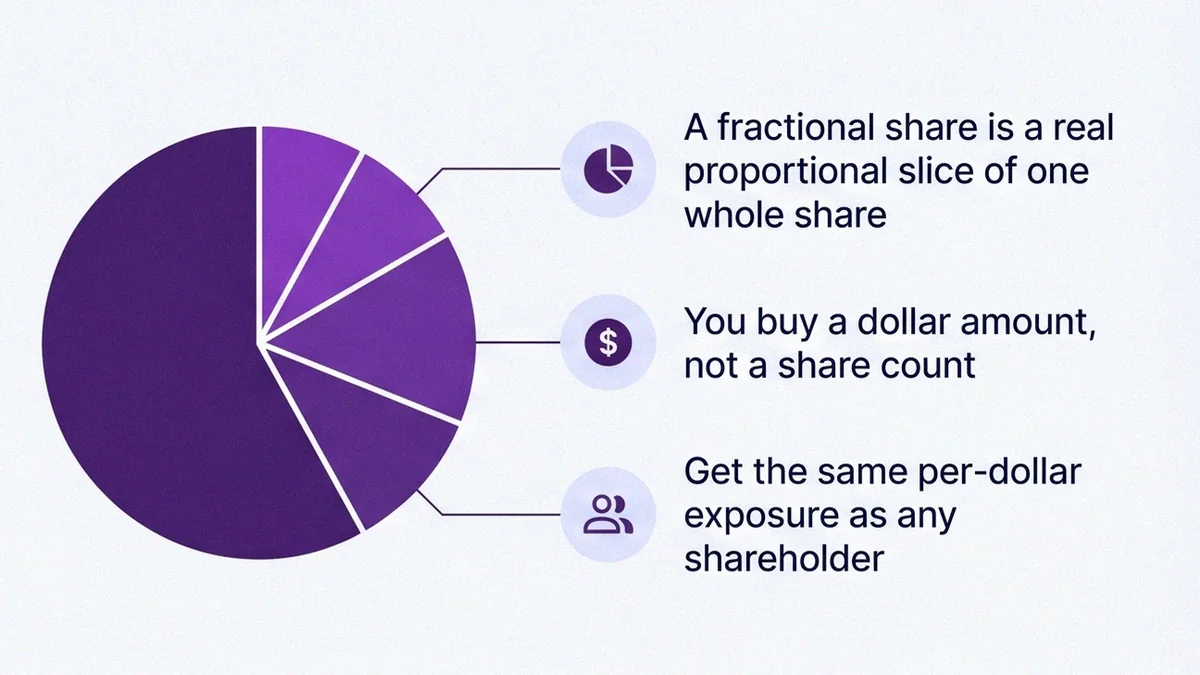
A fractional share is a portion of one whole share. Picture a share of an expensive company as a whole pizza you cannot afford; a fractional share lets you buy one slice for a set price, and you own a real proportional piece of the company, with the same per-dollar exposure as any shareholder.
The mental switch is simple: stop thinking in “how many shares” and start in “how many dollars.” You want $50 of a company, the platform works out the fraction $50 buys, and a high-priced stock or broad ETF is no longer off-limits. Do this now: pick one stock or ETF you could never afford whole and write down the dollar amount you would put in instead.
2. See why $50 is now enough to start
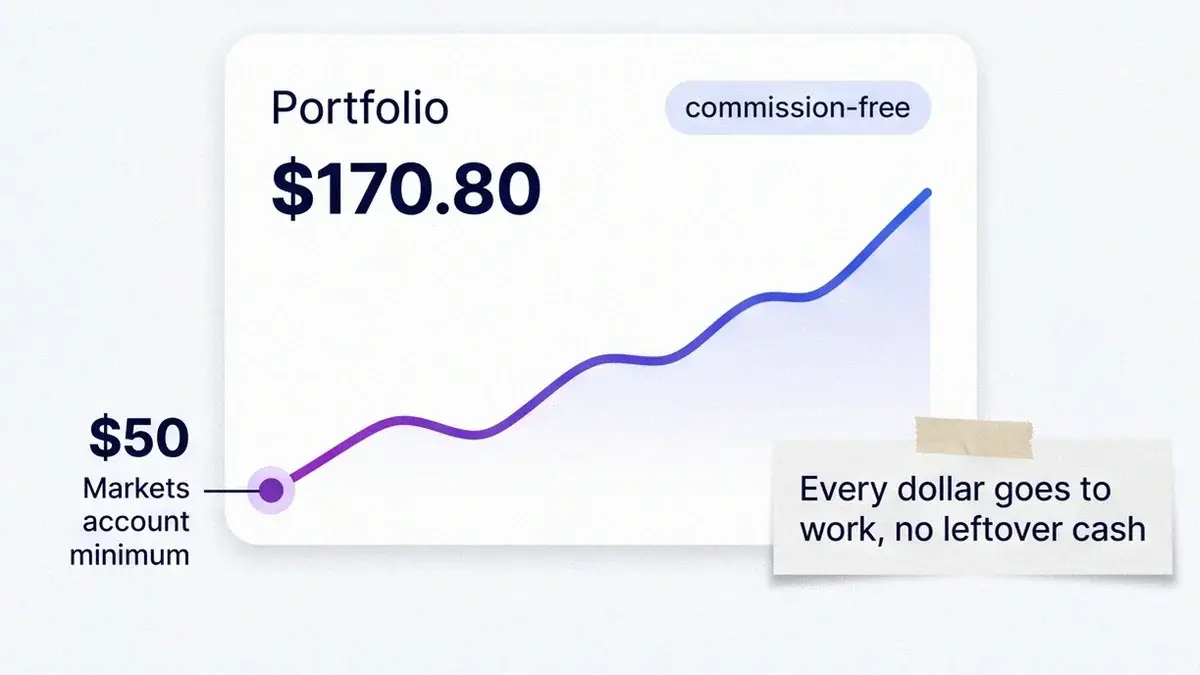
The old barrier was the price of one share: if it cost more than your spare cash, your money stayed on the sidelines. Dollar-based investing removes that wait, because you buy value, not a round number of shares, so the whole deposit goes to work at once. With Volity the entry number is concrete: a $1 entry minimum on the Markets account, and commission-free trading.
The common mistake is treating $50 as a one-time experiment. Do this now: decide your first fixed amount, for example $50, and commit to it as a figure you can repeat monthly. Repetition builds a real position.
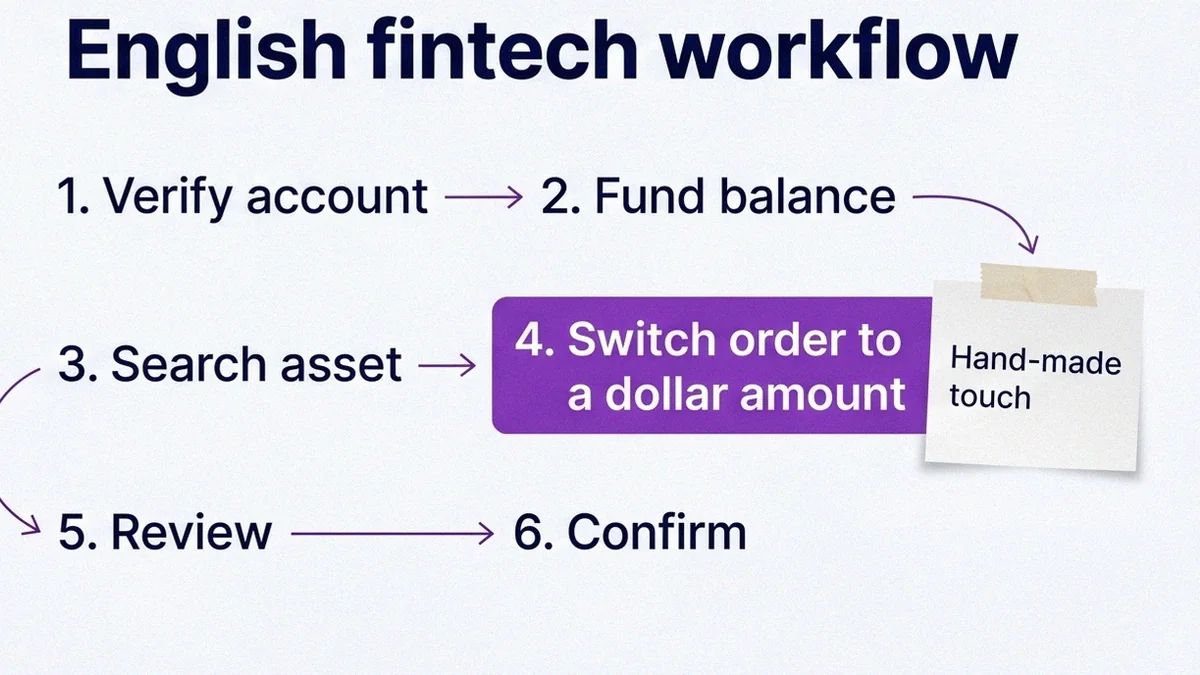
The flow is the same on any serious platform. Follow it in order, and never skip the review screen.
- Open and verify your account. You must be 18 or older and complete KYC (“know your customer” checks): photo ID, proof of address, source of funds.
- Fund the account so you have a tradable balance. On Volity, deposits process 24/7 and crypto top-ups are instant and free and card top-ups carry a 2.99% fee.
- Search for the stock or ETF you chose and open its trading screen.
- Switch the order from “shares” to a dollar amount. This is the key step: type 50 into the amount field, not a share quantity.
- Choose your order type. Many platforms run fractional orders as market orders, buying at the next available price.
- Review the confirmation screen: asset, dollar amount and any costs.
- Confirm, then screenshot it as a record of the buy.
Workflow: Verify account -> Fund balance -> Search asset -> Switch to dollar amount -> Review -> Confirm -> Screenshot
Common error: people type a share quantity out of habit and request far more than $50. Confirm the field shows dollars before you buy.
4. Know what you own: dividends, voting and splits
Owning a fraction is real ownership. Three things matter before you buy more.
Dividends. If the company pays a dividend, you receive it in proportion to your slice: own 0.75 of a share paying $10, and you receive $7.50, not a rounded figure.
Voting rights. These are broker-dependent: some platforms pass voting through proportionally, some do not, so check yours.
Splits. A stock split or reverse split applies proportionally to your fraction too. Do this now: check your platform’s help page for how it handles fractional dividends and voting before you add more.
5. Plan around the one real limitation: transferring
Here is the caveat most beginner guides skip. Fractional positions generally cannot be moved between brokers: the standard transfer system moves whole shares only, so a fraction is usually sold off (liquidated) when you transfer an account elsewhere, which can mean a tax event and time out of the market. This is general market mechanics.
Do this now: Choose a platform you intend to keep as your long-term home. If one account already holds your shares, crypto, wallet and everyday money, you are far less likely to be forced to sell to move.
With $50 the real question is “what should that $50 buy.” A single fractional share concentrates your money in one company; an ETF slice spreads it across many, for instant diversification.
| Criterion | Fractional share | Whole share | ETF (fractional or whole) |
|---|---|---|---|
| Minimum to start | Small dollar amount | Full price of one share | Small amount if fractional |
| Diversification | Low (one company) | Low (one company) | High (many in one basket) |
| Every dollar invested | Yes, no leftover | No, you wait to afford one | Yes, if fractional |
| Best for a first $50 | One company you understand | Only if a share fits your budget | Broad market in one buy |
Verdict: For a first $50, most beginners are best served by one broad ETF slice for diversification, plus at most one single-company slice they understand. Write that split down before you trade.
7. Build the habit with dollar-cost averaging
One $50 buy is a start, not a strategy. Dollar-cost averaging (DCA) means investing the same fixed dollar amount on a schedule, whatever the price. When prices fall, your amount buys a bigger slice; when they rise, a smaller one, which smooths your average entry price. Fractional shares make it effortless.
To learn the rhythm before risking real money, the Volity trader hub covers beginner habits and the free demo. Do this now: set a monthly reminder to repeat the same fixed buy. Consistency, not timing, compounds.
8. Run your first-$50 checklist with Volity
Before a real trade, walk this 10-point list top to bottom. If a box is unticked, fix it first.
- Account opened and KYC verified (ID, proof of address, source of funds).
- Account funded with a tradable balance of at least your chosen amount.
- Free demo tried first, so the order screen is known.
- Asset chosen: one ETF slice, optionally one single company.
- Dollar amount set, for example $50, and repeatable.
- Order field switched from share quantity to dollars.
- Order type understood (often a market order for fractions).
- Confirmation reviewed: asset, amount and costs all correct.
- Ownership understood: dividends proportional, voting checked.
- Transfer caveat noted, a long-term home chosen, a monthly reminder set.
Volity fits this checklist cleanly: one account holds fractional shares, real shares, crypto and CFDs (“contracts for difference,” a way to trade price moves) alongside a $0 wallet, with commission-free Markets trading and a free demo. See the Volity fees page, or the Volity stocks hub for more on shares.
What to do next
You have a complete path from $50 to a placed, understood first investment: rehearse on the demo, fund a real account, place one fractional buy, check how dividends and voting work, then set the monthly reminder. When ready, OPEN A VOLITY ACCOUNT at volity.io with the $1 Markets minimum, or TRY THE FREE DEMO at volity.io first.
Reviewed by: the Volity editorial desk under the A. Bennett byline.
Data accuracy: the account and fee figures here (the $1 Markets minimum, commission-free Markets trading, $0 wallet and free demo) come from Volity’s published fee schedule at volity.io/charges-fees as of June 2026; fractional-share mechanics reflect broadly documented market practice.
Related coverage on Volity
- How to Start Stock Trading: A 2026 Beginner Guide
- How to Avoid Common Stock Trading Mistakes
- How to Read a Forex Spread: Bid, Ask, Pips and Cost
- Market Order vs Limit Order: Which to Use and When
- Fundamental Analysis in Stock Trading: A Working Definition
Frequently asked questions
Yes. A fractional share gives the same per-dollar exposure as a whole share, so its value tracks the company and you receive dividends in proportion to your slice. Grow it by adding fixed amounts on a schedule and holding long term. Fractional buying is also one route into how to buy Visa stock without a large outlay. Returns are never guaranteed.
If the company pays a dividend, you receive it in proportion to the fraction you own. Hold 0.5 of a share and you receive half the per-share dividend. The cash lands in your account, and many investors reinvest it.
Because you buy by dollar amount instead of share price, the entry bar is low. With Volity, the Markets account has a $1 entry minimum and trades commission-free, so $1 is a realistic first-slice number.
For most beginners, yes. They put your whole deposit to work at once, make diversification affordable, and suit a buy-and-hold approach. The catch: fractional positions usually cannot be transferred between brokers, so pick a home you intend to keep.
What can I own with $50 on one account?
On a single Volity account, $50 can buy a fractional slice of a stock or a broad ETF, and the same login also holds real shares, crypto, CFDs and a $0 wallet. Start with one slice and grow into a full setup without separate accounts. If a specific company is on your list, our guide on how to buy Tesla stock compares owning the share with trading it as a CFD.
Sources
This guide draws on the following public sources.
- ESMA – MiFID II rules on costs, charges and disclosure
- London Stock Exchange – Index families listed on the London Stock Exchange
- BIS – BIS Quarterly Review on the growth of passive investing
- European Central Bank – ECB Economic Bulletin on markets and household investment
- ESMA – ESMA investor corner on funds, ETFs and costs
- London Stock Exchange – London Stock Exchange listing and market structure
- CFA Institute – CFA Institute Research and Policy Center publications
- Bank of England – Why inflation erodes the real value of returns
- Bank of England – How interest rates and inflation interact