Most new traders chase a higher win rate when the real lever is somewhere else. The risk-reward ratio decides how much you stand to make versus how much you risk on every trade, and it quietly sets how often you actually need to be right to come out ahead. Get it straight and the vague goal of “win more trades” turns into a simple, repeatable pre-trade routine.
TL;DR / Quick insight: The risk-reward ratio compares your potential profit to your potential loss on a single trade, written like 1:3 (risk 1 to make 3). The higher the reward side, the fewer trades you need to win to stay profitable, and the math is fixed: break-even win rate = 1 / (1 + reward-to-risk). A common guideline is to aim for at least 2:1. Place your stop at a real chart level first, set the target at the next real level, then read the ratio off – never widen your risk to manufacture a pretty number.
This walkthrough uses plain arithmetic. Every ratio, win rate and dollar figure below is an illustrative example to show how the math works, not a forecast or a result you should expect. Trading carries risk; these are teaching numbers.
1. The risk-reward ratio in one line (and the formula)
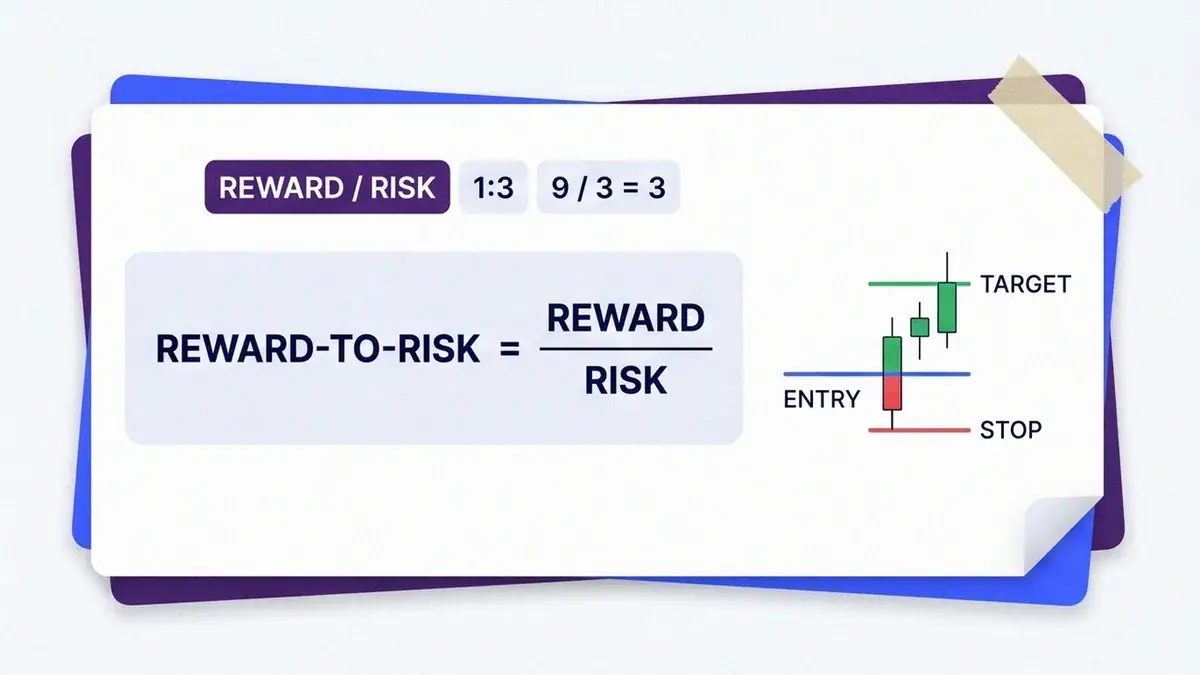
The ratio answers one question: for every unit of money at risk, how many am I trying to make? You compare entry to your stop-loss (the risk, where you exit if wrong) with entry to your target (the reward, where you take profit).
Risk-reward formula:
Reward-to-risk = potential profit (entry to target) / potential loss (entry to stop)
Read 1:3 as “risk 1, make 3.”
Action: say every setup out loud as “risk 1 to make N” – it forces you to know both numbers before you trade.
2. Calculate it on any trade – one worked example
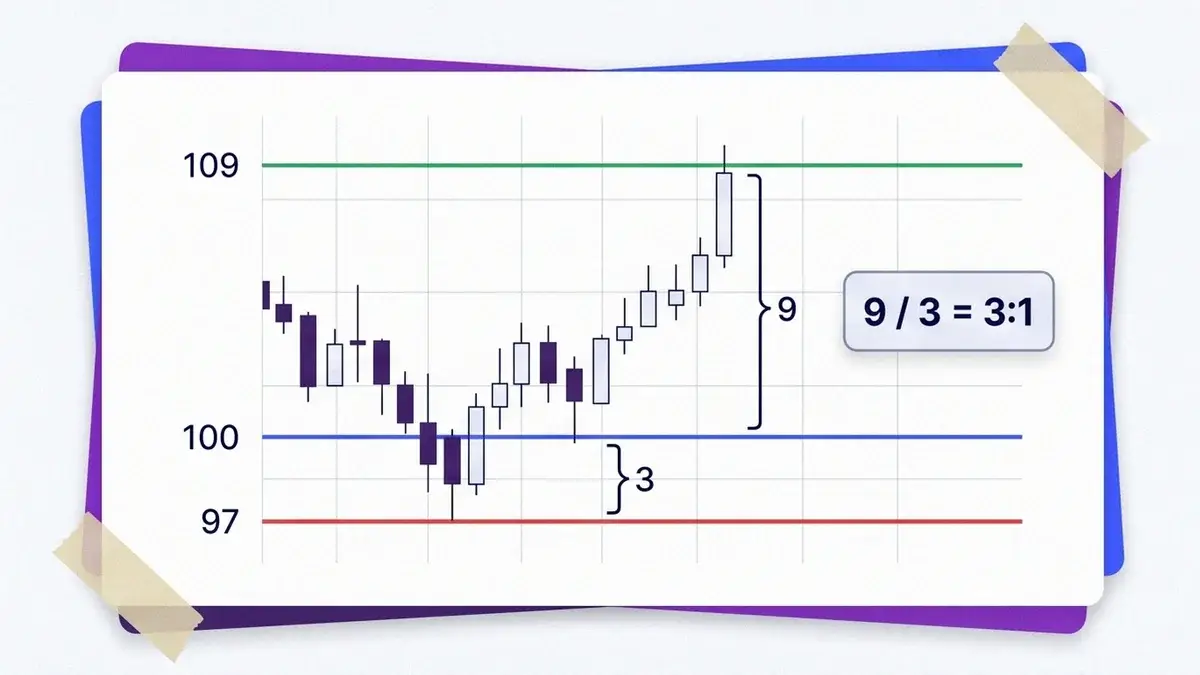
Here is one illustrative trade we carry through the article. You buy a stock at 100, set the stop-loss at 97 and the target at 109. Now do the two subtractions:
- Measure the risk: entry minus stop = 100 – 97 = 3 points at risk.
- Measure the reward: target minus entry = 109 – 100 = 9 points of profit.
- Form the ratio: reward / risk = 9 / 3 = 3, a 3:1 reward-to-risk trade.
- Check direction: for a sell (short), flip it – stop above entry, target below, same subtraction. The same math works on stocks, forex and crypto.
Action: work out the reward-to-risk before you click buy – if you cannot define entry, stop and target, you have a hunch, not a trade.
3. Why win rate and risk-reward work together
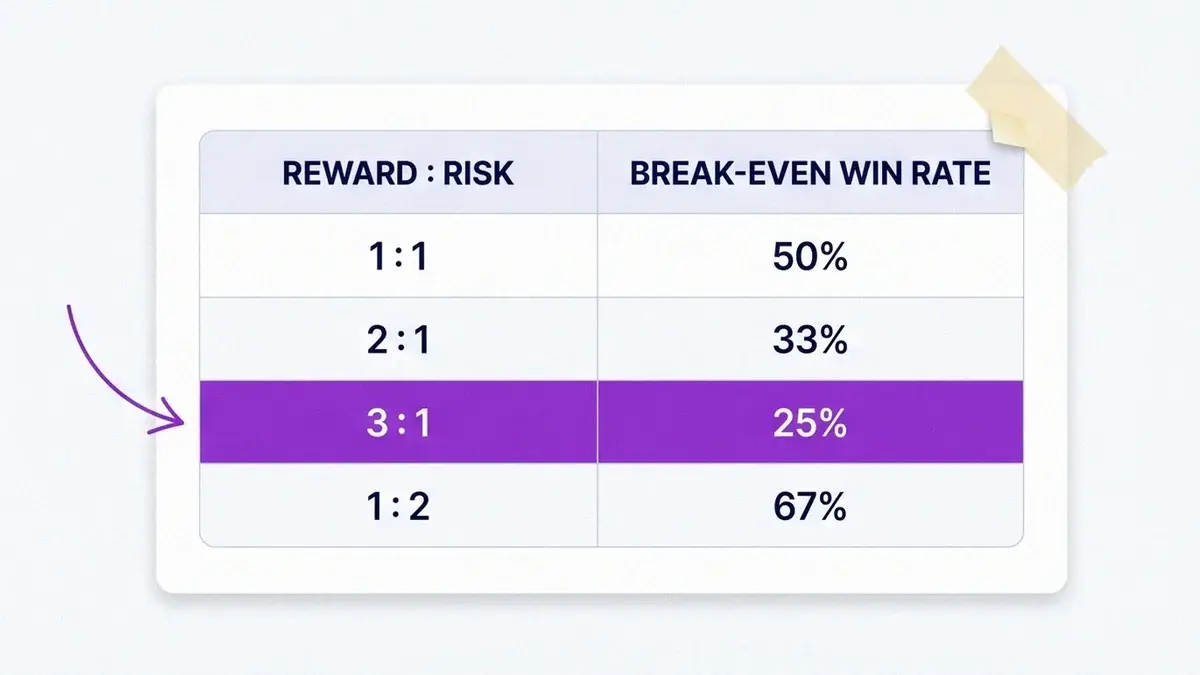
A high win rate can still drain an account if your losers are bigger than your winners; a low win rate can be profitable if your winners are bigger. The break-even win rate is fixed:
Break-even win rate:
Break-even win rate = 1 / (1 + reward-to-risk)
A 3R trade: 1 / (1 + 3) = 1/4 = 25%.
| Reward : Risk | Break-even win rate | In plain words |
|---|---|---|
| 1 : 1 | 50% | Win half just to stand still. |
| 2 : 1 | 33.3% | Win 1 in 3 to break even. |
| 3 : 1 | 25% | Our example – profitable winning 1 in 4. |
| 1 : 2 (reward below risk) | 66.7% | Win 2 of 3 just to break even. |
Look at the 3:1 row: at a 25% break-even point, you could lose three in a row and recover it all with one winner worth three losers. That is why a common guideline is to aim for at least 2:1 – general trading mathematics, not a Volity recommendation. Action: look up your ratio here and note the win rate you must beat – that is your real target.
4. Set the stop first, then the target – so the ratio is honest
The order you work in separates a real ratio from a fantasy one. The common mistake is picking a target you like, then jamming the stop wherever flatters the ratio. Reverse it:
- Place the stop at a real level first. For a buy, just below support (a price the chart has bounced off before) or a recent swing low; for a sell, above resistance or a swing high.
- Place the target at the next real level. The next resistance (buy) or support (sell) price has actually reached – not a number you wish for.
- Measure the ratio last. Only now do the 9 / 3 = 3 subtraction – the ratio is an output of the chart, not an input you force.
- Reject the trade if it falls short. If an honest stop and target give 1:1 and your minimum is 2:1, the fix is not a closer stop – it is no trade.
Action: mark the stop at a real level first, the target second, then read off the ratio – and if it is below your minimum, walk away.
5. Connect it to position size and costs
A clean ratio still has to survive a real account, and two things decide that: how much you risk per trade and the costs you pay. A widely taught idea is to risk only a small, fixed slice on any single trade – 1% is a common illustrative figure, so 100 on a 10,000 account. This is universal money-management math, not a Volity rule; your position size then follows from the stop distance and that fixed risk.
Costs eat into the reward side too. The spread (the small gap between the buy and sell price) and any commission come off your profit, so subtract them before you trust a tight ratio – on a 1:1 setup, costs alone can turn a winner into a scratch. The Volity trader hub collects more risk-management guidance: the Volity Markets account is commission-free and Standard spreads start from 0.6 pip (a pip is the smallest standard price step in a currency pair). An overnight rollover fee applies to positions held past 22:00 GMT, positive or negative. You can SEE FEES at volity.io/charges-fees.
Action: pick one fixed risk-per-trade percentage, size so the stop equals that amount, and rehearse it on a free demo first. TRY A FREE DEMO at volity.io before you risk a cent.
6. Common risk-reward mistakes to avoid
Most ratio failures are not bad math – they are bad discipline:
- Moving the stop to dodge a loss. Slide it lower “to give it room” and your 3-point risk becomes 6 – ratio halved, loss doubled.
- Widening risk to keep a “nice” ratio. Dragging the stop to a meaningless level so the number looks good – it is honest only when the stop is.
- Chasing a 5:1 target price never reaches. A huge ratio is worthless if the target sits beyond any level the chart realistically reaches.
- Ignoring spread, fees and rollover. A 1:1 trade can be a net loser after costs – subtract them on short setups.
- Judging a single trade. The ratio works over a series – one loss on a sound 3:1 plan is one sample, not a broken plan.
Action: before each trade, confirm you have not moved the stop from its structure level. If you have, re-plan.
7. Pre-trade checklist – and log it
Run this list before clicking buy. If any line fails, skip the trade:
- Stop-loss is at a real chart level, not a convenient price.
- Target is at the next real level price can realistically reach.
- Reward-to-risk is at or above your minimum (a guideline is 2:1 or higher).
- You know the break-even win rate from the table and believe you can beat it.
- Position is sized so the stop equals your fixed risk-per-trade amount.
- Spread, commission and any overnight rollover are subtracted from the reward.
- You have not moved the stop closer to flatter the ratio.
Action: run this checklist on your next trade and log the planned reward-to-risk against the actual result, so over time you see whether your plans and your execution match. The same stop-and-target logic plays out cleanly on the Volity forex pages, where pips make distances easy to measure.
What to do next: rehearse the routine on a free demo, then, when you are ready, OPEN A VOLITY ACCOUNT at volity.io – real shares, fractional shares, crypto and CFDs from one login.
Reviewed by: A. Bennett, Volity editorial desk.
Data accuracy: the risk-reward ratio, break-even win-rate formula and 1% risk idea are universal trading mathematics shown as illustrative arithmetic, not forecasts; Volity product facts (commission-free Markets account, spreads from 0.6 pip, free demo) are verified against the published Volity fee schedule, June 2026.
Event contracts print the same ratio on the price tag. A share bought at $0.35 risks 35 cents to make 65, a payoff of about 1.86 to 1 expressed as a probability instead of a ratio. Our guide to prediction market odds works those conversions through.
Related Volity guides
- Market order vs limit order: which to use
- How to read a forex spread and what it costs
- Demo vs live trading account
Some instruments make the ratio explicit before you enter. An event contract costs whatever you pay for it and redeems at one dollar or at nothing, so the reward against the risk is fixed the moment you buy. Our comparison of prediction markets and betting sets out how that structure differs from a price quoted by a fixed-odds operator.
Related coverage on Volity
- How to Size a Trade: Position Sizing and Risk Per Trade for Beginners
- Forex Risk Management: A Position-Sizing Framework for Pairs
- Market Order vs Limit Order: Which to Use and When
- How to Read a Forex Spread: Bid, Ask, Pips and Cost
- Forex Day Trading: Setup, Risk, and What Actually Works
Frequently asked questions
What is a good risk-reward ratio?
There is no single correct number, but a common guideline is at least 2:1 or higher, so winners outweigh losers over a series. What matters more is that the ratio is honest – measured from a real stop and target – rather than forced to look impressive.
How do you calculate the risk-reward ratio?
Measure entry to stop-loss (the risk) and entry to target (the reward), then divide reward by risk. In our example, entry 100, stop 97, target 109 gives 3 points of risk and 9 of reward, so 9 / 3 = 3, a 3:1 trade. The same subtraction works for stocks, forex and crypto.
Can a low win rate still be profitable?
Yes – this is the key insight. The break-even win rate is 1 / (1 + reward-to-risk), so a 3:1 setup only needs you to win 1 trade in 4 (25%) to break even before costs. With a strong ratio you can be wrong more often than right and still come out ahead. These are arithmetic facts, not a promise of results.
What ratio should beginners use?
A practical starting point is a minimum of 2:1, because it forces discipline: you only take trades where the reward is at least double the risk. Set the stop first, then the target, and skip the trade if the honest ratio falls short. Practise on a free demo before risking real money.
Does the risk-reward ratio account for fees and spreads?
No – the raw ratio is just price distances, so you subtract costs yourself. Spread, commission and overnight rollover come off the reward side. The Volity Markets account is commission-free and Standard spreads start from 0.6 pip, but still factor costs into tight setups, since on a 1:1 trade they alone can turn a small winner into a loss.
Sources
This guide draws on the following public sources.
- ESMA – ESMA warning on speculative retail trading risk
- CFA Institute – CFA Institute Research Foundation on investor behaviour
- Bank of England – Bank of England explainers on markets and risk
- IOSCO – IOSCO report on retail market conduct and online marketing
- Nobel Prize – Thaler's Nobel work on behavioural economics
- Bank of England – Bank of England explainer on interest rates and risk
- IOSCO – IOSCO on retail distribution and digital engagement practices
- Nobel Prize – Kahneman's Nobel work on judgement under uncertainty
- Bank for International Settlements – BIS working paper on retail trading behaviour