Most beginners do not lose money because their strategy is bad. They lose because they cannot follow it when real money is on the line. Trading psychology is the study of how fear, greed and impatience hijack a sensible plan, and how to stay calm enough to do what you decided. This guide covers the emotions that sink new traders and the habits that keep you trading your plan, not your mood.
TL;DR / Quick insight: Trading psychology is the gap between the plan you write when calm and the trades you take when scared or greedy. The fix is structure, not willpower. Decide your entry, stop and exit before you click, write them down, and let rules carry the decision so emotion has less room to act. Every Volity tier includes a free demo, so you can build the habit before a single euro is exposed.
Nothing here is personal advice, and trading carries risk. The goal is a calmer, more repeatable process.
Why emotions, not strategy, sink most beginners
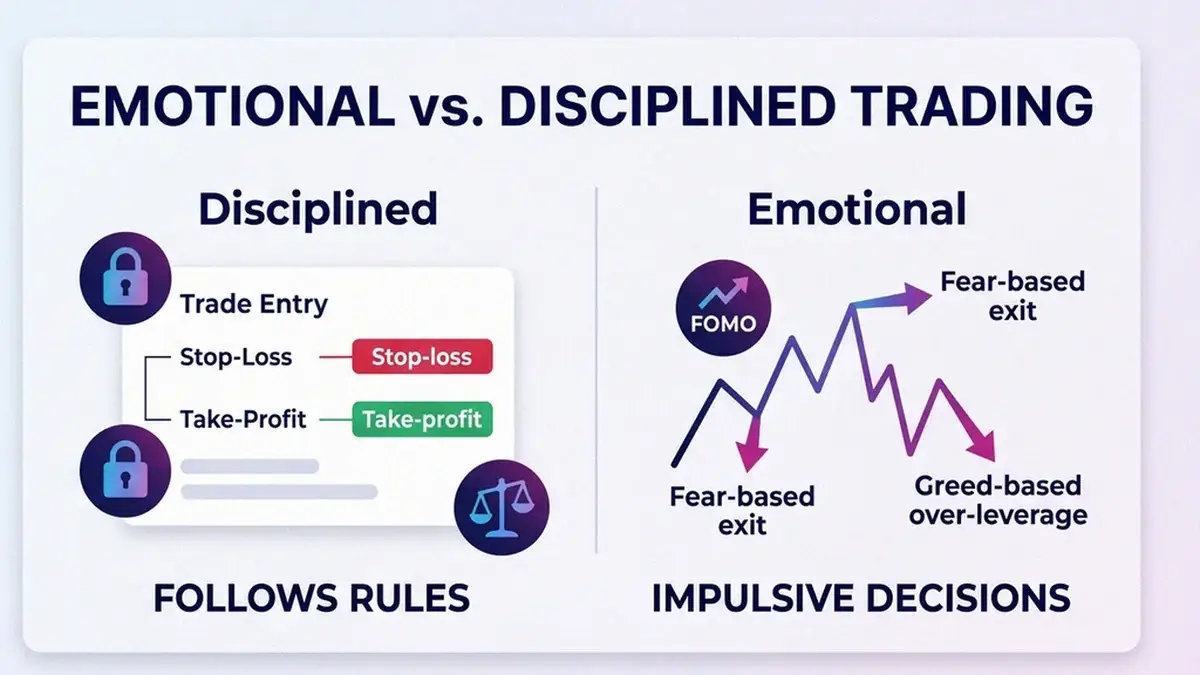
Ask a struggling beginner what went wrong and most blame the strategy. Look closer and it was usually fine; what broke was the person running it. You test a method on paper and the numbers look reasonable. Then you go live, the price moves against you for an hour, and your stomach takes over. You close early to stop the discomfort, hold a loser hoping it recovers, or double the size to win it back faster. None of that was in the plan, yet all of it felt urgent.
That gap, between the calm plan and the panicked click, is what trading psychology is really about. A method only works if you execute it consistently, and consistency is an emotional skill before a technical one. The market does not punish your knowledge; it punishes your impulses. Fix the impulses and an ordinary strategy behaves the way it did on paper.
Fear and greed, the two forces to manage
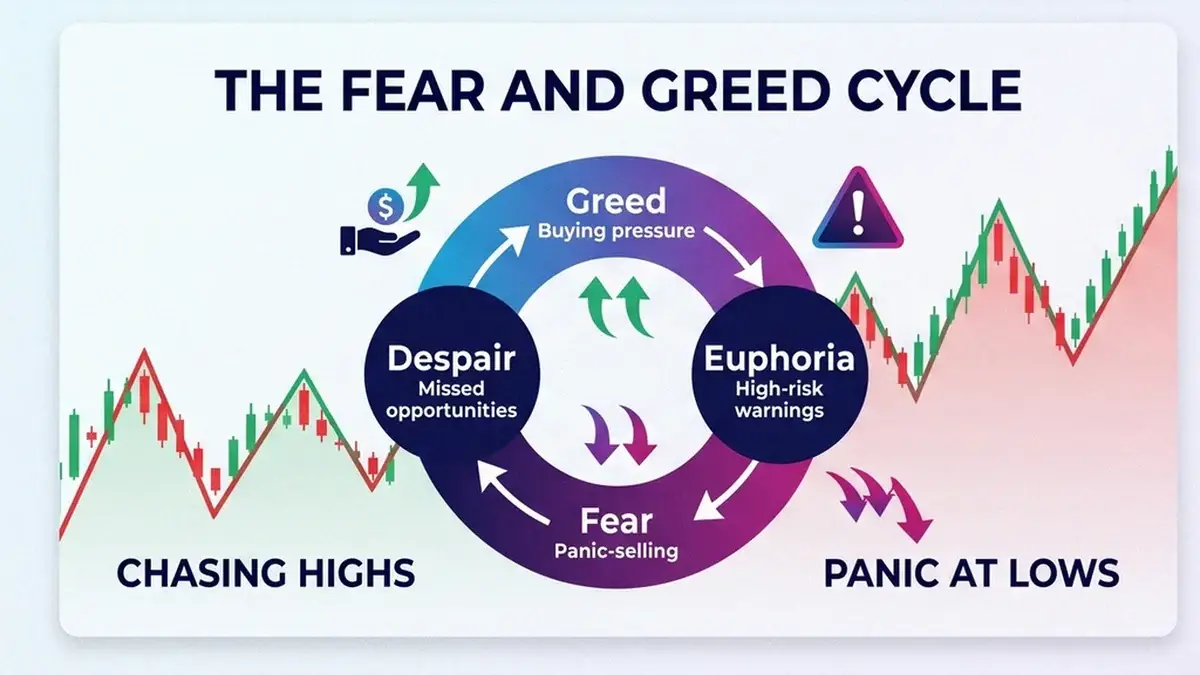
Nearly every bad trade traces back to one of two feelings. Fear makes you act too small or too late; greed makes you act too big or too long. Fear shows up as panic selling the moment a position dips, skipping a good setup, or widening your stop because you cannot bear to be wrong. Greed shows up as adding to a winner past your plan, over-leveraging, or staying in long after your target. Learn to spot which one is talking and you have most of the battle won.
| Feeling | How it shows up | The rule that counters it |
|---|---|---|
| Fear | Panic selling, skipping valid setups, widening the stop to avoid a loss. | Pre-set a fixed stop-loss and a position size you can sit with calmly. |
| Greed | Over-leveraging, chasing winners, ignoring the exit you planned. | Pre-set a target and a maximum size, then take the exit you wrote down. |
The cure for both is the same: decide the numbers before you enter. A stop-loss set while calm protects you from the fear you will feel later, and a size chosen in advance protects you from greed when a trade runs your way. Volity helps you enforce this, with stop-loss orders on the Volity MT platform and leverage you control rather than max out by default.
Revenge trading and how to break the loop
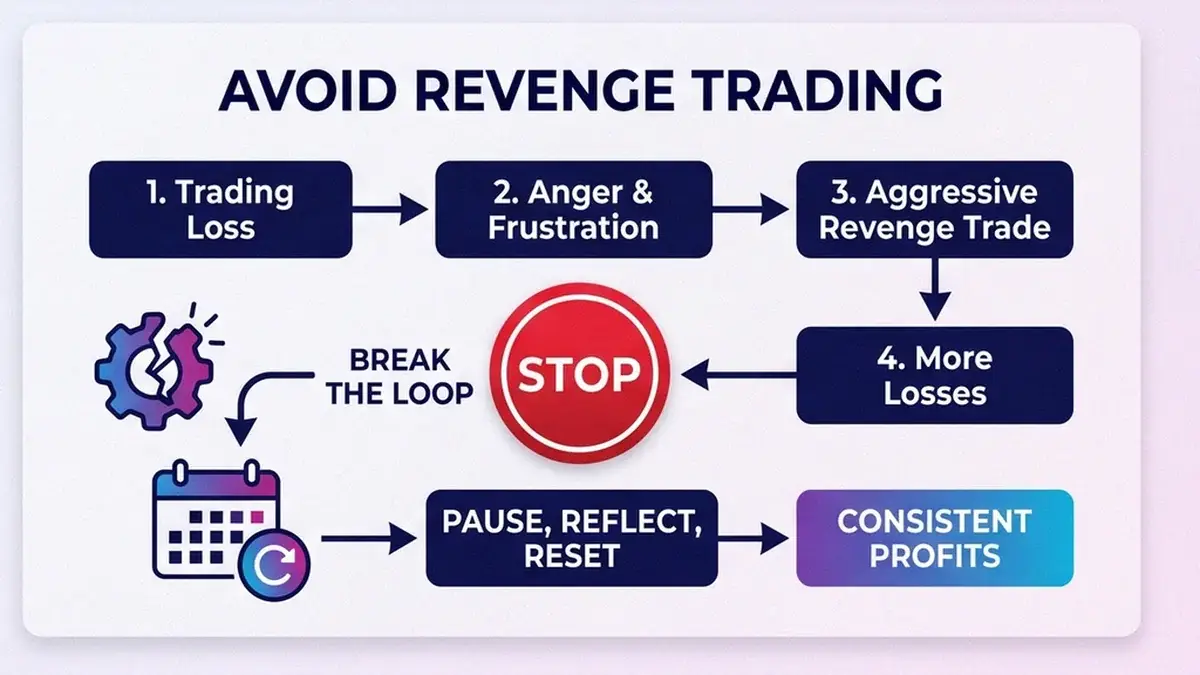
Revenge trading is the urge to win back a loss immediately by taking a trade you would never normally take. Your ego wants the loss erased now, so you reach for a bigger, faster bet. It is the fastest way to turn one small loss into a ruined day.
The loop is predictable. You take a loss, feel the sting, enter again without a real setup, lose that trade too, and now you are angrier and further down. Each spin lowers the quality of the next decision.
You break it with a circuit breaker decided in advance. After any losing trade, step away from the screen for a set period before placing another order. A daily loss limit works the same way: once you hit it, you are done for the day. Professionals use hard stops because they know the urge will come. Write yours down today, before you need it.
Rules that take emotion out of the moment
The reliable way to beat emotion is to make fewer decisions while the trade is live. A workable rule set is short: it names the entry conditions, the exact stop-loss, the target or trailing exit, and the position size. Once those four are written, the trade becomes mechanical, and the exits are already placed.
- Entry condition. Spell out what must be true before you act.
- Stop-loss. Decide where you are wrong and place the stop there before you enter.
- Exit or target. Know where you take profit, so greed does not choose for you.
- Position size. Fix how much you risk per trade so a single loss is survivable.
Tools can shoulder some of the discipline. Copy trading and trading signals are available on Volity, letting a newer trader follow a defined approach rather than freelance on emotion while the habit forms. Used sensibly, they are training wheels, not a substitute for understanding risk.
A pre-trade and post-trade routine
Discipline is easier as a routine than as a fresh act of willpower. Two short checklists, one before and one after, do most of the work. Before you enter, check: is this a real setup from my plan, is my stop placed, is my size correct, am I calm rather than chasing? If any answer is no, you skip the trade. After you exit, log what you did, why, and how you felt. Patterns invisible in one trade become obvious across twenty.
Over time the log tells you the truth about your behaviour, perhaps that every big loss came right after a win. You cannot fix a leak you have not measured. Keep both routines short enough that you do them.
How a demo account builds discipline first
A demo account is the empty car park where the habits get built. It runs on live prices with virtual money, so you rehearse entries, stops and exits, and feel the pull of fear and greed, with no real loss to panic over.
The point is not to prove you can pick winners. It is to prove you can follow your own rules under pressure. Practise placing a stop on every trade, walking away after a loss, and sizing the same way each time. When those actions feel boring rather than effortful, you have the discipline that survives the move to real money.
Every Volity tier comes with a free demo, so you can rehearse the full routine on the same Volity MT platform you will trade for real, then move across when your behaviour is steady. Beginners start there; active traders use it to test ideas. The minimum deposit when you go live is just EUR 10, with commission-free trading on the Markets account.
Trade your plan, not your mood
Run this before every trade, a pre-flight check that keeps emotion out of the click.
- Is this a setup from my written plan, or am I improvising?
- Have I placed a stop-loss before entering, not after?
- Is my position size one I can sit with calmly if it goes against me?
- Am I entering to follow my plan, or to win back a recent loss?
- Have I hit my daily loss limit? If yes, I stop for the day.
- Do I know my exit or target before I am in the trade?
- Am I calm right now, or rushed, angry or euphoric?
- Am I using leverage I chose deliberately, not the maximum by default?
If any line gets a no, fix it before you trade. The checklist catches the emotional slips you cannot feel in the moment.
What to do next
Write your four core rules, set a circuit breaker for losing days, then rehearse the routine on the free demo until it feels dull. That dullness is the goal; it means the plan, not the mood, is driving. OPEN A VOLITY ACCOUNT to practise on the demo and trade with stop-loss discipline on one platform, or read more in the trader education hub. SEE FEES AND ACCOUNT TYPES.
Reviewed by: A. Bennett, Volity editorial desk.
Data integrity: every product figure here (free demo on every tier, EUR 10 minimum deposit, commission-free Markets trading, copy trading and signals on the Volity MT platform) is verified against Volity’s published account and fee docs.
Related Volity guides
Related coverage on Volity
- How to Avoid Overtrading: 8 Practical Rules
- How to Size a Trade: Position Sizing and Risk Per Trade for Beginners
- Risk-Reward Ratio Explained: How to Set It and Why It Matters
- Demo vs Live Trading Account: A 7-Step Checklist Before You Go Live
- How Much Money Do You Need to Start Trading? A Realistic Guide
Frequently asked questions
How do I control my emotions when trading?
You control them with structure, not willpower. Decide your entry, stop-loss, target and position size before you click, and write them down so the live trade is mechanical. Set a circuit breaker, such as a daily loss limit, for when feelings run high. Practising on a free demo first makes the calm behaviour automatic.
What is revenge trading?
Revenge trading is taking a trade purely to win back a recent loss, rather than because a valid setup appeared. Your ego wants the loss erased now, so you enter bigger or faster than your plan allows, which usually deepens it. The cure is a hard rule to step away after any loss.
Why do I panic sell?
Panic selling is fear acting faster than your plan. A position dips, the discomfort spikes, and you close to make the feeling stop, often right before it would have recovered. The fix is a pre-set stop-loss placed when you are calm, so the exit is already decided rather than improvised while scared.
How do professional traders stay disciplined?
Professionals lean on rules and routine rather than mood. They size every position the same way, place a stop on every trade, keep a journal, and respect hard limits like a maximum daily loss. They expect the urge to break their own rules and refuse to negotiate with it. Discipline is a habit, not a feeling.
Is trading psychology important for beginners?
Yes, arguably more than strategy at the start. Most beginners lose because they cannot follow a sound plan under pressure, not because the plan was flawed. Building the emotional habits early, on a free demo where mistakes cost nothing, means your method behaves with real money the way it did on paper.
Sources
The guidance above draws on the following public sources.
- Financial Conduct Authority – behavioural data on investment outcomes
- Financial Conduct Authority – how people make financial decisions
- Corporate Finance Institute – why losses hurt more than gains
- Corporate Finance Institute – the main behavioural biases
- arXiv preprint – the disposition effect in practice
- arXiv preprint – why retail traders overtrade
- OpenStax, Psychology 2e – how emotion drives behaviour
- OpenStax, Principles of Management – reflective versus reactive decisions
- European Securities and Markets Authority – leverage limits and negative balance protection
- European Securities and Markets Authority – standardised retail loss warnings