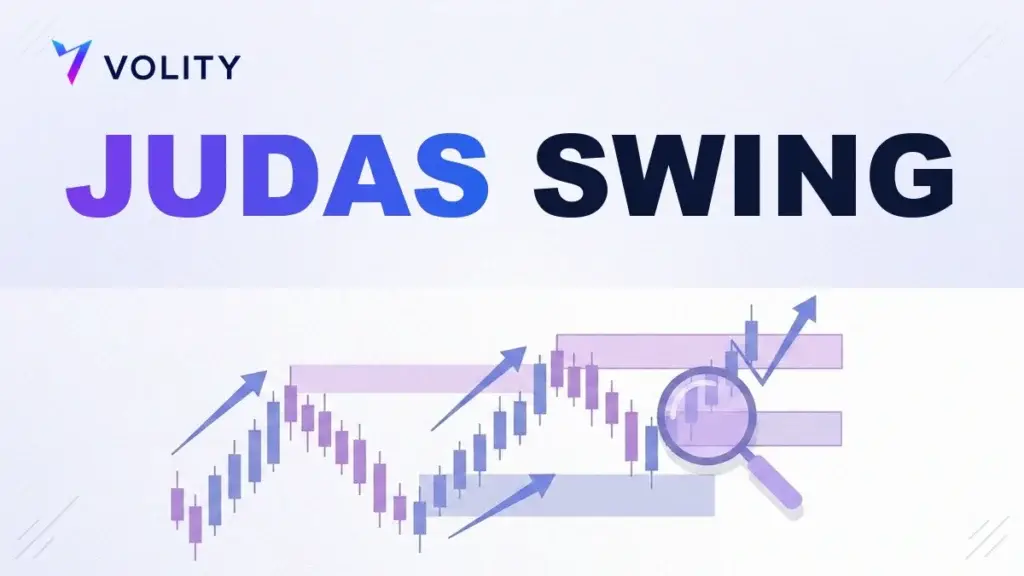
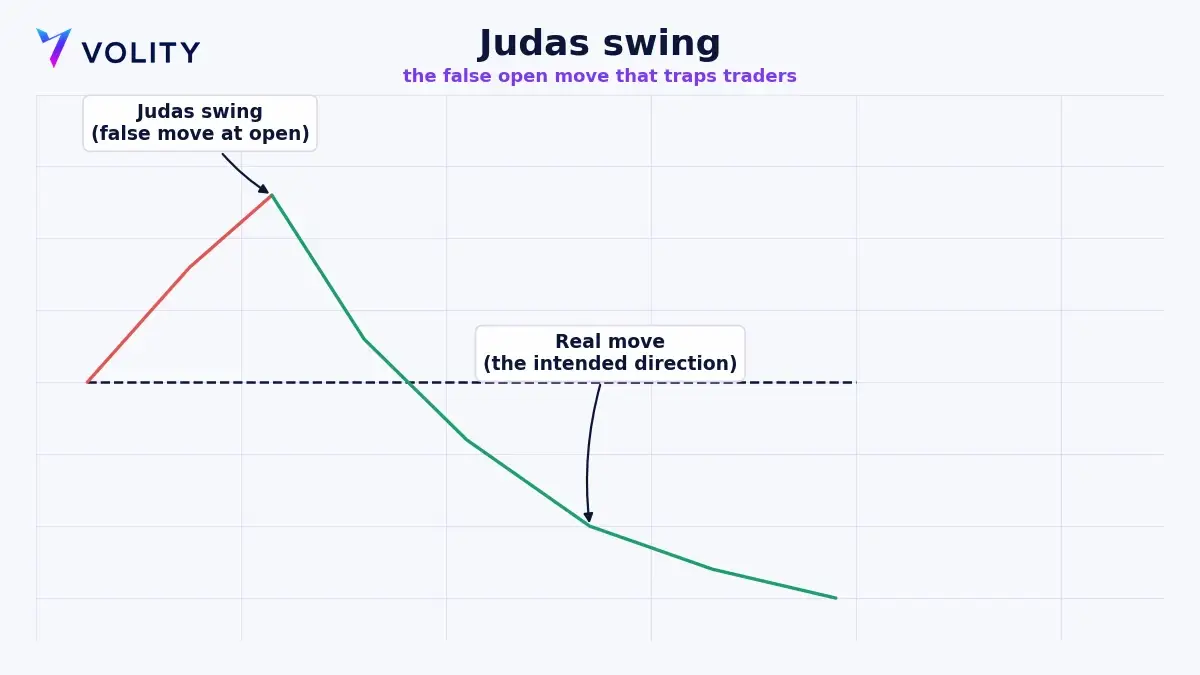
The Judas swing is a false move at the start of a trading session that pushes price one way to grab liquidity, then reverses into the real direction for the day. It takes its name from the betrayal, because it traps traders who chase the opening move just before the genuine trend gets going. Learn to read it, and the move that catches so many people at the open becomes one you can wait for and trade.
What is the Judas swing?
The Judas swing is an Inner Circle Trader concept that describes the deceptive first move of a session. In the opening minutes or hours, price often makes a confident push in one direction. It looks like the day has picked its trend, so breakout traders climb aboard and others rest stops just beyond the move. Then it fails. Price turns and spends the rest of the session travelling the other way, leaving the early move stranded as a trap. The idea sits inside the wider family of smart money concepts, a technical analysis approach built around institutional order flow.
The opening push is there to set up the trend. Its job is to reach a pool of liquidity, trigger the orders resting there, and give larger participants the fills they need before price commits to a direction. Those orders gather in predictable places, which is what makes the move repeatable. Research by Carol Osler on currency markets, published through the Federal Reserve Bank of New York, found that stop-loss orders cluster around round numbers and prior extremes and can set off fast, self-reinforcing price cascades. Read the push correctly and a familiar trap becomes an edge.
Why is it called the Judas swing?
The name is a deliberate nod to betrayal. Just as the biblical Judas gave a false sign of loyalty, the Judas swing gives a false sign of direction. It has every appearance of a real breakout and invites traders to trust it, then turns into a false breakout that traps them. The label sticks because it captures how the move feels once it has caught you: a promising start that betrays you the moment you commit.
When does the Judas swing happen?
Timing is what defines the Judas swing. It clusters around session opens, when fresh liquidity arrives and the trading sessions hand over to each other. Knowing the best time to trade forex tells you when to watch for it.
- The London open is the most watched Judas swing. After the quiet Asian range, London brings volume, and the first move often spikes into liquidity before reversing for the main session trend. The London session frames it more cleanly than any other.
- The New York open is the second common window. An early push can trap traders before the US session settles on its real direction.
- A daily or weekly open scales the same idea up, with a false move early in the period leading the genuine trend.
Because it is tied to session timing, the Judas swing is easiest to trade when you know which session you are in and where the previous range sits.
How do you spot a Judas swing?
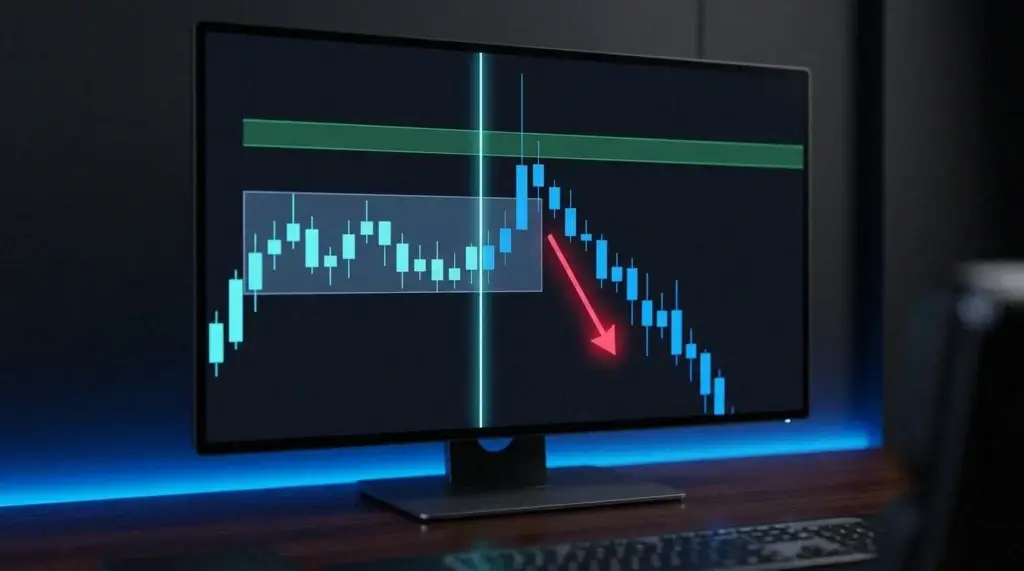
Spotting a Judas swing comes down to framing the session before it opens, then waiting for a spike that fails.
- Mark the range before the session open, such as the Asian range ahead of London, and note the support and resistance levels where liquidity sits above and below it.
- Watch the opening push. A Judas swing spikes into one of those pools and takes the stop-loss orders resting beyond the range.
- Look for the failure, where price rejects the pool and closes back inside the range, often leaving a wick from a liquidity grab.
- Confirm with a shift in market structure in the opposite direction, which signals the real move is under way.
How do you trade the Judas swing?
You do not trade the opening push. You trade its failure, which is the higher-probability event once the liquidity has been taken.
- Leave the opening push alone. Chasing it is the trap working exactly as intended.
- Wait for the swing to reach a liquidity pool and fail, shown by a rejection and a close back inside the prior range.
- Enter in the direction opposite the false move once structure confirms the reversal.
- Place the stop just beyond the extreme of the Judas swing, the point where the idea is wrong.
- Target the liquidity on the far side, since the real session move often runs to the opposite pool.
The stop beyond the swing high or low is usually tight, because the swing has already stretched to the extreme it needed. That tight, well-defined risk is what makes the setup worth waiting for when it appears.
How does the Judas swing fit into AMD and Power of 3?
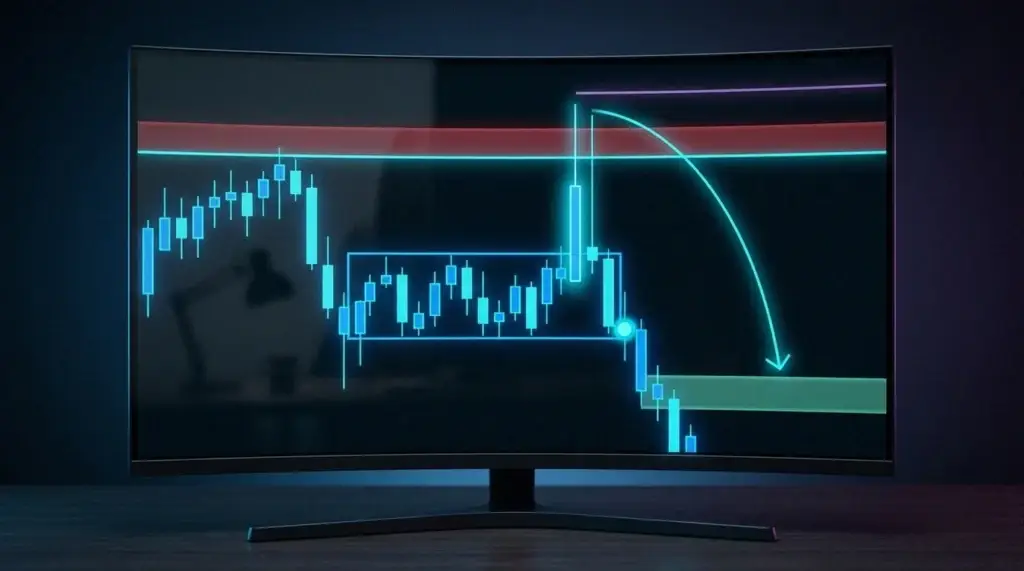
The Judas swing is the manipulation phase in action. In the accumulation, manipulation, distribution model, the session range is accumulation, the Judas swing is the manipulation that grabs liquidity, and the real trend is distribution. The same sequence plays out inside a single candle in the ICT Power of 3, where the manipulation wick is the Judas move within the bar. Learning the Judas swing means learning to trade the middle phase of both frameworks, the piece where most traders get caught.
What are the common Judas swing mistakes?
- Trading the opening push. The first move is the bait, so acting on it is the exact mistake the swing is built to cause.
- Ignoring the prior range. Without the earlier range and its liquidity, you cannot tell a Judas swing from a genuine breakout.
- Entering before the failure. The trade is the reversal after the pool is taken, so entering earlier is only a guess that the push will fail.
- Forcing it every session. Not every open gives you a clean Judas swing, and when the pattern is absent there is nothing to trade.
How does the Judas swing differ across sessions?
The Judas swing repeats at each major session, and each one carries its own character. Knowing that character helps you anticipate the move instead of reacting to it.
- The London Judas swing is the classic version. After the quiet Asian range builds a tidy pool of liquidity above and below, the London open often spikes one way to take it before the true European trend sets in. It reads most cleanly because the pre-session range is so well defined.
- The New York Judas swing can run against the London trend. A common shape sees New York briefly reverse the morning move to grab liquidity before continuing, trapping traders who assumed the London direction would simply roll on.
- The higher-timeframe view carries the same logic to the daily and weekly open, where an early false move leads the genuine trend. On this scale the swing can last a day rather than an hour, and it leans on the session liquidity that arrives when a cash market opens.
Across all of them the mechanics are the same: a push into liquidity, a failure, and a reversal into the real move. What changes is the range you measure beforehand and the clock time you watch. Trade the session whose pre-move range is clearest to you, and let the others confirm the idea rather than stretching to catch every one. Most traders first learn the Judas swing at the London open, because the Asian range frames it so consistently.
Putting the Judas swing to work on Volity
The Judas swing is a session-timing trade, so it pays to watch the open on markets that move most at that hour. Volity offers CFD trading across forex, indices, commodities, and crypto from one account on Volity MT, so you can follow the London and New York opens on the instruments that react to them. Spreads start from 0.6 pips, 99.6% of orders fill in under a second, and leverage runs up to 1:500 on selected forex pairs, all regulated by CySEC through UBK Markets under licence 186/12. You can open an account for nothing, invest from as little as $1, and start trading from $1, using your own capital plus leverage rather than a funded account. The charts on the Volity platform make it quick to box the prior range and set a stop beyond the swing extreme.
Leverage magnifies losses as much as gains, so size every position from its stop distance. Forex is the deepest and most liquid market in the world, so the pools a Judas swing targets can be large enough to move price sharply at the open, when spreads can widen for a moment. Rehearse waiting out the fake-out on a demo account first, and check the spread for your instrument on the charges and fees page before you trade it live.
Judas swing FAQ
What time is the Judas swing?
It clusters around session opens, most famously the London open and, secondarily, the New York open. The exact clock time depends on your timezone and the current daylight-saving offset, but the principle holds: the false move tends to appear in the opening phase of a major session, before the real trend for that session sets in.
Is the Judas swing the same as a liquidity grab?
They are closely related without being identical. A liquidity grab is any spike that takes resting orders and reverses. The Judas swing is a liquidity grab with a specific context, since it happens at a session open and precedes the day’s true directional move. Every Judas swing involves grabbing liquidity, though plenty of liquidity grabs are not Judas swings.
Which markets show the Judas swing best?
Forex shows it most clearly, because sessions and their liquidity cycles are well defined, especially around the London open. Index CFDs also display it around cash-market opens, and gold and large-cap crypto can show similar behaviour. Any market with a clear session rhythm and clustered stops can produce a Judas swing.
How do I avoid being trapped by the Judas swing?
Do not trade the opening push. Mark the pre-session range, wait for the early move to spike into liquidity and fail, and only then enter in the opposite direction once structure confirms. Placing stops away from the obvious range extremes also helps, so your own orders are not part of the liquidity the swing is designed to take.