Volatility index trading means taking a position on how much a market is expected to move rather than which way it goes. The best-known volatility index is the VIX, which gauges the 30-day swings that options traders expect on US shares, but it is one of a family that also includes Europe’s VSTOXX and VDAX and the bond market’s MOVE Index. You cannot buy any of these numbers directly. You trade them through futures, options, exchange-traded products or CFDs that reference them.
What is a volatility index in trading?
A volatility index is a gauge of how much a market is expected to move, calculated from the prices traders are paying for options rather than from share prices themselves. It reads expected movement, not the direction of that movement, so it can climb whether the crowd fears a crash or braces for a violent rally. The flagship is the VIX, run by Cboe, which distils the option prices on the S&P 500 into a single reading for expected 30-day implied volatility. It picked up the nickname “fear gauge” because it tends to jump when investors rush to protect their portfolios. You can pull the full history of daily closes from the St. Louis Fed’s FRED database if you want to see how it has behaved through past shocks.
One point of clarity before going further. The phrase “volatility index” is sometimes borrowed for the synthetic, always-on instruments that a handful of brokers manufacture in-house. This guide covers market volatility indices such as the VIX, which are derived from real option markets and are the mainstream meaning of the term.
Which volatility indices can you trade?
The VIX gets the headlines, but a non-US trader has several volatility gauges worth watching, each tied to a different corner of the market. They behave in similar ways while measuring different things, so it helps to know the main ones.
| Volatility index | What it measures | Underlying market |
| VIX | Expected 30-day volatility of the S&P 500, from its option prices | US large-cap shares |
| VSTOXX | Expected volatility of the Euro Stoxx 50 | European blue-chip shares |
| VDAX-NEW | Expected volatility of Germany’s DAX | German shares |
| MOVE Index | Expected volatility of US Treasury yields, from bond options | Government bonds and rates |
Europe’s equivalents matter more than the VIX for anyone trading local markets. The VSTOXX tracks expected volatility on the Euro Stoxx 50, and the VDAX-NEW does the same for the DAX. The MOVE Index sits apart from the equity gauges because it reads the bond market, and it often stirs first, since rates tend to lead. Because the VIX is the most heavily traded of the group, it has plenty written about it on its own, so treat the sections below as the shared logic that runs across the whole family.
How does a volatility index work?
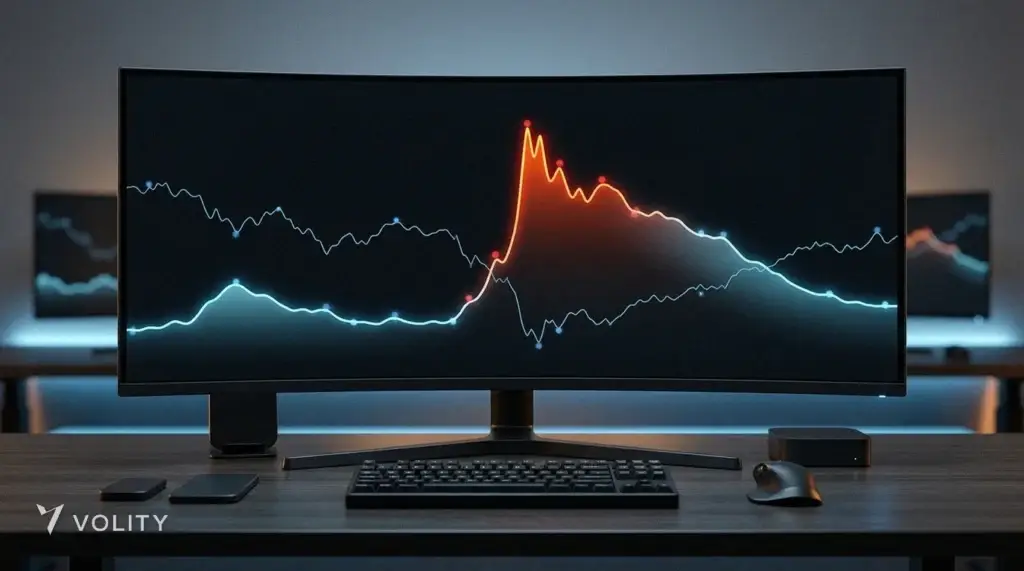
A volatility index reads the options market. When traders expect calm, they pay less for the options that protect against big moves, and the index sits low, often in the low teens for the VIX. When fear rises, demand for that protection pushes option prices up and the index climbs. Two behaviours follow. A volatility index is strongly inverse to the market it tracks, so as shares fall the index usually spikes. It is also mean-reverting: volatility tends to jump fast and then drift back down, because panics are short-lived while calm is the default state. That asymmetry, a quick move up and a slow grind back, shapes almost every strategy built around these indices.
Why can’t you buy a volatility index directly?
A volatility index is a calculated statistic, not an asset. There are no shares of the VIX to own and no pool of stock sitting behind it, only a formula applied to live option prices, which Cboe sets out in its published index methodology. That is why you cannot hold the index itself. To take a position you use a derivative that references it, and the choice of derivative matters a great deal, because each one behaves differently from the headline number you see quoted on the news.
How do you trade a volatility index?
Trading a volatility index runs through four main routes, each one referencing the index rather than being it.
| Instrument | How it works | Watch out for |
| Volatility futures | Exchange contracts on the future index level, with an expiry date | The futures curve, expiry and rolling |
| Volatility options | Options written on the volatility index | Added complexity and time decay |
| Volatility ETPs | Exchange-traded products that hold volatility futures | Roll decay over time; some are leveraged |
| Volatility CFDs | Contracts for difference that reference volatility futures | Leverage and overnight financing |
A crucial detail links all of them: the futures curve. Volatility futures are usually more expensive the further out you go, a shape called contango. A position holding longer-dated exposure loses a little value each time it rolls closer to expiry, a drag known as roll decay. That is why long volatility products tend to grind lower during calm periods and make poor buy-and-hold investments. During a genuine panic the curve can flip into backwardation and long volatility positions pay off sharply, though timing that is hard. The single most traded gauge, the VIX, has its own quirks around futures and expiry that reward a dedicated read once the shared mechanics here make sense.
What moves a volatility index?
Volatility indices are driven by stress and surprise. Sharp falls in the underlying market push them up fastest, but so does anticipation. An approaching central bank decision, an election, a geopolitical flashpoint or a run of weak economic data can all lift expected volatility before anything actually happens. When the event passes and the uncertainty clears, the index usually deflates just as quickly. Because the relationship with the underlying market is inverse, a volatility index often works as a mirror of market confidence, which is exactly what makes it useful and what makes it dangerous to hold at the wrong time.
What is a normal volatility index level?
Reading a volatility index is easier with a sense of scale. The VIX is quoted in percentage points of expected annualised volatility, and history gives rough zones to lean on.
| VIX level | What it usually signals |
| Low teens (around 12 to 15) | Calm, even complacent market |
| High teens to low twenties | Ordinary, everyday uncertainty |
| Above 30 | Real fear, often alongside sharp falls in shares |
| 50 and above | Genuine crisis, though such spikes rarely last |
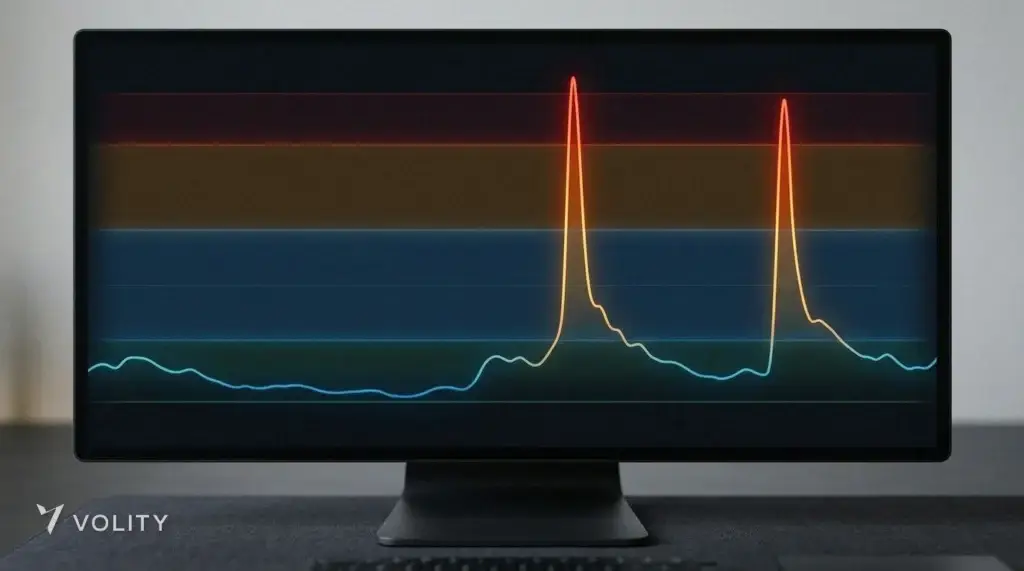
These zones are guides, not signals in their own right. A low reading does not promise the calm will continue, and it can stay low for long stretches. A very high reading marks fear that may already be near its peak, given the index’s habit of reverting. The European gauges, the VSTOXX and VDAX-NEW, follow similar patterns against their own markets, though their typical ranges differ. Used sensibly, the level of a volatility index is a quick temperature check on sentiment, best read alongside what the underlying market is actually doing rather than on its own.
Why do traders use volatility indices?
There are three common reasons. The first is hedging: a long volatility position tends to gain when equities fall, so it can offset losses elsewhere in a portfolio and work a little like insurance. The second is reading sentiment, using the level and direction of the index to judge how nervous or complacent the market has become. The third is tactical mean-reversion, trading the tendency of volatility to spike and then revert. Each has a place, and each carries the risk that volatility fails to behave as expected within your timeframe. This is also why volatility indices are watched well beyond trading desks. Bodies such as the Bank for International Settlements lean on the same signals to judge how tight or loose financial conditions have become.
What are the risks of volatility index trading?
The risks are real and specific. Roll decay steadily erodes long volatility positions during calm markets, so time works against you. Spikes are violent and can reverse before you react, punishing both late buyers and short sellers. Leveraged and inverse volatility products are especially unforgiving. In February 2018 a popular inverse volatility product lost most of its value in a single session and was wound down soon after, as Reuters market coverage documented at the time. On top of that, any leveraged position magnifies losses as well as gains. Volatility index trading is a tool for defined, timed views, not a set-and-forget holding. Treat it as tactical, size positions from the risk you can afford, and use stops.
Volity gives you leveraged access to global indices and related markets on one account, traded as contracts for difference on the Volity MT platform. Leverage runs up to 1:500 depending on the product, and it cuts both ways, which is why regulators including the FCA and ESMA limit how CFDs are sold to retail traders. Trading execution is regulated by CySEC through UBK Markets under licence 186/12. You can open an account for nothing, practise on a free demo that mirrors live pricing, invest from $1 and start trading from $1. Confirm margin and financing on the charges and fees page, and if the risk side is new, start with what an index actually is before putting money to work.
Related guides
Frequently asked questions
What is a volatility index?
A volatility index measures a market’s expected volatility, calculated from option prices rather than share prices. It gauges how much movement traders anticipate, not the direction. The VIX is the best known, tracking expected 30-day volatility of the S&P 500; Europe has the VSTOXX and VDAX, and the MOVE Index covers bonds.
What is the difference between the VIX and other volatility indices?
They differ by the market they read. The VIX measures expected volatility on the S&P 500, the VSTOXX on the Euro Stoxx 50, the VDAX-NEW on Germany’s DAX, and the MOVE Index on US Treasury yields. All are built from option prices and behave in similar ways, spiking in stress and reverting as calm returns.
Can you trade a volatility index directly?
No. A volatility index is a calculated statistic with no underlying asset to buy, so you trade it through derivatives: volatility futures, options, exchange-traded products, or CFDs that reference volatility futures. Each behaves differently from the headline number because of the futures curve and roll decay.
Is volatility index trading risky?
Yes. Roll decay erodes long positions in calm markets, spikes reverse quickly, and leveraged or inverse volatility products can collapse in a single session. Leverage magnifies losses as well as gains. Volatility index trading suits defined, timed views with tight risk control, not buy-and-hold.