Crypto’s $80,000 test: leverage breaks, regulation advances and tokenisation gathers pace
Tuesday, October 27, 2026 – Bitcoin is testing $80,000 while the rest of crypto tells a more complicated story. Leveraged traders have suffered heavy losses, and US Bitcoin funds have shed fresh capital. Yet regulators, banks and technology groups continue laying rails for digital payments and tokenised assets.
Bitcoin meets the liquidation machine
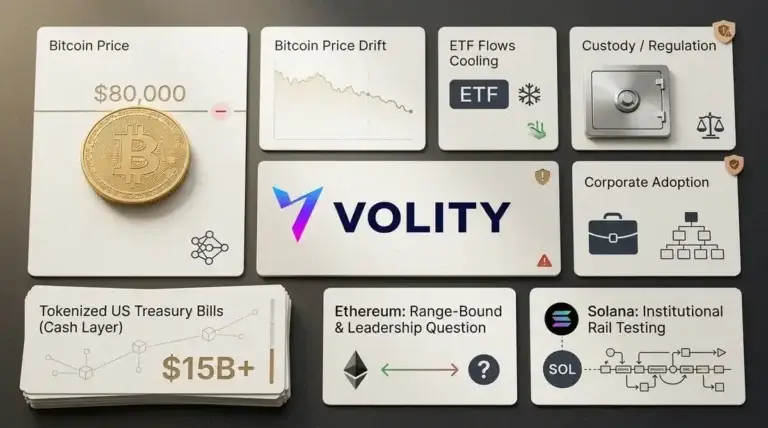
Bitcoin fell below $80,000 over the weekend, reaching about $79,280 before recovering near that round number. The slide tracked weakness in global equities, firmer oil prices and renewed doubts about richly valued technology shares.
That backdrop matters because Bitcoin now trades increasingly like a high-beta macro asset. When investors retreat from risk, crypto often moves faster and falls harder.
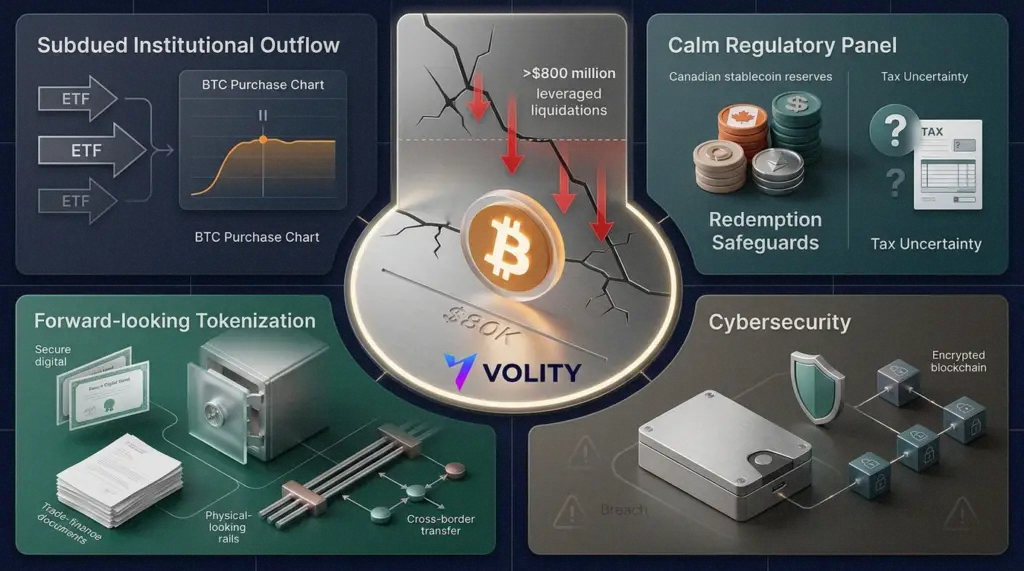
Leverage sharpened the latest decline. More than $800 million of crypto positions were liquidated during a recent 24-hour period, with long positions taking most of the damage.
During one four-hour stretch, forced long closures exceeded $400 million. Traders who borrowed to chase higher prices found their collateral disappearing faster than they could add funds.
The immediate trading map has two obvious pressure points. Liquidation clusters sit around $78,500 to $79,000 below spot, and around $81,500 to $82,000 above it.
A break through either range could bring rapid follow-through. Forced closures can turn an ordinary price move into a disorderly rush.
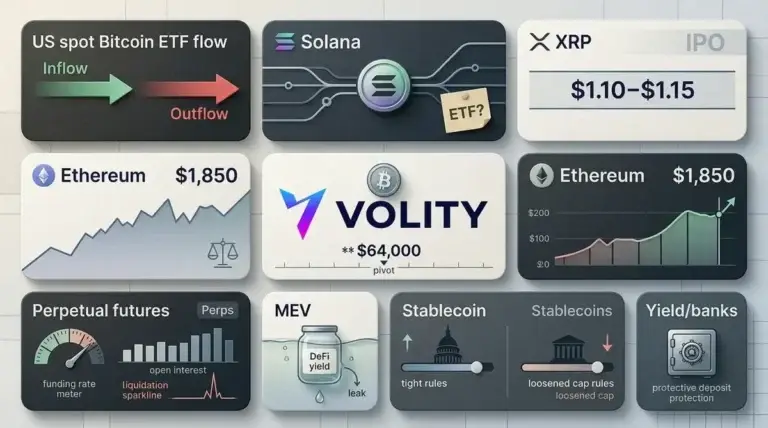
ETF flows have added another drag. US spot Bitcoin funds saw about $635.6 million in withdrawals on October 22, while recent product outflows exceeded $1 billion.
Those numbers do not settle Bitcoin’s direction. However, they show that institutional demand has become less dependable during the sell-off.
Strategy pauses its buying
Corporate demand is facing its own test. Strategy has paused additional Bitcoin purchases while allocating roughly $205 million to preferred-share repurchases.
The move reflects a harder market for companies that financed large Bitcoin holdings. Share prices, funding costs and investor patience now matter alongside any view on Bitcoin itself.
During a rally, treasury purchases can reinforce bullish sentiment. In a downturn, the same holdings can leave companies exposed to volatile asset values and tighter access to capital.
Canada draws a line on stablecoin yield
Canada has opened a 60-day consultation on stablecoin rules, with implementation expected in autumn 2027. The proposal would allow non-bank issuers, provided they register with the Bank of Canada.
Issuers would need reserves matching tokens in circulation and must offer one-to-one redemption in the reference currency. They would also need eligible Canadian custodians to hold segregated reserve assets.
The draft makes a deliberate distinction between payments and savings. Issuers would generally be barred from paying interest merely for holding a stablecoin.
Transaction-linked rewards could still be permitted. That line seeks to make stablecoins useful for spending without creating direct rivals to bank deposits.
For payment firms, the proposal offers a clearer route into Canada. In return, they would face stricter rules on reserves, governance and public disclosures.
South Korea leaves tax timing unresolved
South Korea may delay its crypto gains tax again, possibly until 2029. Under the current timetable, a combined 22% levy would begin in January 2027.
The tax would apply to qualifying annual virtual-asset income after a 2.5 million won deduction. A further delay may please traders, yet it leaves exchanges and accountants working without a settled timetable.
Record-keeping remains important whatever Seoul decides. Investors trading across several venues should track purchases, transfers, fees and disposals before records become difficult to rebuild.
Authorities are also considering an education-related tax on exchanges. Meanwhile, officials continue pursuing foreign platforms accused of operating without domestic registration.
The direction is plain even if the dates keep changing. South Korea wants a larger regulated market, not an unmonitored one.
Tokenisation becomes back-office work
Speculative tokens may dominate price screens, but tokenisation projects are gathering momentum elsewhere. Ripple is expanding its custody work with BNY and bringing C2FO trade-finance activity to the XRP Ledger.
BlackRock, SBI and Startale are exploring connections between tokenised funds and a yen-denominated stablecoin. Hong Kong’s Gold Exchange is also working with Chainlink on gold-token transfers.
None of this guarantees an immediate token rally. Instead, these projects target mundane and valuable tasks: settlement, custody, ownership records and cross-border transfers.
Protocol teams are also making quieter improvements. Solana has activated faster finality, reducing waits for users and applications.
Ethereum developers have corrected a validator deposit flaw linked to Glamsterdam upgrade work. Such repairs rarely excite traders, but working infrastructure depends on them.
Security remains crypto’s unpaid bill
The sector’s security problems have not eased. Predict.fun users reportedly lost about $260,000 in a suspected wallet drain.
An old CoinDCX wallet, which continued receiving deposits, was linked to a reported $16 million loss. Keystone has also said it will destroy 18,835 hardware wallets after an authentication-key breach.
These episodes offer a blunt reminder for market participants. Popularity, regulation and polished software do not remove custody risk.
Traders should keep operating balances separate from long-term holdings. They should also verify withdrawal addresses through an independent channel before sending funds.
What traders should watch
- Bitcoin levels: $79,000 below and $81,500 to $82,000 above remain the nearest leverage-heavy zones.
- ETF demand: Further withdrawals could turn fund flows into a persistent source of selling.
- Open interest: Rising leverage during a weak market raises the chance of another forced unwind.
- Stablecoin rules: Canada’s consultation could shape how payment tokens compete with bank products.
- Custody controls: Fresh wallet incidents make platform due diligence more than a box-ticking exercise.
Crypto is not moving as one market. Bitcoin is trading with macro risk, stablecoins are entering payment law, and tokenisation is moving into institutional plumbing. Prices look defensive, but the industry’s underlying build-out continues at a steady clip.
Related coverage on Volity
- How to Avoid Crypto Scams: A Beginner Safety Checklist
- How to Choose a Trading Platform: A 10-Point Checklist
- Demo vs Live Trading Account: A 7-Step Checklist Before You Go Live
- How to Size a Trade: Position Sizing and Risk Per Trade for Beginners
- Risk-Reward Ratio Explained: How to Set It and Why It Matters
- ETF vs Index Fund: The Difference and Which to Pick