Does gold fall when the dollar rises? Usually, but not as a rule. The gold vs dollar link is a tendency of moderate strength: rolling one-year correlations of weekly returns averaged -0.42 from 1996 to 2026, and both 2022 and 2026 produced clear exceptions. Below you will see why the link exists, how strong the evidence is, when it fails, and a checklist to run before you trade gold on a dollar move.
TL;DR: Gold is priced in dollars and pays no interest, so a weaker dollar and lower yields tend to lift it. The long-run link is moderate, not a law. Severe stress, 2022 and parts of 2026 broke it. Before you act, check which dollar index moved, what real yields did and which currency your position is in.
The stakes were clear in 2026. Gold set a record of US$5,405 an ounce on 29 January, then lost 11.8% in March alone, and the World Gold Council called the dollar’s rise during that fall “modest”. On Volity, gold trades as a CFD (contract for difference: it pays the change in price, and you never own the metal) as XAU/USD and XAU/EUR, in the same account as forex pairs.
Why gold is priced in dollars
The world’s reference price for gold is a dollar price. The LBMA Gold Price is set by auction twice a day, at 10:30 and 15:00 London time. LBMA also shows sterling and euro prices, but calls them “indicative prices for settlement only”.
So the price in your own currency has two moving parts: the dollar price and the exchange rate. Take a hypothetical example. Gold is US$4,000 an ounce and EUR/USD is 1.10, so an ounce costs about EUR 3,636. The dollar weakens, EUR/USD moves to 1.15, and the dollar price stays at US$4,000. The same ounce now costs about EUR 3,478, roughly 4% less. Gold got cheaper for euro holders without moving in dollars.
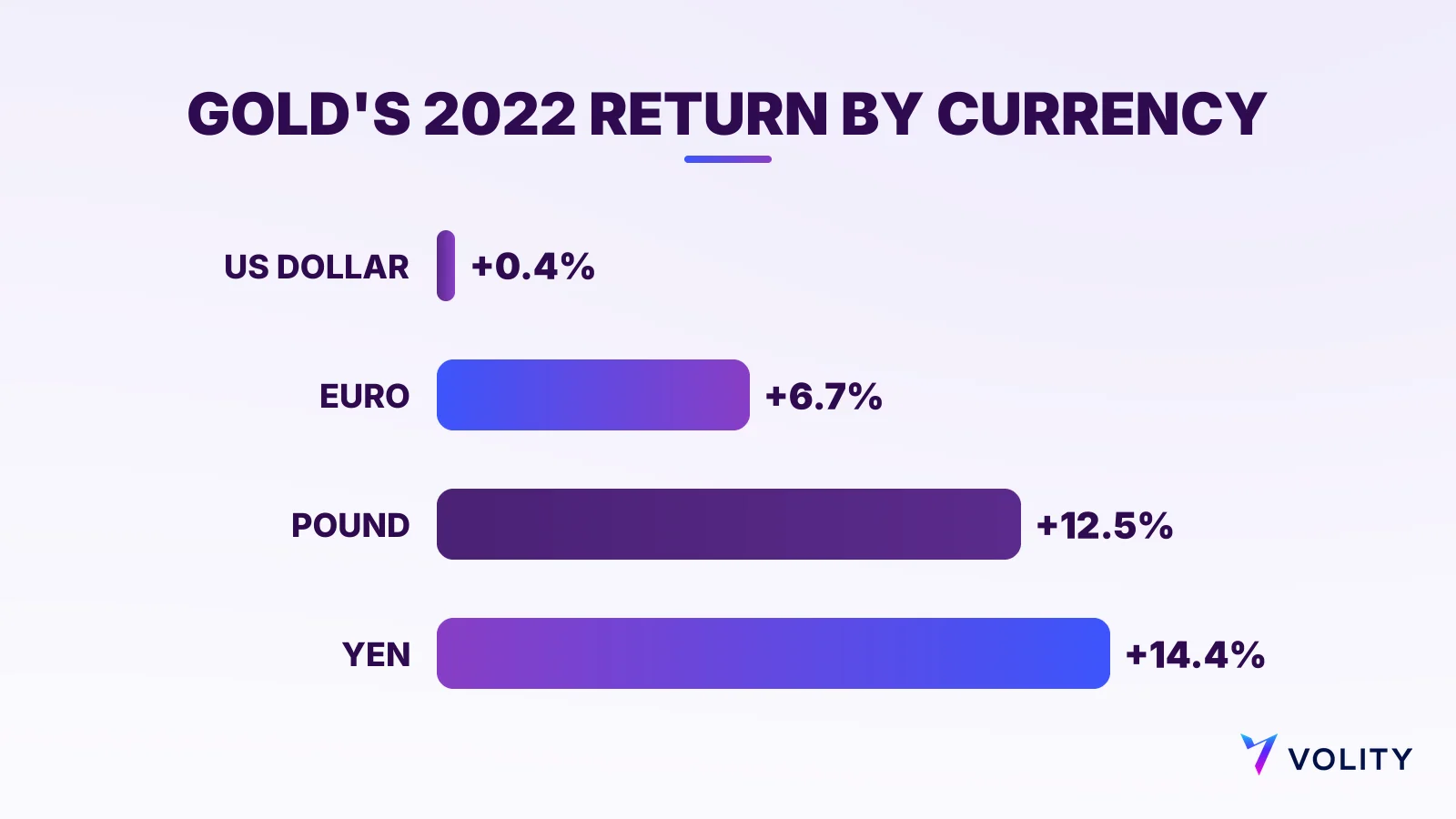
Cheaper gold tends to draw buyers outside the US, which is one reason the dollar price usually rises when the dollar weakens. In real markets both parts move at once, and the results can differ a lot. The dollar index gained over 8% in 2022, according to the World Gold Council. Gold returned +0.4% in dollars, but +6.7% in euros, +12.5% in pounds and +14.4% in yen.
For a UK holder, gold was a double-digit gainer in 2022 while the dollar price barely moved. XAU is gold’s code in a currency pair, and Volity offers XAU/USD and XAU/EUR in one account, side by side.
What the dollar index measures
When a headline says “the dollar rose”, it usually means the US Dollar Index, or DXY. ICE Futures U.S. describes it as a “geometrically-averaged calculation of six currencies weighted against the U.S. dollar”. The weights are euro 57.6%, yen 13.6%, pound 11.9%, Canadian dollar 9.1%, Swedish krona 4.2% and Swiss franc 3.6%. The Federal Reserve developed it in 1973, and ICE has compiled it since futures began in 1985.
The basket has changed once, in January 1999, when the euro replaced several European currencies at the same combined weight (ICE). So the DXY is mostly a euro index. It holds no Chinese renminbi and no Mexican peso. The Fed’s broad dollar index “contains the currencies of 26 economies”, weighted by trade in goods and services, as the Fed explained when it revised its dollar indexes in 2019. Its trade weights as of 2 February 2026 look very different.
| Feature | US Dollar Index (DXY) | Fed broad dollar index |
|---|---|---|
| Coverage | 6 currencies | 26 economies |
| Largest weight | Euro 57.6% | Euro area 21.007% |
| Next largest | Yen 13.6%, pound 11.9% | Mexico 14.801%, Canada 12.769%, China 10.891% |
| Basket changes | Once, in January 1999 | Weights updated from trade data |
The gap matters for gold. A dollar fall against emerging-market currencies can barely show on the DXY. The World Gold Council linked gold’s February 2026 gain to “a weaker US dollar, particularly against EM currencies” (EM means emerging markets). More in the currency strength. Learn how DXY movements affect forex pairs and broader market sentiment in 2026." class="internal-link" href="https://volity.io/forex/us-dollar-index-dxy/">US Dollar Index guide.
Why the link is usually inverse
The link has a pricing side and an income side. On pricing, State Street Investment Management puts it simply: “When the dollar weakens, gold becomes more affordable for international buyers” (State Street). The income side is opportunity cost: what you give up by holding one asset instead of another. Gold pays no interest, so when dollar cash and bonds pay more, holding gold means giving up that income. The World Gold Council’s return attribution model lists the dollar and interest rates as separate parts of this cost.
How strong is the link? Analysts use correlation, a number from -1 to +1. A reading of -1 means two prices always move in opposite directions, 0 means no steady link, and +1 means they always move together. State Street reports that rolling one-year correlations of weekly gold and dollar index returns “have averaged negative 0.42” over the past three decades, on data from February 1996 to February 2026 (source). That is moderate. It leaves room for many weeks when both move the same way.
The World Gold Council tested the link another way in its July 2026 commentary. It ran a regression, a model that estimates how one variable moves with others, on 222 quarters from 1971 to mid-2026. The coefficient on the DXY was -0.93. In this model, a quarter in which the DXY rose by one percent went with gold about 0.93 percent lower, with inflation, real rates and recession risk held fixed. In the 72 quarters when US inflation ran above 4%, it was -1.2. The model shows association, not cause. An earlier World Gold Council note on weekly data from 1971 to 2018 found the same negative sign, and warned that the dollar “won’t explain gold’s movements entirely”.
The first half of 2025 shows the link at work. According to the World Gold Council, the dollar had “its worst start to a year since 1973”, and gold rose 26% in dollars. The Council’s model credited about 6 percentage points of that gain to dollar weakness, with 4 points from risk and uncertainty and 5 from momentum (Mid-Year Outlook 2025). Over the full year gold gained 67.4% (World Gold Council, December 2025), while State Street measured the dollar 9.4% lower against major currencies. The dollar helped, but it explained only part of the move.
When the relationship breaks
A correlation of -0.42 leaves room for long stretches when gold ignores the dollar or moves with it. These episodes catch out traders who treat the rule as a law.
Severe stress can lift both
In a panic, gold and the dollar can attract buyers at the same time. The European Central Bank studied stress periods from January 1997 to March 2025. In the most severe episodes, gold and the dollar rose together while stocks and bonds fell, for example after 9/11 and at the start of COVID-19 (ECB, May 2025). A recent case came on 2 March 2026, during a Middle East conflict. The World Gold Council noted that “the dollar rallied” while gold “bounced, up almost 5% across two trading sessions”.
A strong dollar year without a gold fall
In September 2022 the World Gold Council wrote that “The DXY sits at a 20-year high”, and gold fell for a sixth month in a row (source). Yet gold ended 2022 up 0.4% in dollars, “a marginal gain” despite the strong dollar and rising rates, while central banks bought 1,136 tonnes (Gold Demand Trends 2022). A dollar gain of over 8% brought no matching fall in gold.
Gold and real yields parted ways
A real yield is a bond yield minus expected inflation, the income you give up by holding gold. The ECB found that gold moved against real yields between 2008 and early 2022, then wrote: “This correlation broke down after Russia’s full-scale invasion of Ukraine” (ECB, June 2025). In October 2026 the World Gold Council noted that “gold and yields moved in the same direction”, which its model does not capture (source).
Big gold moves that were not about the dollar
In March 2026 gold fell 11.8% to US$4,608 an ounce, which the World Gold Council called “its weakest month since June 2013”. The dollar rose, but the Council said “it was modest” and said gold “appeared to overreact to a conflict-led bounce in US real yields” (source). October 2026 looked more like the textbook: gold fell 6.3% to US$3,913, and the Council said the dollar index “has rallied into its top tier” over 52 weeks. The rule is not wrong. It is incomplete.
Reserve buying and momentum can dominate
Central banks bought 321 tonnes of gold in the third quarter of 2026 (World Gold Council). It is tempting to read each purchase as a bet against the dollar, but a Federal Reserve working paper found that gold reserve accumulation “is generally not associated with de-dollarization of international reserves at the country level, except in a few prominent cases” (Federal Reserve, 2025). In late 2025 the BIS found gold and the S&P 500 in “explosive territory” at the same time, a first in at least 50 years. When flows and momentum drive the price, a dollar move may tell you little. Read more on how central banks influence gold prices and the gold and stocks correlation.
How to watch both on one screen
You can watch the DXY on any chart you already use. On the trading screen, a forex pair does the job well.
- Open XAU/USD, gold priced in dollars.
- Add EUR/USD. The euro is 57.6% of the DXY, so EUR/USD is a fair stand-in, read upside down: when EUR/USD rises, the dollar is weakening.
- Add XAU/EUR. If XAU/USD rises while XAU/EUR stays flat, the move is mostly the dollar. If both rise, gold is gaining on its own.
- Use the same timeframe on every chart. A one-year correlation and a one-hour move answer different questions.
- When emerging-market currencies move, check the Fed’s broad index in its H.10 release as well.
- Mind the hours. On Volity, gold trades 24/7 and forex 24/5, so some gold moves come when dollar pairs show no new prices. See the best time to trade gold.
Gold CFDs on Volity offer leverage of up to 1:500. Leverage lets you open a position larger than the money you put down (the margin), and it magnifies losses as much as gains. Spreads, the gap between the buy and sell price, are dynamic, so check the live gold spread on the free demo first.
A checklist before you trade gold on a dollar move
A dollar move is a reason to look closer, not a trade on its own. Run these checks first.
 trading gold on a dollar move: the dollar measure, the time window, real yields, stress, your currency and the stop-loss" loading="lazy">
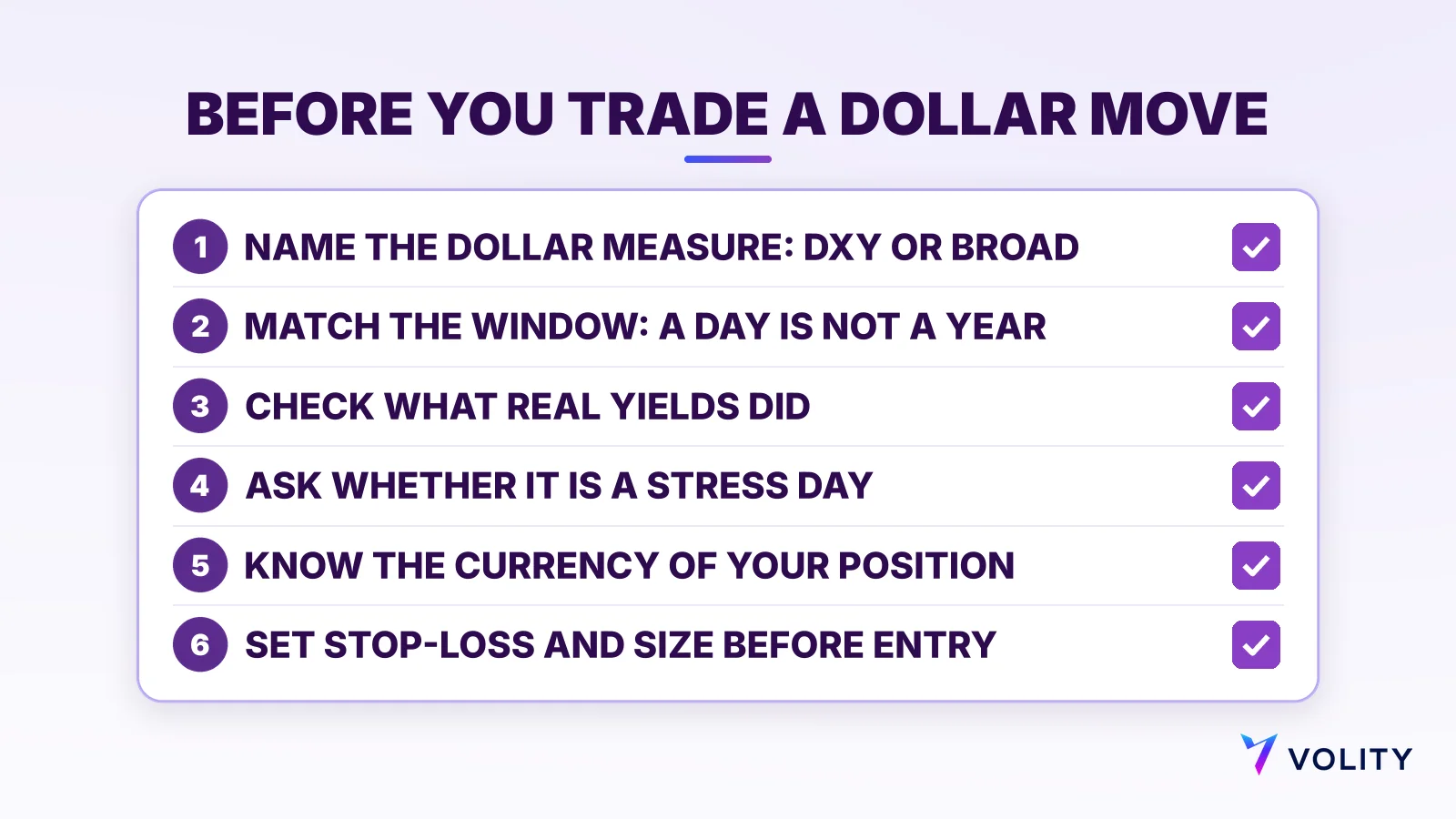
- Name the dollar measure. A DXY move is mostly a euro move. If the story is about the renminbi or the peso, look at the broad index.
- Match the window. The -0.42 figure averages one-year correlations. A single day can go the other way.
- Check real yields. In March 2026 the World Gold Council ranked them above the dollar.
- Ask whether it is a stress day. In severe stress, gold and the dollar can rise together.
- Know your currency. In 2022 gold made +0.4% in dollars and +6.7% in euros.
- Set your stop-loss and position size before you enter, so a failed signal costs a known amount.
For setups, see gold trading strategies. Spreads, overnight swap amounts and other costs are set out on the charges and fees page.
The dollar is a useful input for a gold trader, but only one. Real yields, stress and reserve buying can each outweigh it.
Fact check: figures come from the World Gold Council (commentaries from September 2022 to October 2026, Gold Demand Trends), State Street Investment Management (data to 28 February 2026 and 3 September 2026), ICE Futures U.S., the Federal Reserve (H.10 weights as of 2 February 2026), the ECB (2025), the BIS (December 2025) and the LBMA. Sources checked on 10 November 2026. Correlations describe the past and do not predict prices.
Frequently asked questions
Does gold go up when the dollar goes down?
Usually, but not every time. State Street found that rolling one-year correlations of weekly gold and dollar index returns averaged -0.42 from 1996 to 2026. In early 2025 a weak dollar helped gold, but it explained only part of the gain.
Why is gold priced in US dollars?
The global benchmark, the LBMA Gold Price, is set in dollars by auction twice a day in London. LBMA also shows sterling and euro prices, but calls them indicative prices for settlement only, so the dollar price is the reference point.
What is the correlation between gold and the dollar index?
State Street puts the long-run average at -0.42, on rolling one-year windows of weekly returns. The World Gold Council’s quarterly regression since 1971 gives a dollar coefficient of -0.93. Neither predicts what happens next week.
Do gold and the dollar ever rise together?
Yes. The ECB found that in the most severe stress episodes since 1997 both rose while stocks and bonds fell. On 2 March 2026 the dollar rallied and gold gained almost 5% across two trading sessions.
How do interest rates affect gold and the dollar?
Gold pays no interest, so higher real yields raise the income you give up by holding it. The ECB found that gold’s inverse link with real yields broke down after Russia’s full-scale invasion of Ukraine in 2022. In March 2026 the World Gold Council ranked yields above the dollar.
Can I trade gold against other currencies?
Yes. On Volity you can trade XAU/USD and XAU/EUR as CFDs, long or short, from the same account that holds forex, indices, commodities and crypto. The quote currency changes your result, as 2022 showed.