Investing in financial products involves risk. Losses may exceed the value of your original investment.
Automated forex trading via Expert Advisors (EAs) has been retail’s holy grail and most expensive lesson for two decades. The MQL5 marketplace lists thousands of EAs; the median performance after launch is materially worse than the backtest. The reasons are well-documented. The remaining 5-10% of EAs that work share a small set of structural properties. Here is the realistic 2026 view.
What an EA actually is
An Expert Advisor is a script that runs on MT4 or MT5, monitors price and indicator data, and places orders according to coded rules. The platform supplies tick data, order routing, and position management; the EA supplies decision logic. Three components in any well-built EA:
- Signal logic: when to enter (setup conditions, indicator thresholds, time filters).
- Risk logic: position size, stop loss, take profit, daily loss limit.
- Management logic: stop-trail rules, partial profit, news avoidance, weekend handling.
An EA without explicit risk and management logic is a signal generator, not a trading system. Most marketplace EAs have weak risk logic; this is the primary reason they blow up live.
The two honest categories
Retail EAs cluster into two structural types:
1. Trend-following EAs
Identify a trend (moving average crossovers, ADX above threshold, breakout of N-bar range), enter in the direction, trail a stop. Win rate 35-45%, average winner 2-3R. Long stretches of small losses punctuated by occasional large winners. Psychologically hard to sit through, mathematically robust over years.
2. Mean-reversion EAs
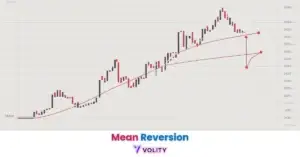
Identify overextension (RSI extremes, deviation from moving average, range-fade conditions), enter against the move, exit at the mean. Win rate 65-75%, average winner 0.7-1R. Smooth equity curve until a trending regime, then a sharp drawdown when the assumptions break. Looks great in backtest; the failure mode is regime change.
Most retail traders prefer mean-reversion EAs because the equity curve is smoother. The data on long-run performance favours trend-followers because they have asymmetric payoffs.
The four failure modes that drain accounts
1. Curve fitting
The EA was optimised on the backtest data. Live performance reverts to mean (or worse). The tell: a backtest equity curve that goes up smoothly with no drawdown periods, while the live curve oscillates around zero.
Fix: out-of-sample testing. Reserve 30-50% of the data for validation; the EA must perform on the validation set. If it fails out-of-sample, do not deploy.
2. Martingale and grid sizing
The EA scales position size after losses, betting that the next trade reverts. Mathematically guaranteed to blow up; the question is when, not if. The MQL5 marketplace is full of these; the equity curves look perfect for 18 months and then return to zero in a single week.
Fix: never deploy an EA that increases position size after a losing trade. No exceptions.
3. No news filter
The EA opens a position 30 seconds before US CPI. The print misses by 0.3%, the pair moves 80 pips against the position, the stop fills 30 pips beyond its level due to spread widening. One bad release wipes a month of gains.
Fix: every EA needs a news filter. Either block trading 30 minutes before and after high-impact releases, or close existing positions ahead of the print.
4. Latency-sensitive logic on retail infrastructure
The EA’s edge depends on filling within milliseconds of a price move. Retail VPS latency to the broker is 5-50ms; institutional desks are sub-1ms. The EA fills 30ms behind the front of the queue and consistently gets the worst tick.
Fix: stay away from latency-sensitive scalpers. The retail edge is in 4-hour and daily timeframes where 30ms is irrelevant.
What deploying a real EA looks like
Five-stage deployment:
- In-sample backtest on 5+ years of data. Targets: positive expectancy, max drawdown under 25%, profit factor above 1.4.
- Out-of-sample validation on a separate 1-2 year window. Performance should be within 30% of in-sample.
- Forward test on demo for 2-3 months on live tick data. Must show consistency with backtest.
- Live deployment at quarter size: 25% of intended capital, monitor closely for the first 50 trades.
- Scale to full size only if live performance tracks backtest within 30%.
Skipping any stage is the path to expensive surprise.
Where retail can actually find EA edge
Three pockets that survive the failure-mode list:
- Mechanical execution of a discretionary edge. You have a setup that works in your hands; the EA runs the same rules without emotion. Most realistic source of EA value for retail.
- Slow trend-following on majors and gold. 4-hour or daily timeframes, simple breakout or moving average crossover, news filter, robust position sizing. Boring; works.
- Specific session strategies. London-open breakout, NY-open momentum. Time-bounded, news-aware, structurally sound.
Tooling in 2026
- Platform: MT5. The strategy tester is multi-threaded and supports multi-currency tests. MT4 still works for single-pair systems.
- VPS: hosted in the same region as your broker’s servers. Reduces latency from 100ms-class to sub-10ms.
- Monitoring: telegram bots or email alerts on stop-outs, drawdown thresholds, and connection failures. An EA running unmonitored is a liability.
- Code review: if you bought the EA, read the source. If you cannot read MQL5, hire a developer for two hours to audit it. Cheap insurance against martingale and grid logic hidden in the code.
Realistic expectations
A well-tested trend-following EA on majors and gold, deployed with proper risk logic and a news filter, can target 15-30% net annual returns with 15-20% drawdown periods. This is not a 5%-per-month number. It is what the math supports for a retail trader running mechanical rules at 1% risk per trade. Anyone selling more is selling.
Automated trading at Volity
Volity supports MT4 and MT5 with full Expert Advisor compatibility, custom indicators, and API access. ESMA leverage caps apply: 1:30 majors, 1:20 minors. Negative balance protection applies. Trading is executed by UBK Markets Ltd (CySEC 186/12).
About Volity
Volity is your all-in-one hub for money movement, market access, and financial clarity. Trading is executed by UBK Markets Ltd, a Cyprus Investment Firm authorised by CySEC under licence 186/12.
Risk disclosure
CFDs are complex instruments and come with a high risk of losing money rapidly due to leverage. Between 70% and 80% of retail investor accounts lose money when trading CFDs.
Volity operates a trading platform and also publishes educational and analytical content about trading. The content on this page is for educational purposes only and should not be considered financial advice. Volity may benefit commercially when readers open trading accounts through links on this site.
Our content is produced and reviewed under documented editorial standards; comparison and review methodology is published here.